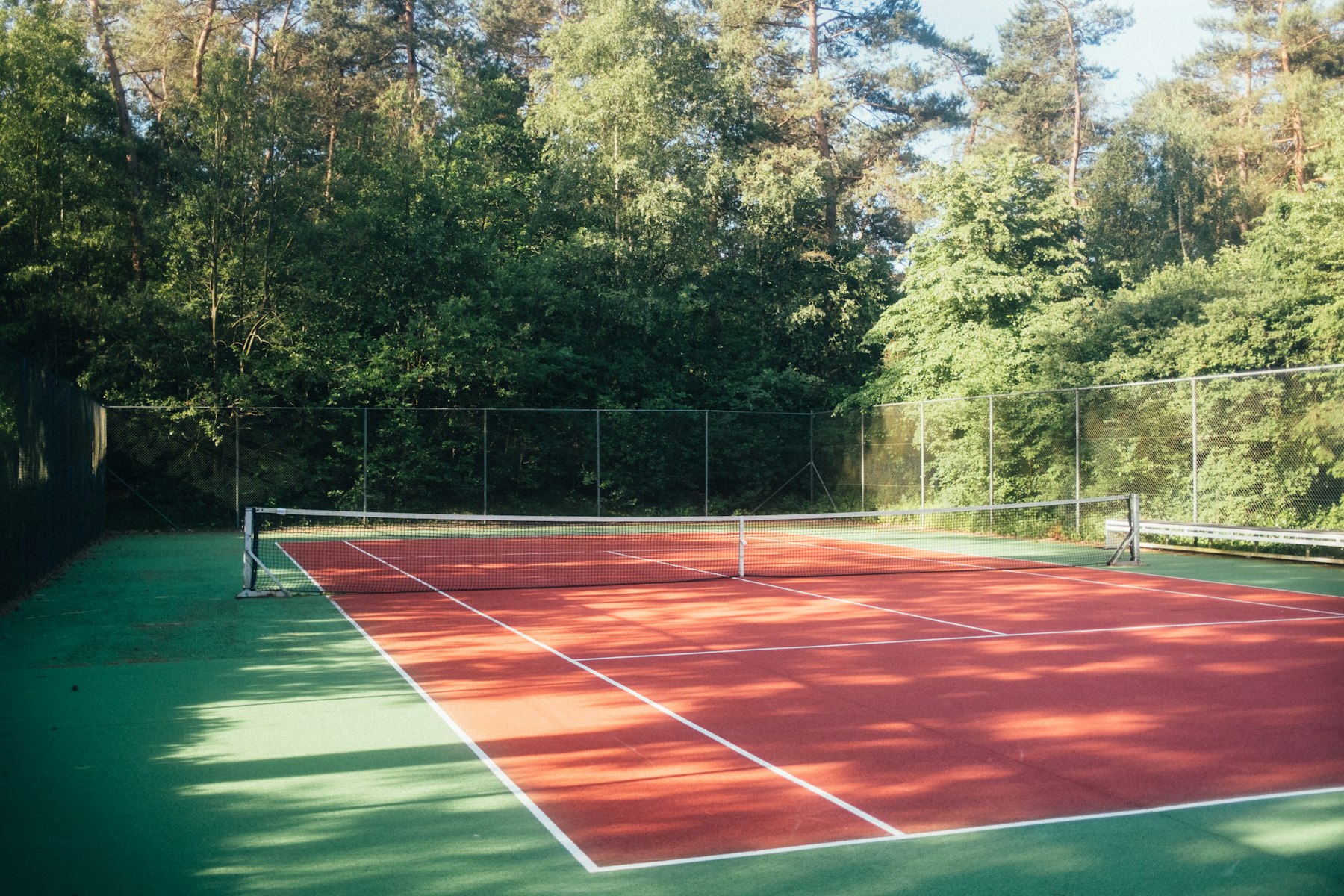
Tennis Court Dimensions & Space Requirements
The exact numbers — 78 × 36 ft of play, 120 × 60 ft recommended total — and what they mean for fitting a real court on a New Jersey lot.
Get a Court Build Quote →A regulation doubles tennis court is 78 ft × 36 ft of play area; singles narrows that to 78 × 27 ft. The recommended total build footprint is 120 ft × 60 ft (about 7,200 sq ft) once you add run-off, fencing, and access. The net is 3.5 ft at the posts, 3 ft at center. On most New Jersey lots, town setbacks and impervious-coverage limits — not the yard itself — are what actually decide whether a full-size court fits. If it doesn't, a pickleball court is a realistic fallback at roughly a quarter of the footprint.
What Are the Exact Tennis Court Dimensions?
Unlike pickleball, a tennis court actually changes size depending on whether you\'re playing singles or doubles — the alleys on each side are only in play for doubles. Here are the numbers a builder works to:
All of the numbers below are the full 78-foot adult game. If you're sizing a court for a young player instead, USTA's youth progression uses two smaller courts first — see our junior and mini tennis court construction guide for the 36-foot and 60-foot dimensions and how they compare in cost and footprint to the full-size build below.
| Element | Dimension | Notes |
|---|---|---|
| Doubles play area | 78 ft × 36 ft | The full playing surface including both doubles alleys, measured to the outside of the lines. |
| Singles play area | 78 ft × 27 ft | Same 78 ft length, but the 4.5 ft alley on each side is excluded from singles play. |
| Recommended total surface | 120 ft × 60 ft | About 7,200 sq ft — play area plus run-off, fencing clearance, and equipment access. |
| Net height | 3.5 ft / 3 ft | 42 in at the posts, sagging to 36 in at the center strap. |
| Service boxes | 21 ft × 13.5 ft | Four boxes total — two on each side of the net, split by the center service line. |
| Line width | 2 in (4 in max baseline) | Sidelines and service lines are 2 in; the baseline may be widened up to 4 in. |
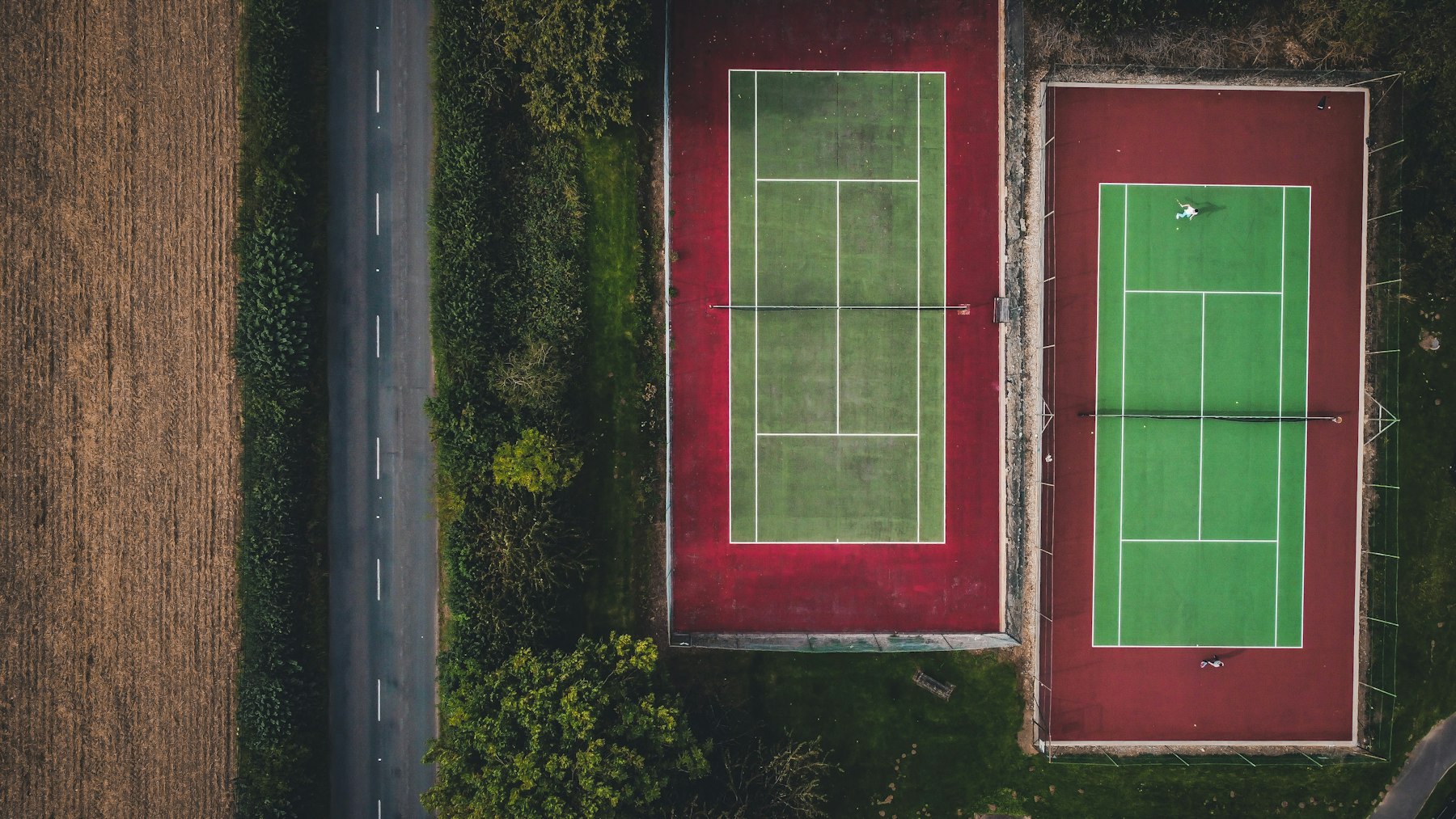
Play Area vs. Real Build Size
The 78 × 36 ft you search for is only the play area. A real build needs about 120 × 60 ft once you add run-off behind the baselines, sideline clearance, and fencing.
- ✓ 21 ft of run-off behind each baseline
- ✓ About 12 ft on each sideline
- ✓ Fencing and access sit outside the pad
How Much Space Do You Actually Need?
Absolute Minimum — 78 × 36 ft
The play area alone, with almost nothing beyond the lines. Workable only on an already-open site — anything less than that and a serve return sends players straight into a fence. We won't build to this without a serious conversation first.
Recommended — 120 × 60 ft
The standard build target: roughly 21 ft of clearance behind each baseline and 12 ft on each sideline. This is the number to size your lot against, and what most of our NJ builds are actually poured to.
Extra Clearance — 128 × 64 ft+
Some clubs and tournament-oriented builds go larger for spectator space, benches, and shade structures. Rarely necessary for a residential court, but worth knowing if you're planning a multi-use build.
These are surface dimensions only. Perimeter fencing — typically 10 ft for a residential tennis court — sits outside the pad, and construction crews need equipment access to the site, both of which eat into a tight yard. If 120 × 60 ft won\'t fit, compare against a pickleball court\'s 30 × 60 ft recommended footprint — a quarter of the space for a full court. See our guide to the smallest yard that can fit any court for how the numbers compare across sports.
Not Sure Your Lot Fits a Tennis Court?
Send us your address and rough lot size. We'll check your town's setbacks and coverage limits, tell you honestly what fits, and send a fixed quote after a site visit.
Request a Quote →What Site Requirements Matter Beyond the Lines?
Orientation — North-South
Run the long axis north-south so the low morning and evening sun stays off the baselines. Serving into direct low sun is dangerous, not just inconvenient, and it's one of the most common complaints on courts oriented east-west.
Slope — About 1%
Like every outdoor court, a tennis court is pitched roughly 1% in a single plane so water sheds instead of pooling — never a crown down the middle. See our court drainage guide for how that grading actually works.
Setbacks & Coverage
A 120 × 60 ft pad is 7,200 sq ft of impervious coverage — enough to push many NJ lots over their town's limit on its own. This, not the yard's raw size, is usually what determines whether a full court fits.
Fencing Clearance
Residential tennis courts typically get 10 ft chain-link fencing outside the pad. Windscreens, gates, and backboard walls all add to the footprint and the price — budget the space, not just the dollars.
Why Baseline Clearance Matters More Than Sideline Clearance
The 78 × 36 ft figure is the one most people search for, and it\'s the one that gets backyard courts built too tight. That number is the play area — the lines a ball is in or out of. It has nothing to say about where a player ends up chasing down a deep lob past the baseline at full speed, and that\'s exactly where the gap between 78 × 36 and 120 × 60 goes: roughly 21 ft behind each baseline versus about 12 ft on each sideline.
That split isn\'t arbitrary. Baseline movement in tennis is fast, backward, and frequent — players are constantly retreating for deep balls and overheads. Sideline movement is comparatively rare and lower speed. If your lot forces a trade-off, protect the baselines first and let the sidelines run tighter; a court with 15 ft behind the baseline and 8 ft on the sides plays and feels safer than the reverse.
If your property genuinely can\'t hold 120 × 60 ft even with that trade-off, it\'s worth being honest about it before you commit to a design. We\'d rather size a court correctly on a site visit — or point you toward a pickleball build that fits the same footprint far more comfortably — than build something you regret playing on. Our tennis court installation cost guide covers what a full build runs once the site is confirmed, and our step-by-step build guide walks through the full process once the footprint fits. On a lot too tight for any full court, a standalone practice wall is worth considering instead.
On the opposite end, a club, school, or HOA planning to host sanctioned matches needs more than the 120 × 60 ft standard, not less — the full ITF/USTA tournament run-off pushes past what a typical backyard build reserves. See our tournament-grade tennis court construction guide for exactly how much extra clearance that requires and why it has to be planned in from day one.
Where in New Jersey Do We Build Tennis Courts?
Bergen County
Backyard, club, and HOA court installation throughout North Jersey.
Bergen County court installation →Essex County
New builds and resurfacing for Montclair, the Oranges, and surrounding towns.
Essex County court installation →Monmouth County
Shore-area residential and facility court construction.
Monmouth County court installation →Morris County
Court installation for Morristown, Madison, Chatham, and nearby communities.
Morris County court installation →Hudson County
Space-efficient builds and slab surfacing for Hoboken and Jersey City.
Hudson County court installation →Related Guides
Tennis Court Installation Cost in NJ
Full pricing breakdown once you know how much space and what base your build needs.
Junior & Mini Tennis Court Construction in NJ
36-foot and 60-foot USTA youth courts — a smaller footprint for younger players.
How Long to Build a Tennis Court in NJ
Where site grading and layout fit into the overall construction timeline.
Pickleball Court Dimensions & Space Requirements
The same breakdown for pickleball — a fraction of the footprint of a tennis court.
Convert a Tennis Court to Pickleball in NJ
How one tennis court footprint typically becomes multiple pickleball courts.
Pickleball & Tennis Court Permits & Zoning in NJ
The setback and coverage rules that often decide what actually fits on your lot.
Tennis Court Dimension FAQs
What are the dimensions of a tennis court?+
A regulation doubles court is 78 ft × 36 ft of play area, measured to the outside of the lines. A singles court uses the same 78 ft length but only 27 ft of width — the doubles alleys (4.5 ft on each side) are excluded. Each service box is 21 ft × 13.5 ft, and the net drops from 3.5 ft at the posts to 3 ft at the center.
How much space do you need to build a tennis court in New Jersey?+
Plan on roughly 120 ft × 60 ft — about 7,200 sq ft — for the full pad including safe run-off around the 78 × 36 ft play area. That breaks down to roughly 21 ft of clear space behind each baseline and about 12 ft on each sideline. See our tennis court installation cost guide for what a build that size runs in NJ.
What's the difference between a singles and doubles tennis court?+
Both are 78 ft long. Doubles adds a 4.5 ft alley on each side, bringing total width to 36 ft versus 27 ft for singles-only. Nearly every court we build in New Jersey is striped for doubles, since the alleys just sit unused during singles play — building singles-only to save space rarely makes sense unless the lot genuinely can't fit 36 ft.
How high is a tennis net?+
A tennis net is 3.5 ft (42 in) high at the two posts and sags to 3 ft (36 in) at the center, held down by a center strap. That's taller at the posts than a pickleball net, which is one reason a tennis net doesn't play correctly for pickleball without an adapter strap or a separate net system.
My yard doesn't fit a full tennis court — what are my options?+
A 120 × 60 ft pad is a lot to ask of most New Jersey backyards, especially with town setbacks eating into the usable lot. Two real alternatives: build to the smaller minimum footprint with tighter run-off if the site allows it, or build a pickleball court instead — a full pickleball court fits in roughly a quarter of the space, and four of them fit inside one former tennis court footprint. See our guide on pickleball court dimensions and space requirements to compare the two directly.
Get a Tennis Court Installation Quote
Tell us your location and your lot size, and we'll fit the largest usable court your site and town allow — with a fixed quote after a site visit.
Request a Quote →