Tournament-Grade Tennis Court Construction in New Jersey
What separates a solid backyard build from a sanctioned, tournament-ready court — run-off distance, net tension, fencing, and lighting for USTA-level play.
Get a Tournament-Spec Quote →A tournament-ready tennis court needs the full 21 ft of run-off behind each baseline called for in the ITF Rules of Tennis and the USTA/ASBA construction manual, not the 18 ft minimum some public courts get built to. Beyond footprint, a sanctioned build tightens surface flatness, uses reinforced net-post footings that hold tension through a full day of matches, and lights the court to 50–75 foot-candles for evening rounds. Net height itself doesn't change — 3.5 ft at the posts, 3 ft at center — at any level of play. NJ Court Pros prices a standard build and a tournament-spec build side by side so you can see exactly where the difference comes from.
What a Sanctioned Build Actually Adds
Full Run-Off Distance
The ITF and USTA/ASBA construction manual call for 21 ft behind each baseline and 12 ft on each sideline — more than the 18 ft of back clearance many public courts are built to save space.
Net Tension That Holds
Height doesn't change — 3.5 ft at the posts, 3 ft at center — but a sanctioned court needs a post and footing that keeps that height under load through a full day of matches, not just at setup.
Consistent Surface Bounce
No low spots that hold water, no high spots that skip a bounce. That's a base-grading and leveling-coat discipline, not a different acrylic product.
Competition-Level Lighting
50–75 foot-candles evenly distributed for night matches, versus 30–50 for casual and club-recreational play — usually a 4- or 6-pole layout engineered for the specific footprint.
Run-Off Is Where Backyard Builds Fall Short
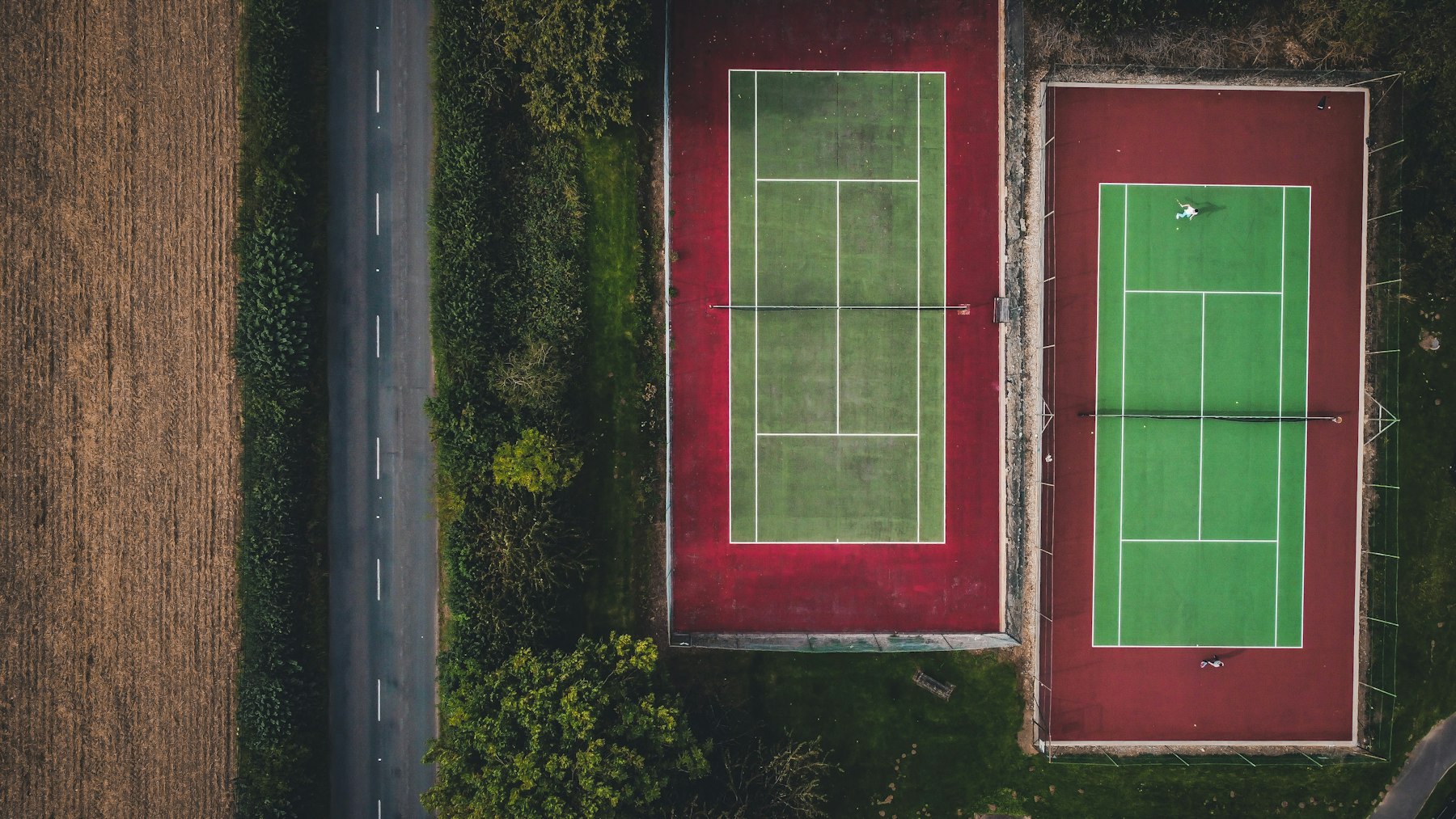
Most NJ backyard courts build to the 120×60 ft recommended footprint and call it done. Sanctioned play wants the full 21 ft behind each baseline, which on a tight lot can mean the difference between a court that plays fine casually and one that would need to be rebuilt to host a real event.
- ✓ 21 ft behind each baseline for tournament play
- ✓ 12 ft along each sideline (unchanged from standard)
- ✓ 128×64 ft footprint gives room to spare where the lot allows
Standard Build vs. Tournament Spec
| Element | Standard NJ Build | Tournament Spec |
|---|---|---|
| Behind each baseline | 18–21 ft (typical NJ backyard build) | 21 ft minimum — no exceptions on a sanctioned court |
| Along each sideline | 12 ft | 12 ft (unchanged, but rarely trimmed to save space) |
| Total recommended footprint | 120 ft × 60 ft | 128 ft × 64 ft or larger where site allows |
| Surface flatness | Level and well-drained; minor imperfections tolerated | No birdbaths, no crown — tighter leveling-coat tolerance |
| Net post anchoring | Standard sleeve or ground post | Reinforced footing sized to hold tension through full-day play |
| Lighting | 30–50 foot-candles | 50–75 foot-candles, engineered per court |
These figures come from the ITF Rules of Tennis (Rule 1, Note 2) and the joint USTA/ASBA "Tennis Courts: A Construction & Maintenance Manual." See our tennis court dimensions guide for the full standard-build breakdown these numbers build on.
Where the Extra Cost Actually Goes
Larger Footprint
Extending run-off from 18–21 ft toward the full tournament distance can add several hundred square feet of base and fencing per court — the single biggest line item in the delta.
Tighter Leveling Pass
An extra grading and leveling-coat pass to eliminate any birdbath or high spot adds a modest amount over a standard resurfacing coat, but it's not optional at sanctioned level.
Competition Lighting
Stepping from a 30–50 foot-candle backyard package to a 50–75 foot-candle competition layout usually means more poles and a purpose-engineered layout, not just brighter bulbs.
There isn't a single "tournament-grade tax" percentage we can quote in the abstract — it depends on how much your lot already has to spare and how far your intended lighting and fencing package is from competition spec. A site visit gives an exact number.
Building a Court That Needs to Host Real Matches?
Tell us whether it's casual, club-level, or sanctioned play, and we'll price the footprint, base, and lighting to match — with the standard build shown alongside it for comparison.
Request a Quote →Why Retrofitting a Backyard Court Rarely Works
The footprint decision gets made once, on day one, and it's the hardest thing to fix afterward. A court poured to the 120×60 ft standard with 18 ft of back run-off can't simply borrow another 3 ft on each end later — that space either got reserved during excavation and base work or it didn't, and by the time the concrete is cured, adding it back means tearing out fencing, extending the base, and repouring, which usually costs more than building it correctly the first time. If there's any real chance the court will host a sanctioned event, league final, or club tournament down the line, it's worth reserving the full run-off distance during initial design even if the lighting and net hardware get upgraded later.
Lighting is more forgiving to defer than footprint, but not by much. A 4-pole backyard layout sized for 30–50 foot-candles doesn't become a competition layout by adding fixtures to the same poles — even coverage at 50–75 foot-candles without glare in the service boxes is a pole-placement and photometric design problem, closer to starting over than upgrading. See our court lighting cost guide for how foot-candle levels and pole count scale together.
Net hardware is the cheapest of the three to get wrong and the cheapest to fix. A standard ground post and sleeve is fine for casual and even club play, but on a court that's hosting back-to-back matches all day, a post that flexes under repeated tensioning drifts the net height out of tolerance by the afternoon round. We spec a reinforced footing on tournament builds specifically so this stops being something a tournament director has to check between matches.
If you're weighing whether the extra footprint and lighting spend is worth it against a standard build, our tennis court installation cost guide covers the baseline numbers this guide builds on top of. And if pickleball is part of the same facility plan, the same logic applies there too — see our tournament-grade pickleball court construction guide for how IPA certification and USA Pickleball's published standards work on the smaller footprint.
What We See on "Almost Tournament-Ready" Courts
Run-Off Trimmed to Fit the Lot
The most common gap. A board or homeowner asks for a "tournament-quality" court, and the lot only has room for 18 ft behind the baseline instead of 21. The surface and lighting can be excellent and the court still won't pass a sanctioning walkthrough.
Lighting Bought by Wattage, Not Foot-Candles
A brighter fixture isn't the same as even, glare-free coverage. We've been called in to fix courts where more lights were added to an existing layout and still left dark service boxes at one end.
Fencing Sized for Containment, Not Spectators
Standard 10 ft perimeter fencing keeps balls in. A club or municipal court that expects to host matches with spectators needs to think through sightlines and gate placement before the fence footings go in, not after.
No Plan for Benches or an Umpire Station
Small items, but they need a poured pad and clearance outside the run-off zone. Adding them after the surrounding fence and hardscape are finished is far more disruptive than reserving the space up front.
We Build Tournament-Spec Courts Across New Jersey
Bergen County
Club and HOA tournament-spec builds throughout North Jersey.
Bergen County court installation →Essex County
Competition court construction for Montclair, the Oranges, and surrounding towns.
Essex County court installation →Monmouth County
Shore-area club and facility court construction, built to sanctioned spec.
Monmouth County court installation →Morris County
Tournament-grade court installation for Morristown, Madison, Chatham, and nearby towns.
Morris County court installation →Hudson County
Facility-scale court construction for Hoboken and Jersey City clubs and schools.
Hudson County court installation →Related Guides
Tennis Court Installation Cost in NJ
The standard-build pricing this guide's tournament spec builds on top of.
Tennis Court Dimensions & Space Requirements
The 78×36 ft play area and 120×60 ft standard footprint, in full detail.
Tournament-Grade Pickleball Court Construction
The same sanctioned-play spec conversation, scaled to a pickleball footprint.
Multi-Court Complex Installation for HOAs & Towns
Spacing and per-court economics when a club or town builds several courts at once.
Court Lighting Cost & Installation
Foot-candle levels and pole layouts, from casual play up to competition.
Tournament-Grade Tennis Court FAQs
What makes a tennis court "tournament grade" instead of just a standard build?+
A standard NJ build typically hits the 120×60 ft recommended footprint, which already includes reasonable run-off. Tournament spec tightens that further — full 21 ft of clearance behind each baseline rather than the 18 ft minimum some public courts use, a flatter and more consistent surface, a net that holds its certified height under match tension instead of sagging by the third set, and lighting sized for evening rounds rather than casual play. Most of it is construction-quality control and footprint discipline, not exotic materials.
How much extra run-off does a sanctioned court need behind the baseline?+
The ITF Rules of Tennis and the joint USTA/ASBA construction manual both call for a minimum of 21 ft behind each baseline and 12 ft along each sideline for tournament play. That is more than the 18 ft of back run-off many public and backyard courts are built to. The gap matters most on deep defensive balls — a player at full sprint retreating for a lob needs the extra 3 ft to stop safely instead of hitting a fence at speed.
Does the net height change for tournament play?+
No — net height is fixed by the rules of tennis at any level: 3.5 ft (42 in) at the posts, sagging to 3 ft (36 in) at the center strap. What changes at tournament level is whether the net holds that height consistently through a full day of matches. A net post that flexes or a center strap that loosens under repeated tension is a maintenance detail on a backyard court and a match-integrity problem on a sanctioned one, which is why we spec heavier post anchoring on competition builds.
What lighting level does night tournament play require?+
Plan on 50–75 foot-candles of even coverage for competitive and tournament matches, above the 30–50 that works fine for casual or club-recreational play. Getting even coverage without glare or dark service boxes at that level usually means a 4- or 6-pole LED layout engineered specifically for a 120×60 ft footprint, not a backyard fixture count scaled up.
Does building to tournament spec cost significantly more than a standard court?+
The delta is real but narrower than people expect — it shows up in three places: the extra run-off (which can push a 120×60 ft pad toward 128×64 ft or more), a tighter base-flatness tolerance during grading and the leveling coat, and a competition-grade lighting package instead of a casual one. On a club, HOA, or school project we price a standard build and a tournament-spec build side by side so a board can weigh the difference against how often the court will actually host sanctioned play.
Get a Tournament-Spec Construction Quote
Tell us whether the court needs to host sanctioned play, and we'll price the footprint, base, and lighting to match from day one — with a standard build shown side by side for comparison.
Request a Quote →