Pickleball Court Dimensions & Space Requirements
The exact numbers — 20 × 44 ft of play, 30 × 60 ft recommended total — and what they mean for fitting a real court on a New Jersey property.
Get a Court Build Quote →A regulation pickleball court is 20 ft × 44 ft of play area — the same for singles and doubles. The recommended total surface is 30 ft × 60 ft, which adds safe out-of-bounds run-off, with 34 ft × 64 ft preferred for tournament play. The net is 36 in at the sidelines and 34 in at center, and the kitchen runs 7 ft off the net on each side. On a New Jersey property, your real constraint is usually town setbacks and impervious-coverage limits rather than the yard itself. NJ Court Pros fits the largest usable court your site and town allow.
What Are the Exact Pickleball Court Dimensions?
Every regulation pickleball court uses the same measurements, whether you are playing singles or doubles — unlike tennis, the court does not narrow for singles. Here are the numbers a builder actually works to:
| Element | Dimension | Notes |
|---|---|---|
| Play area | 20 ft × 44 ft | Same for singles and doubles, measured to the outside of the lines. |
| Recommended total surface | 30 ft × 60 ft | Play area plus out-of-bounds run-off. 34 × 64 ft preferred for tournaments. |
| Net height | 36 in / 34 in | 36 in at the sidelines, sagging to 34 in at the center. |
| Non-volley zone (kitchen) | 7 ft deep | Extends 7 ft from the net on each side, across the full 20 ft width. |
| Service courts | 10 ft × 15 ft | Four of them — right and left of the centerline on each side. |
| Line width | 2 in | All lines are 2 in wide and part of the area they bound, except the kitchen line. |
Play Area vs. Total Surface
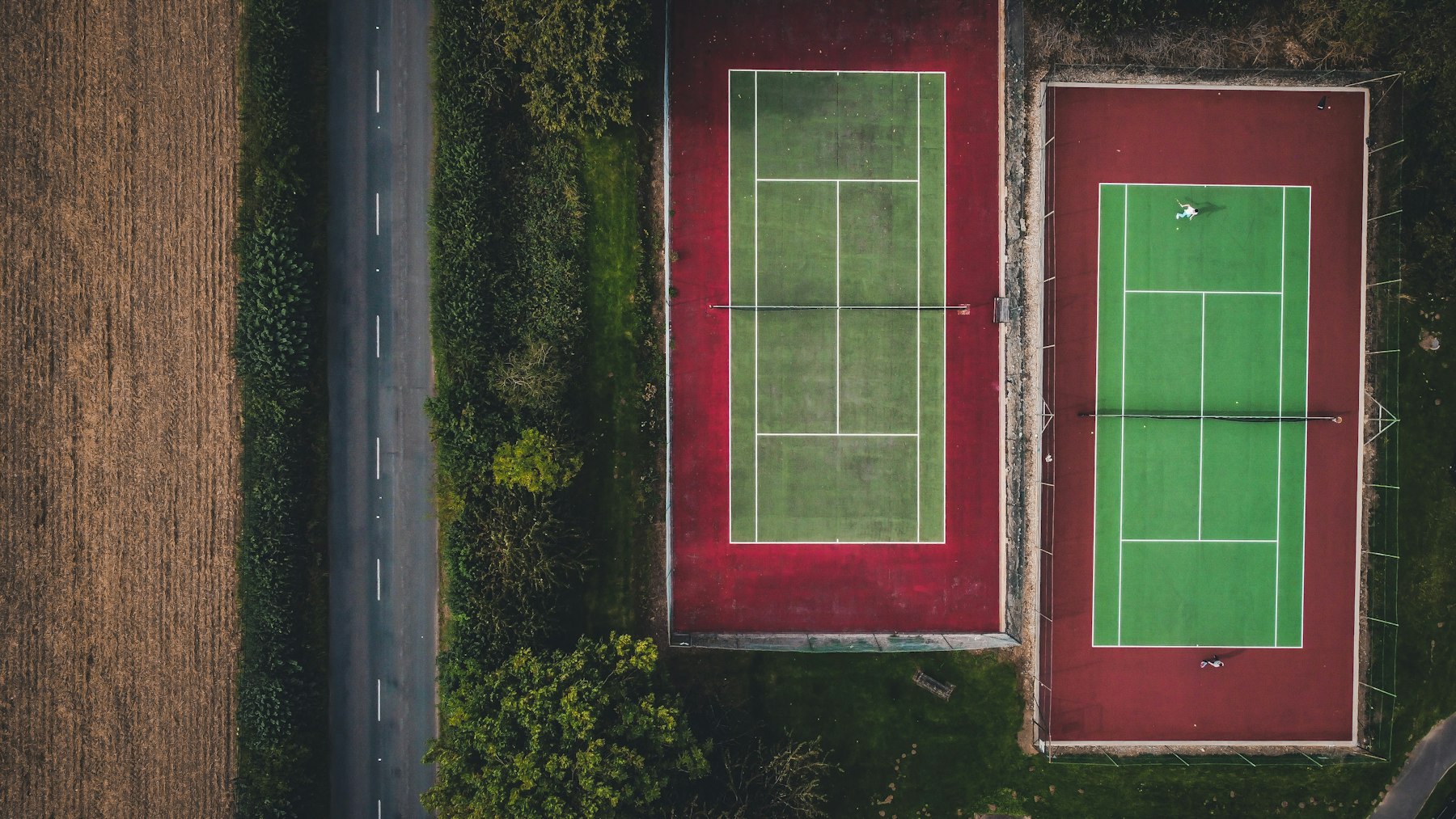
The 20 × 44 ft play area is only the lines. Build to 30 × 60 ft so players have safe run-off chasing a lob past the baseline — and remember, on an NJ lot, town setbacks and coverage limits often decide the size before the yard does.
- ✓ 20 × 44 ft play area, singles or doubles
- ✓ 30 × 60 ft recommended total surface
- ✓ Setbacks and coverage limits set the legal footprint
How Much Space Do You Actually Need?
Absolute Minimum — 20 × 44 ft
The play area alone. Only workable if the surround is already open and forgiving — a court with no run-off means players hit fences chasing balls. Not what we recommend building to.
Recommended — 30 × 60 ft
The standard build target: play area plus about 5 ft of run-off on the sides and 8 ft behind each baseline. This is the number to plan your NJ backyard around.
Preferred — 34 × 64 ft
USA Pickleball's preferred total for tournament play. Generous run-off, room for benches and shade. Worth it if the space and budget allow.
These are surface dimensions. Perimeter fencing sits outside the pad, and construction needs equipment access to the site — both of which eat into a tight yard. For context, a tennis court needs roughly 120 × 60 ft of play plus run-off, which is why four pickleball courts fit on one tennis court. If even 30 × 60 ft is tight for your lot, see our guide to how small a yard can be and still fit a court for the real minimum and what to do below it.
Not Sure Your Yard Fits a Court?
Send us your address and rough yard size. We'll check your town's setbacks and coverage limits, tell you honestly what fits, and send a fixed quote after a site visit.
Request a Quote →What Site Requirements Matter Beyond the Lines?
Orientation — North-South
Run the long axis north-south so the low morning and evening sun stays off the baselines. An east-west court puts the sun straight into a server's eyes at exactly the hours most people play.
Slope — About 1%
A court must be pitched roughly 1% so water sheds instead of pooling. Flat is wrong: standing water (birdbaths) destroys the surface and, in NJ, freezes and lifts it.
Setbacks & Coverage
NJ towns enforce property-line setbacks and impervious-coverage limits. A 30 × 60 ft pad is 1,800 sq ft of coverage, which can push a lot over its limit — this is what usually constrains the court, not the yard.
Fencing Clearance
Perimeter fencing sits outside the pad, so budget space for it. Standard is 10 ft chain link; height, gates, and wind screens are all decisions that affect the footprint and the price.
Why Does Run-Off Space Matter So Much?
The 20 × 44 ft number is the one everyone finds first, and it is the one that gets backyard courts built too small. That figure is the play area — the lines. It says nothing about where a player goes when they are chasing a lob past the baseline, and that is where people get hurt. A court squeezed to its play area with a fence 2 ft off the line is a court people stop using.
The gap between 20 × 44 and 30 × 60 is entirely run-off: roughly 5 ft on each sideline and 8 ft behind each baseline. If your space is tight, spend it behind the baselines first — that is where the fast, backward movement happens. Sideline run-off matters, but baseline run-off is what keeps play safe.
If your yard cannot hold 30 × 60 ft, you have real options before giving up: shifting orientation, reducing sideline run-off while protecting the baselines, or padding the fence. Orientation deserves its own thought even on a lot that fits the full footprint — see our court orientation and sun glare guide for why the compass direction of the layout matters as much as the dimensions themselves. What we will not do is tell you a cramped court plays fine. We would rather size it honestly on the site visit than build you something you regret — see how to build a backyard pickleball court in NJ for the full process. If the footprint genuinely does not work no matter how it is arranged, a standalone practice wall gets real repetition training out of a fraction of the space.
The 30 × 60 ft figure is the backyard-build target, not the ceiling. If you\'re planning a court that might host club ladders or sanctioned events down the road, see our guide to tournament-grade pickleball court construction for the larger 34 × 64 ft footprint and surface tolerances that competitive play actually requires.
Where in New Jersey Do We Build Courts?
Bergen County
Backyard, club, and HOA court installation throughout North Jersey.
Bergen County court installation →Essex County
New builds and resurfacing for Montclair, the Oranges, and surrounding towns.
Essex County court installation →Monmouth County
Shore-area residential and facility court construction.
Monmouth County court installation →Morris County
Court installation for Morristown, Madison, Chatham, and nearby communities.
Morris County court installation →Hudson County
Space-efficient builds and slab surfacing for Hoboken and Jersey City.
Hudson County court installation →Pickleball Court Dimension FAQs
What are the dimensions of a pickleball court?+
A regulation pickleball court is 20 ft × 44 ft of play area, measured to the outside of the lines, and that is the same for both singles and doubles. Within it, the non-volley zone (the kitchen) extends 7 ft from the net on each side, and the four service courts are each 10 ft wide × 15 ft deep. Lines are 2 in wide. The net is 36 in high at the sidelines and 34 in at the center.
How much space do you need for a pickleball court?+
Plan on a minimum total surface of 30 ft × 60 ft — the 20 × 44 ft play area plus safe out-of-bounds run-off around it. USA Pickleball recommends 34 ft × 64 ft as the preferred total for tournament play. You can play on a smaller pad, but tight run-off is where players run into fences, so more surround is the single best upgrade to a backyard court. Add room outside that for fencing and access.
How much space do you need for a pickleball court in a backyard?+
For a New Jersey backyard, budget roughly 30 ft × 60 ft of buildable, reasonably flat area for the pad itself, plus clearance outside it for perimeter fencing and equipment access during construction. Your usable space is also limited by your town's property-line setbacks and impervious-coverage limits, which vary by municipality — so the legal footprint is often what constrains the court, not the yard.
How high is a pickleball net and how deep is the kitchen?+
A pickleball net is 36 in high at the sidelines and sags to 34 in at the center. The non-volley zone — the kitchen — extends 7 ft back from the net on each side, spanning the full 20 ft width. This is one reason a tennis net does not work well for pickleball: a tennis net is 42 in at the posts and 36 in at center, so it plays high across the middle.
Which direction should a pickleball court face?+
Orient the long axis of the court north-south. That keeps the low morning and evening sun off the baselines, where players are looking up to serve and return. An east-west court puts the sun directly in a player's eyes at the times of day people most often play. On a constrained NJ lot orientation is sometimes forced by the yard shape, in which case screening or lighting can offset it.
Planning your project? See how to build a backyard pickleball court in NJ, pickleball court installation cost, court permits & zoning, and sport court surface types.
Get a Pickleball Court Installation Quote
Tell us your location and your space, and we'll fit the largest usable court your site and town allow — with a fixed quote after a site visit.
Request a Quote →