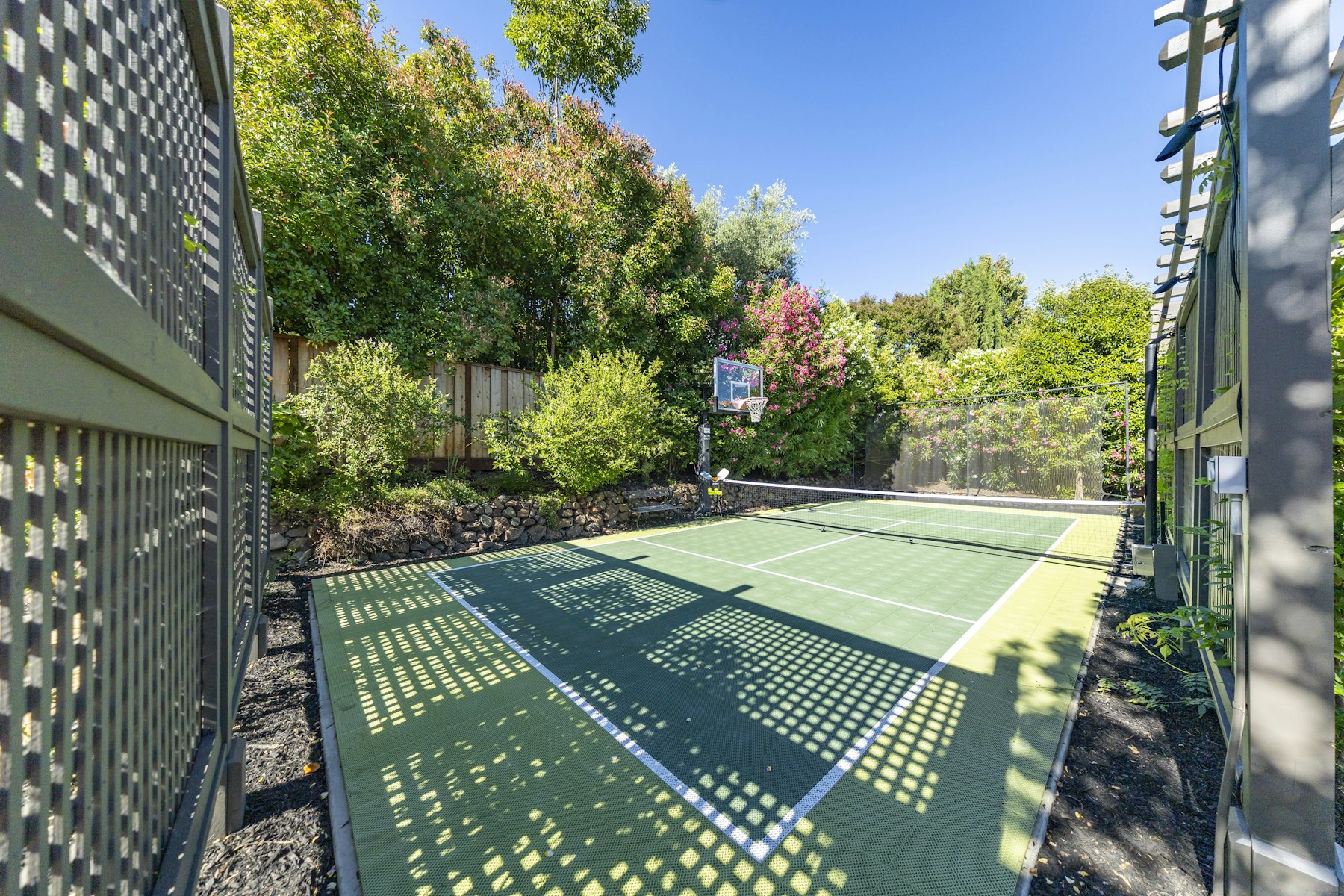
Tournament-Grade Pickleball Court Construction in New Jersey
What separates a solid backyard court from a sanctioned, tournament-ready one — surface tolerance, net spec, lighting levels, and the certification path for clubs, HOAs, and towns.
Get a Tournament-Spec Quote →A tournament-ready pickleball court needs more than the 20×44 ft play area — it needs a 34×64 ft preferred footprint, a flatter and more uniform surface than a casual backyard recoat, a net that holds certified height under tension, and 50–75 foot-candles of even lighting for night rounds. USA Pickleball publishes the construction standards; the IPA certification protocol verifies a specific facility against them. NJ Court Pros builds clubs, HOAs, and municipal courts to that spec from the start.
What a Sanctioned Court Adds
Larger Footprint
USA Pickleball's preferred tournament total is 34×64 ft, beyond the 30×60 ft backyard-build minimum, to give competitive players more safe run-off on lobs and defensive shots.
Surface Tolerance
No birdbaths, no crown, and a consistent bounce across the whole play area — held to a tighter standard than a backyard recoat through a more careful base and leveling-coat pass.
Net Height Compliance
36 in at the sidelines, 34 in at center, and holding that height under match tension rather than sagging after a few games — a net hardware and post-anchoring detail as much as a net choice.
Competition Lighting
50–75 foot-candles evenly distributed, engineered per court rather than a generic backyard fixture count, so there are no dark corners during evening tournament rounds.
Build to Spec First, Certify Second
Retrofitting a backyard court to sanctioned standards after the fact is expensive and sometimes impossible — the footprint and base decisions get made on day one. Facilities that plan to host USA Pickleball sanctioned events build to tournament tolerances from the start, then pursue IPA certification once the court is complete.
- ✓ 34×64 ft preferred footprint over the 30×60 ft minimum
- ✓ IPA certification verifies surface, lines, net, and clearance
- ✓ Retrofitting after a backyard-spec build rarely pencils out
Who Actually Needs Tournament Spec
HOA & Club Facilities
Communities that want to host club ladders, round robins, or open sanctioned events need the larger footprint and lighting package even if most daily play is casual.
Municipal & School Courts
Towns building public courts often size and light them to tournament spec once, since retrofitting a public facility later means a second full construction project.
Serious Home Courts
A handful of homeowners building a single court want tournament-quality bounce and lighting even without ever hosting a sanctioned event — the build quality is the same regardless of who's certifying it.
Whatever the audience, the construction decisions — footprint, base flatness, lighting design — are made once, at the start of the project. NJ Court Pros prices both a standard backyard build and a tournament-spec build side by side so you can decide if the difference is worth it before construction starts.
Building a Court That Can Host Sanctioned Play?
Tell us your intended use — casual, club, or tournament — and we'll spec the footprint, base, and lighting to match.
Request a Quote →Where the Standards Actually Come From
USA Pickleball, the sport's national governing body, publishes construction guidance covering court dimensions, lighting, and shading — the reference document any builder should be working from on a competitive project. That guidance sets the targets; it doesn't inspect or sign off on an individual court. Accreditation for a specific facility that wants to host sanctioned events runs through the IPA (International Pickleball Association) certification protocol, which checks surface quality, line accuracy, net specification, and clearance against the published standards before a venue can list itself as certified.
In practice, that means the certification conversation should happen before construction, not after. The 30×60 ft backyard-build minimum we quote most residential clients is not the same target as the 34×64 ft tournament preference — building to the smaller footprint and trying to expand later usually means starting over rather than adding on. The same logic applies to lighting: a standard backyard lighting package sized for 30–50 foot-candles doesn't simply get brighter with a bulb swap — competitive-level coverage is a different pole count and layout engineered for the court from the start.
Multi-court facilities add another layer: USA Pickleball's recommended court spacing of at least 10 feet between adjacent courts still applies at tournament scale, and a facility hosting several simultaneous matches needs that spacing respected as strictly as the surface tolerance itself — cramped spacing is one of the more common reasons a facility gets built and then can't actually run a bracket the way it was designed to.
Surface consistency is the part that's easiest to under-budget. A backyard court with a minor birdbath or slightly uneven color-coat pass is a cosmetic issue for casual play; on a certified court it's a compliance issue, because uneven bounce affects match integrity in a way recreational players may not even notice. That's a base-prep and leveling-coat quality question well before it's a surface-material question — see our guide on base preparation and grading cost for what drives that part of the budget.
If a facility is planning tennis alongside pickleball, the same sanctioned-vs-casual decision applies on the larger footprint — our tournament-grade tennis court construction guide covers the ITF/USTA run-off standard, net-tension detailing, and competition lighting that the tennis side of a multi-sport build needs from day one.
Related Guides
Pickleball Court Dimensions & Space Requirements
The backyard-build minimum this guide's tournament spec builds on top of.
Multi-Court Complex Installation in NJ
Spacing, bidding, and per-court economics for HOA and municipal projects.
Court Lighting Cost & Installation
Foot-candle levels and pole layouts, from casual play up to competition.
Court Base Preparation & Grading Cost
The leveling and compaction work behind a tournament-flat surface.
Tournament-Grade Court FAQs
What makes a pickleball court "tournament grade" instead of just backyard-ready?+
A backyard court only has to meet the 20×44 ft play area with reasonable run-off. A tournament-grade court adds tighter tolerances on top of that: a flatter, more consistent surface with no birdbaths, a net that holds its certified height under tension across matches, 34×64 ft or larger total footprint, and enough consistent lighting to run evening rounds. Most of that is construction-quality control, not extra square footage.
Does USA Pickleball certify courts directly?+
USA Pickleball publishes official construction guidance covering dimensions, lighting, shading, and surface standards, but court accreditation for sanctioned competitive events is handled through the IPA (International Pickleball Association) certification protocol, which verifies surface quality, line accuracy, net specification, and clearance compliance against those published standards. A facility pursuing certification should build to the published specs from day one rather than trying to retrofit a backyard court later.
What surface flatness tolerance does a certified court need?+
Tournament surfaces are held to a tighter, more uniform slope and flatness standard than a typical backyard recoat — no low spots that pool water and no high spots that create a bad bounce. This is a base and leveling-coat quality issue, not a material choice, which is why the sub-base and resurfacer coat matter more on a certified build than which acrylic brand goes on top.
How much lighting do sanctioned evening matches need?+
Competitive and tournament play wants 50–75 foot-candles of even coverage across the court, well above the 30–50 that's fine for casual backyard or club play. Getting there without harsh glare or dark corners usually means a 4- or 6-pole LED layout engineered for the specific court footprint, not just more fixtures added to a backyard plan.
Does building to tournament spec cost more than a standard court?+
Yes, mainly in three places: a larger footprint (34×64 ft vs. the 30×60 ft backyard minimum), a tighter-tolerance base and leveling pass, and a lighting package sized for competitive foot-candle levels rather than casual play. On a multi-court HOA or municipal build, we can price the delta between "solid backyard spec" and "tournament spec" so a board can decide if hosting sanctioned play is worth the difference.
Get a Tournament-Spec Construction Quote
Tell us whether the court needs to host sanctioned play, and we'll price the footprint, base, and lighting to match from day one.
Request a Quote →