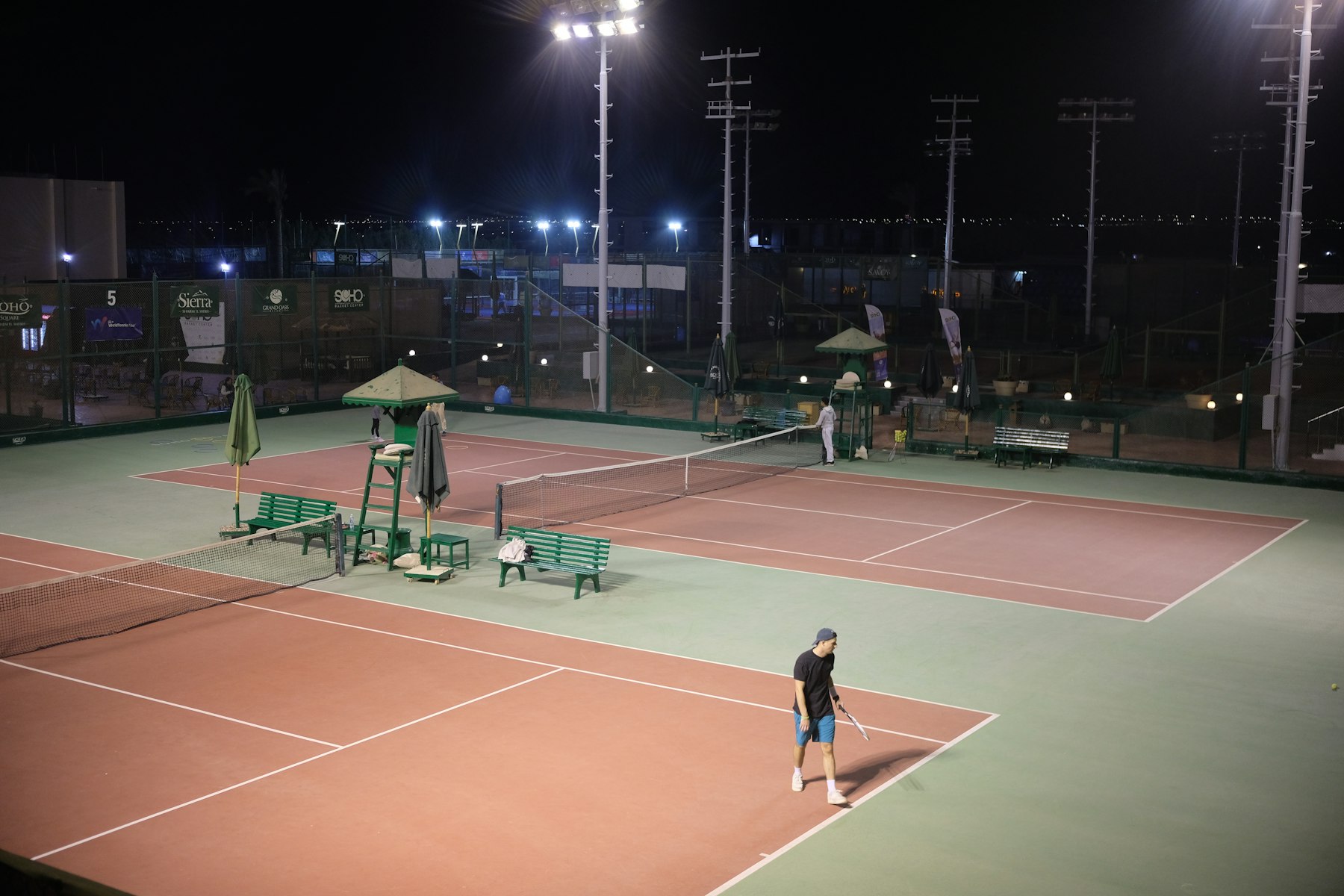
Court Lighting Cost & Installation in New Jersey
How much light your court actually needs, why LED almost always wins the math, and how to keep your fixtures from becoming a problem with the neighbors.
Get a Lighting Quote →Backyard and recreational play is well served by 30–50 foot-candles from a 4-pole LED layout; competitive club play wants 50–75. LED beats metal halide on running cost within a few seasons even though it costs more to install. The variable most people underestimate isn't the fixtures — it's trenching distance from your electrical panel and whether your town has a light-trespass rule for sports lighting.
How Much Light Does Your Court Actually Need?
Casual Backyard Play
Comfortable for family and social games. A 4-pole layout with mid-tier LED fixtures covers this without overbuilding.
Club & League Play
Better ball visibility at speed for regular evening league or club use. Usually the same 4 poles at higher output, or added fixtures.
Competitive / Broadcast
Rarely needed outside dedicated competition venues. Most homeowners and clubs are overpaying if a contractor quotes this tier by default.
Foot-candle (fc) targets are measured at the court surface. More fixtures at lower output generally beats fewer fixtures at higher output for even coverage — dark corners are usually a placement problem, not a wattage problem.
Enough Light, No Glare
Backyard play is comfortable at 30 to 50 foot-candles from a 4-pole LED layout; club play wants 50 to 75. Careful aim and shielding keep the light on the court and out of a neighbor's yard.
- ✓ LED beats metal halide on running cost
- ✓ 4 poles angled to kill dark corners
- ✓ Shielding for town light-trespass rules
LED vs. Metal Halide: The Real Comparison
Metal halide used to be the default for outdoor sport lighting because it was cheaper per fixture. That gap has narrowed, and it no longer wins on total cost. Metal halide draws roughly two to three times the wattage of an LED fixture producing comparable output, needs several minutes to reach full brightness after switch-on (a real annoyance if you\'re popping lights on for a quick evening game), and fixtures typically need replacing every 2–4 years of regular use versus 10+ years for quality LED.
The one scenario where metal halide sometimes still gets specified is a very tight installation budget where the court will see light use — a handful of nights a month rather than several nights a week. Even then, the running-cost gap usually closes the price difference within two or three seasons.
Glare, Light Trespass, and Your Neighbors
Sports court lighting is bright and directional by design, which means poorly aimed fixtures can throw glare and spill light well past your property line. Some New Jersey municipalities regulate this directly for sport courts — capping fixture height, requiring shielding, or setting a maximum light-trespass level measured at the property line. Others fold it into general outdoor lighting ordinances that weren\'t written with a tennis court in mind but still apply.
The fix is mostly in fixture selection and aim, not in dimming the whole system: house-side shields or louvers on poles closest to a neighboring yard, full cutoff fixtures that don\'t emit light above the horizontal, and pole placement that favors your own sightlines over your neighbor\'s bedroom window. We check your specific town\'s rules — see our guide to court permits and zoning in New Jersey — and design the layout around them before anything goes in the ground.
The 30–50 foot-candle range above covers casual and club-level backyard play. If the court needs to support sanctioned evening matches, competitive lighting climbs to 50–75 foot-candles with a layout engineered specifically for that coverage — see our guide to tournament-grade pickleball court construction for what changes.
When Trenching Isn't the Right Call
Everything above assumes a grid-tied system — a trench from your panel to the court, conduit, wire, and a licensed electrician making the tie-in. That's the right call for most courts close to the house with an open trench path. It gets more expensive fast on a court set back from the house, or where the trench would have to cross a septic field, a well's protective radius, or mature tree roots. On those lots, solar-powered court lighting is worth pricing alongside a grid-tied quote — it skips the trench entirely on a self-contained pole footing, at the cost of a higher per-fixture price and a battery that needs sizing for New Jersey's shorter winter daylight hours.
Get a Court Lighting Design & Quote
We size fixtures, plan pole placement, and check your town's glare rules before we quote — so the number you get is the number you pay.
Request a Quote →Related Guides
Court Fencing & Lighting Installation in NJ
Fencing and lighting cost together, including how they're typically bundled into one project.
Pickleball Court Installation Cost in NJ
How lighting fits into a full new-build budget alongside base and surfacing.
Court Permits & Zoning in New Jersey
Permit and setback rules that often apply to lighting and fencing together.
How to Build a Backyard Pickleball Court in NJ
Planning a residential build where lighting is part of the project from the start.
Net Post & Windscreen Installation in NJ
Why we set net post and light pole footings during the same base pour, not as separate trips.
Court Lighting FAQs
How many foot-candles do I need to light a pickleball or tennis court?+
Recreational backyard play is comfortable at 30–50 foot-candles. Club-level and evening league play typically wants 50–75 foot-candles for good ball visibility at speed. Broadcast or serious competitive lighting can run higher, but that's overkill for almost every residential and most club installations in NJ.
Is LED or metal halide better for court lighting?+
LED, in nearly every case. Metal halide is cheaper to buy but uses roughly 2–3x the electricity for equivalent output, takes minutes to reach full brightness after being switched on, and has a much shorter fixture life. LED costs more upfront but wins on lifetime cost within a few years of nightly use.
Will my neighbors be able to see the court lights from their yard?+
Properly aimed fixtures with shields or house-side louvers keep light on the court instead of spilling into adjacent yards. Some NJ towns have glare or light-trespass ordinances specifically for sports court lighting, so we design pole placement and fixture aim to stay within your property's light footprint before installation, not after a neighbor complains.
How much does it cost to run court lights?+
A four-pole LED system used a few hours a few nights a week adds a modest amount to a monthly electric bill, depending on local rates, fixture wattage, and hours of use. LED's efficiency is most of what keeps that number manageable compared to older lighting technology.
How many light poles does a single court need?+
Most single courts use 4 poles, one near each corner, angled to overlap coverage and avoid dark spots at net or baseline. Larger or double courts may need 6 poles. Pole count and height are what a lighting designer calculates first, since it drives both fixture cost and trenching layout.
Should lighting be installed before or after fencing and net posts?+
Pole footings for lighting are usually poured at the same time as the base, since digging near a finished court risks the surface and any net post sleeves already set. Fixtures and wiring typically go in near the end of the project, around the same stage as fencing and net posts, so we sequence all three together rather than treating lighting as a separate trip.
Ready to Light Up Your Court?
Tell us your court size and how you plan to use it, and we'll design a lighting layout and fixed quote around it.
Request a Quote →