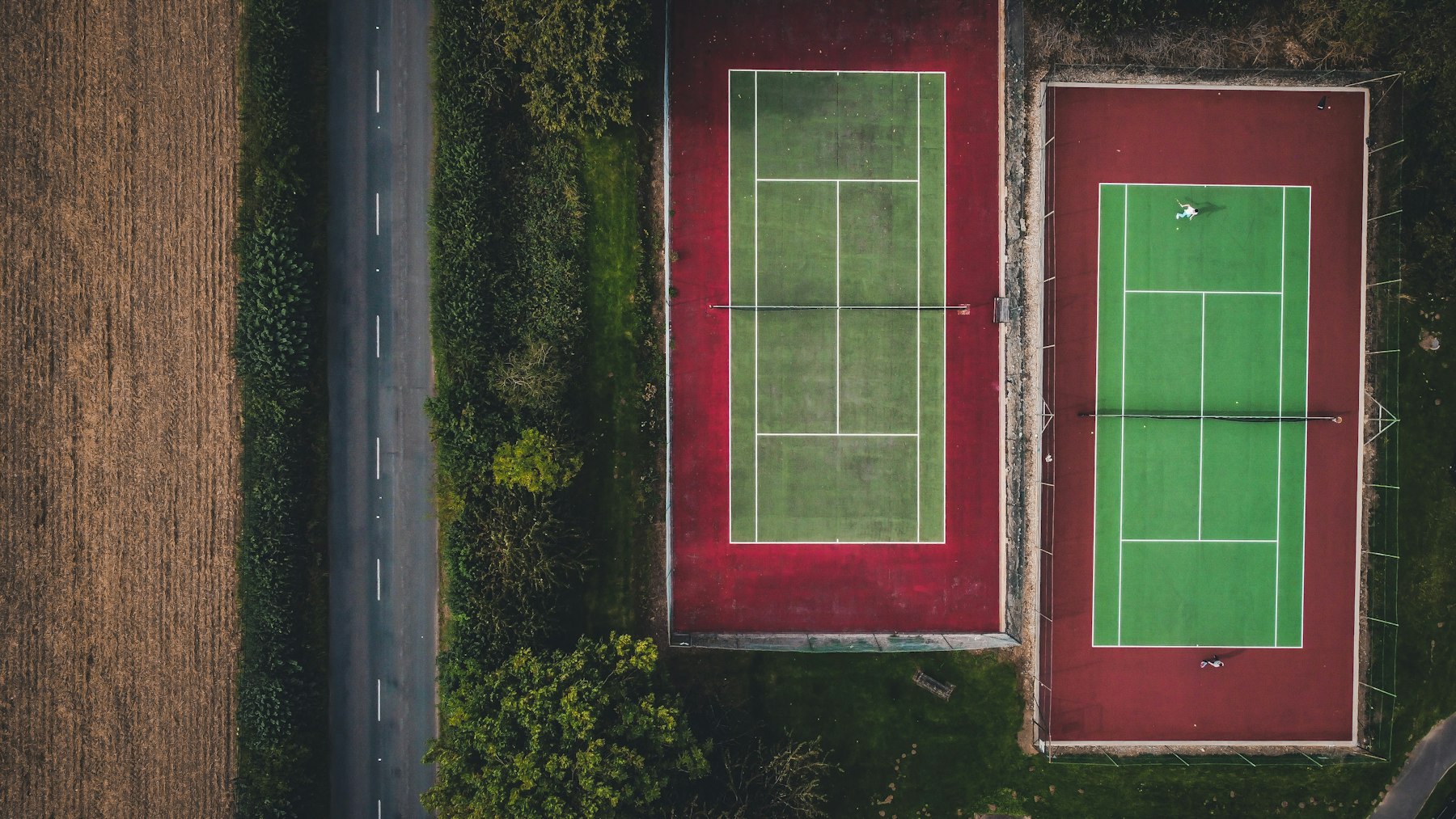
Concrete vs. Asphalt Court Base in New Jersey
The base decision drives more of a court's lifetime cost than any other choice you'll make. Here's how the two compare for NJ's freeze-thaw climate.
Get a Base Recommendation →Post-tension concrete is the stronger base for New Jersey conditions — it resists freeze-thaw cracking better and needs resurfacing every 8–12 years instead of asphalt's 4–8 years. Asphalt costs less upfront than post-tension concrete, so it's the right call when upfront budget matters more than 20-year cost. Standard concrete without post-tensioning splits the difference on both price and durability.
Concrete vs. Asphalt at a Glance
| Factor | Asphalt Base | Post-Tension Concrete |
|---|---|---|
| New build cost | Lower upfront | Higher upfront |
| Resurfacing interval in NJ | Every 4–8 years | Every 8–12 years |
| Freeze-thaw cracking risk | Higher — cracks in 5–15 years without upkeep | Low — cables keep the slab in compression |
| Install timeline | Faster — fewer cure-time constraints | Slower — requires a concrete cure window |
| Best for | Tighter budgets, shorter ownership horizon | 20+ year courts, competitive-level play |
The Base Is the Cost You Can't Undo
Surfacing and fencing can be upgraded later, but switching base material means a near-total rebuild. In NJ's freeze-thaw climate the base decides how soon cracking starts and how often you resurface.
- ✓ Post-tension concrete resists freeze-thaw cracking
- ✓ Asphalt costs less now but resurfaces twice as often
- ✓ Sub-base and drainage matter as much as the material
Why the Base Matters More Than the Surface
Freeze-Thaw Cycles
New Jersey runs dozens of freeze-thaw swings most winters. Every cycle works at any weakness in the base, so the material underneath decides how fast cracking starts far more than the acrylic coating on top.
It's the Cost You Can't Undo Cheaply
Surfacing and fencing can be upgraded later without touching the base. Once concrete or asphalt is poured, switching materials means a near-total rebuild — this is the one decision worth getting right the first time.
Lifetime Cost, Not Just Sticker Price
A cheaper asphalt base that needs resurfacing every 5 years instead of every 10 can cost more over 20 years than paying more for concrete upfront — the math depends on how long you plan to own the court.
Ball Bounce & Consistency
A harder, more stable base gives a truer, more consistent bounce over time. Asphalt that's started to soften or heave in spots changes how the ball plays well before it looks visibly cracked.
Not Sure Which Base Fits Your Budget?
We'll walk you through both options against your timeline and how long you plan to own the court, then quote the one that makes sense.
Request a Quote →Making the Call for Your Project
The honest tradeoff is upfront cost against lifetime cost, and there's no single right answer — it depends on how long you're planning to own the court. If you're building for a growing family that'll use the court for 15–20 years, post-tension concrete usually wins on total dollars spent, because you're resurfacing roughly half as often and starting from a slab that resists cracking in the first place. If you need a court built this season on a fixed budget, asphalt gets you playing sooner for less, and a well-maintained asphalt court still performs fine for years before it needs its first recoat.
Standard, non-post-tension concrete is worth mentioning because it's often overlooked between the two headline options. It costs less than post-tension concrete, cracks less than asphalt, but doesn't carry the same warranty-backed crack resistance that post-tensioning cables provide. For homeowners weighing a middle-of-the-road budget, it's a reasonable compromise, though we're upfront that it's not the top-performing choice in either direction. See our post-tension vs. standard reinforced concrete guide for exactly how each slab type is built and why one resists cracking outright instead of just controlling where it happens, and our control joints and expansion joints guide for how reinforced concrete and asphalt each manage that same temperature movement once the base material is chosen.
All of this assumes you're pouring a new base. If you already have a driveway, patio, or old basketball slab, the better first question is often whether that concrete or asphalt is worth keeping at all — see our guide on converting a driveway or existing slab into a court for how we check thickness, slope, and cracking before recommending surfacing over a rebuild.
Whatever base you choose, the sub-base and drainage design underneath it matter just as much as the material on top — a well-built asphalt court on properly graded, well-compacted stone will outlast a rushed concrete pour with a shortcut sub-base. See our court drainage systems guide for how that grading actually works, our base preparation and site grading cost guide for what that excavation and compaction work actually runs before either material goes down, and our sport court surface types guide for how the acrylic or tile system on top interacts with whichever base you pick. If you're weighing tile specifically against a traditional acrylic coating, our modular tile vs. poured surface guide breaks down the cost and lifespan trade-off in more depth.
Both post-tension concrete and standard asphalt are sealed, impervious bases — the right call for regulation tennis and pickleball bounce, but not your only option if drainage or an impervious-coverage limit is the real constraint on your lot. See our permeable and porous court surfacing guide for when a water-infiltrating base under a basketball pad or multi-sport tile system is worth pricing instead.
We Pour Both Base Types Across New Jersey
Bergen County
Concrete and asphalt base installation for backyard, club, and HOA courts throughout North Jersey.
Bergen County court installation →Essex County
New builds for Montclair, the Oranges, and surrounding towns, base type quoted to your budget.
Essex County court installation →Monmouth County
Shore-area builds where soil and water table often factor into the base recommendation.
Monmouth County court installation →Morris County
Court base construction for Morristown, Madison, Chatham, and nearby communities.
Morris County court installation →Hudson County
Space-efficient base pours for Hoboken and Jersey City lots.
Hudson County court installation →Related Guides
Sport Court Surface Types in New Jersey
How acrylic, cushioned, and modular tile systems sit on top of your base choice.
Court Drainage Systems in New Jersey
Why the sub-base grading matters as much as the base material itself.
Court Base Preparation & Grading Cost in NJ
What excavation, grading, and compaction cost before either base material is poured.
Pickleball Court Installation Cost in NJ
How base choice rolls up into a full new-build price.
Tennis Court Installation Cost in NJ
Base, surface, and pricing benchmarks for a full tennis court build.
Concrete vs. Asphalt Base FAQs
Is concrete or asphalt better for a court base in New Jersey?+
Post-tension concrete is the better base for most New Jersey courts because it resists the freeze-thaw cycles that crack asphalt within 5–15 years. Asphalt costs less to install and is a reasonable choice on a tight budget or for a shorter-term court, but it needs resurfacing roughly twice as often here, which narrows the price gap over a court's life. Standard (non-post-tension) concrete sits in between on both cost and durability.
How much more does a concrete base cost than asphalt?+
For a new single pickleball or tennis court, an asphalt base costs the least upfront, standard concrete costs more, and post-tension concrete costs the most. The gap is real upfront, but asphalt's shorter resurfacing cycle in NJ's climate — often every 4–8 years versus 8–12 for post-tension concrete — adds cost back over a 20-year ownership period.
Why does asphalt crack more than concrete in New Jersey?+
Asphalt is a flexible, oil-based material that expands and contracts more than concrete as temperatures swing through freeze and thaw. New Jersey runs dozens of freeze-thaw cycles most winters, and each one works at any hairline crack or joint in the asphalt, widening it over time. Post-tension concrete is pre-stressed with steel cables that keep the slab in compression, which resists that same cracking far more effectively.
Can you convert an asphalt court base to concrete later?+
Not without a full rebuild — you can't retrofit post-tension cables or add structural reinforcement under an existing asphalt slab. What you can do is remove the asphalt down to the sub-base and pour concrete on the same graded footprint, which saves the excavation and drainage design work but still costs close to a new concrete build. Most owners who start on asphalt stay on asphalt through several resurfacing cycles rather than switching material.
Is asphalt ever the right choice for a New Jersey court?+
Yes, in specific situations: a lower budget where getting a court built now beats waiting to save for concrete, a court expected to see lighter use, or a site where the owner plans to sell or move within 10 years and doesn't need to optimize for 25-year lifetime cost. Asphalt is also common under modular sport tile systems, where the tile — not the base — carries most of the freeze-thaw resistance.
Get a Base Comparison for Your Site
Tell us your budget and how long you plan to own the court — we'll recommend a base, quote both options, and set up a site visit.
Request a Quote →