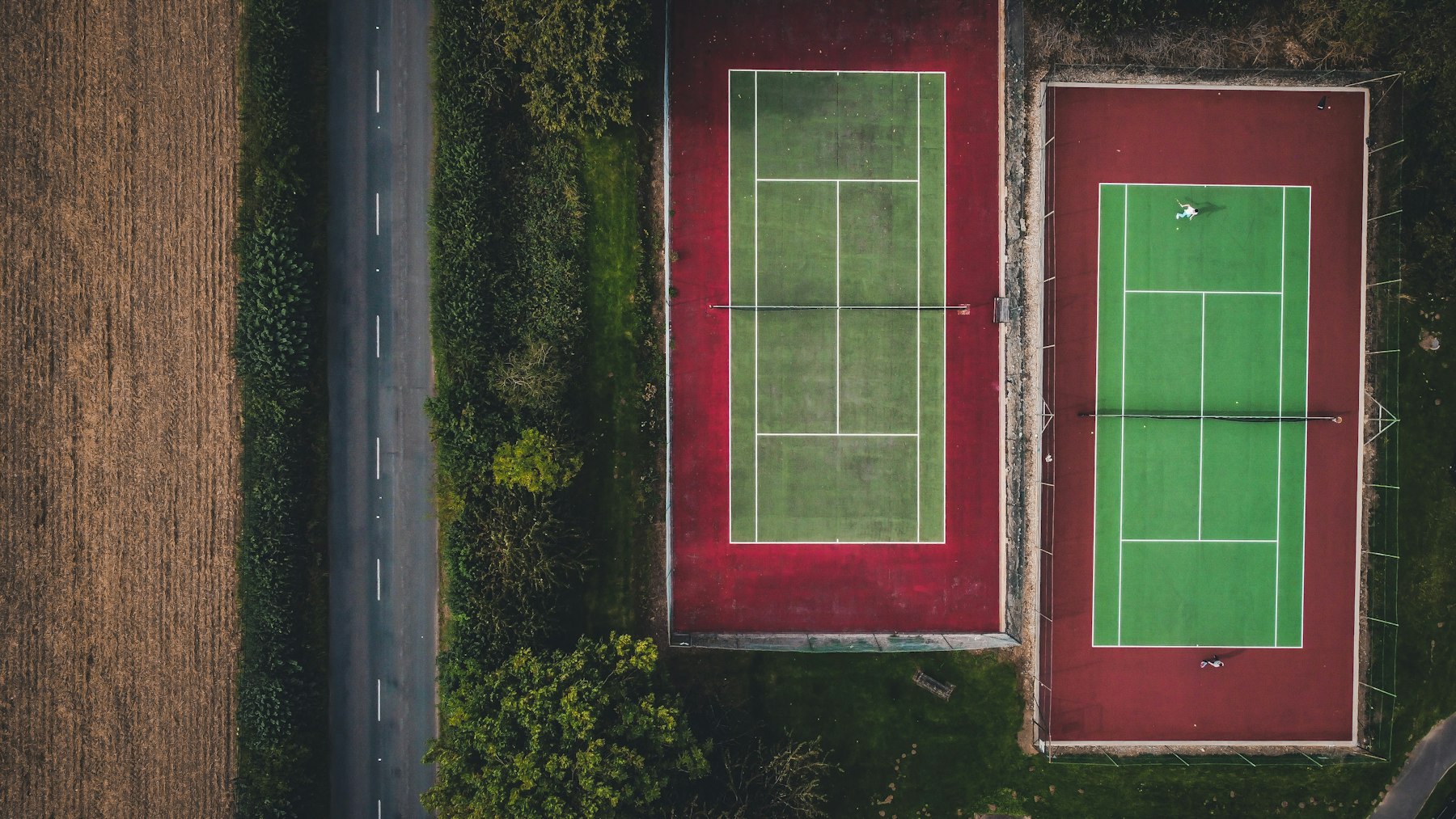
Can You Build a Court on Your Driveway?
Sometimes — and when it works, it's the cheapest court you'll ever build. Here's how to tell if your slab actually qualifies before you plan around it.
Get a Slab Assessment →A driveway, patio, or old basketball slab can become a court if it's the right size, thick enough, free of active cracking, and can be corrected to a proper drainage slope. When it qualifies, surfacing alone costs a fraction of a new build — because you're skipping the most expensive part of the project entirely. When it doesn't qualify, the honest answer is to treat the existing slab as demolition, not foundation.
What Makes a Slab Court-Ready?
Size
At least 30 × 60 ft for pickleball or 60 × 120 ft for tennis. Most driveways and patios fall short on their own — usable footage is the first filter, before thickness or condition even come up.
Thickness & Reinforcement
Roughly 4 inches with wire mesh is typical for residential concrete. It can carry a standard or lightly cushioned acrylic system; it's thinner than a slab we'd pour purpose-built for a court.
Slope
Needs a single, even pitch of about 1% across the whole playing surface — not the crown or street-facing pitch most driveways are poured with. We verify this with a laser level, not a visual check.
Crack Condition
Stable hairline cracks can be routed, filled, and bridged. Active, widening cracks from settling or freeze-thaw will telegraph back through any coating, often within a season.
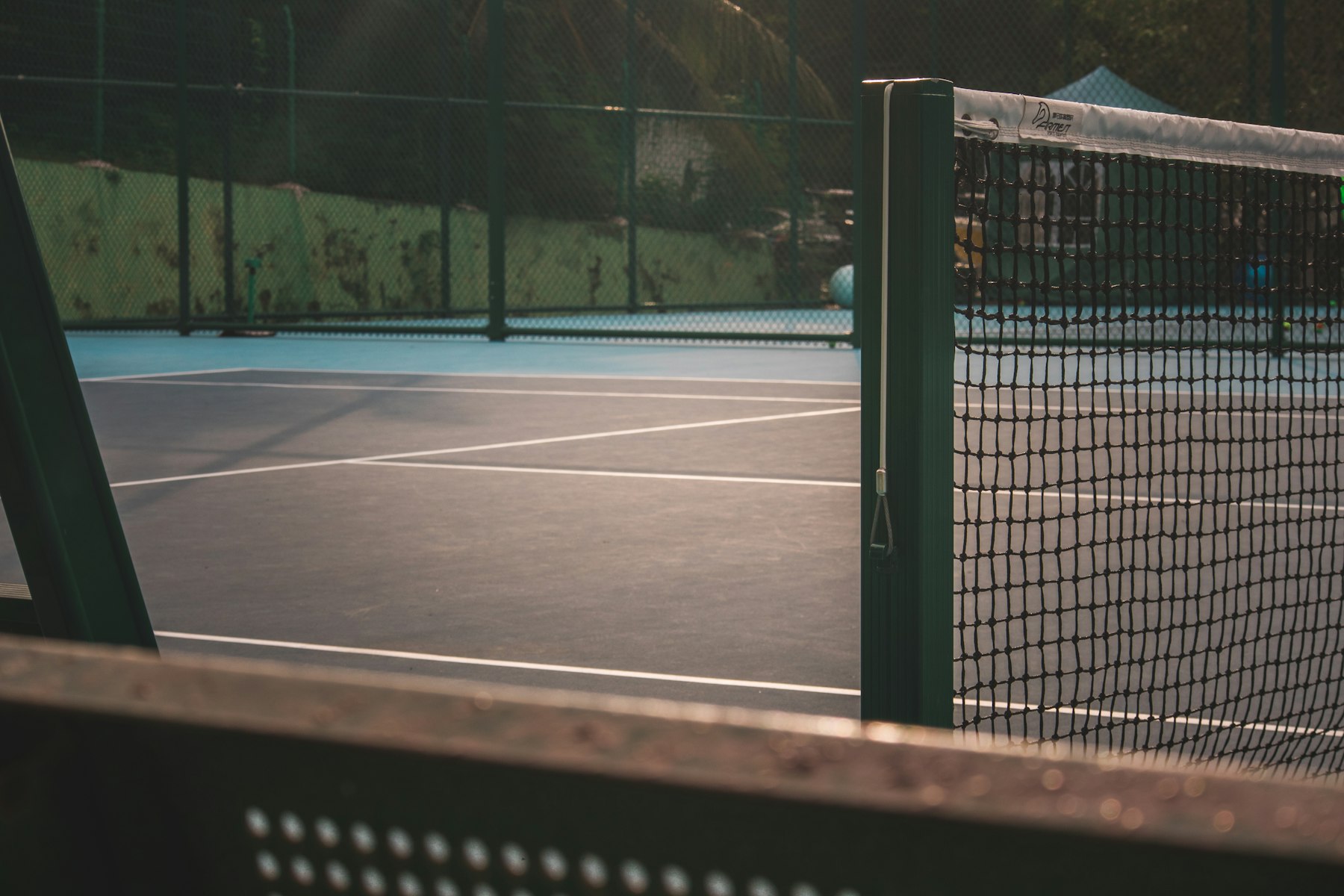
The Cheapest Court You'll Build
A sound slab that's the right size, thick enough, crack-free, and correctable to a 1% slope can be surfaced for a fraction of a new build — because you skip the excavation, drainage, and pour entirely.
- ✓ 30 × 60 ft for pickleball, 60 × 120 ft for tennis
- ✓ About 4 inches thick with no active cracking
- ✓ A single 1% slope, verified with a laser level
How a Contractor Actually Checks Your Slab
Core Sample & Edge Check
A small core at an existing control joint (no new visible cut) or a measurement wherever the slab is already exposed — at a drain, a step, or an edge — confirms real thickness instead of a guess.
Laser Level Slope Reading
A grid of elevation readings across the whole slab shows exactly where water will go once it's coated. Low spots that look invisible on a dry slab show up immediately in the data.
Sounding for Delamination
Tapping or dragging a chain across the surface listens for a hollow sound — a sign the slab has separated from its sub-base internally, even where the surface looks solid.
This is a 30–60 minute site visit, not a demolition project — we can usually tell you the same day whether your slab is a good candidate.
Not Sure If Your Slab Qualifies?
Send us a few photos or book a site visit — we'll tell you honestly whether surfacing works or whether you're better off starting fresh.
Request an Assessment →When Surfacing Wins, and When It Doesn't
Surfacing an existing slab makes sense when the base work someone already did is sound — right thickness, no active movement, and a slope that\'s correctable without major grading. In that scenario you\'re paying for acrylic, striping, and net posts, which is why the cost drops so far below a new build. This is the same logic covered in our DIY vs. professional installation guide: the hard, expensive part is the base, and if it\'s already there and correct, everything on top of it is a much smaller project.
It stops making sense the moment the slab itself is the problem. A driveway with active settlement cracks, a pitch that dumps water into the middle of the court instead of off an edge, or a thickness that won\'t support regular play is not a foundation — it\'s demolition you haven\'t paid for yet. Surfacing over a bad base doesn\'t fix it; it hides it for one season and then costs you twice, once for the coating and again for the rebuild. See our concrete vs. asphalt base guide for what a purpose-built court base actually requires if a rebuild turns out to be the honest answer.
A common middle case in New Jersey: the existing slab is sound but too small. Extending a driveway or patio to full court dimensions means pouring new concrete or asphalt against the old slab, which creates a seam that needs to be engineered — typically with a control joint and reinforcement across the transition — so the two sections move together instead of cracking apart at different rates through freeze-thaw cycles. It\'s a smaller project than a full rebuild, but it\'s not simply surfacing either, and it should be priced and planned as its own scope.
This option comes up constantly in Union County\'s denser towns, where many older Elizabeth, Linden, and Plainfield properties already have a wide driveway or old patio pad on a lot too tight for a fresh excavation. Our Union County cost guide covers how that urban-core-vs-suburban split shapes what\'s realistic to build, town by town.
It comes up even more often in Hudson County, where a fresh excavation isn\'t just costly — it\'s frequently not an option at all. Rear parking pads, old patios, and even rooftop decks already built to load are the realistic starting point for most Hoboken, Jersey City, and Union City properties. Our Hudson County cost guide covers what that means for pricing and which towns still have room for a ground-up build.
A different existing feature we get asked about constantly is an old inground pool. It looks like the same opportunity as a sound driveway — an existing footprint you could build on top of — but it isn\'t, unless the pool comes out completely. See our guide to removing a pool for court installation for why a partially filled pool shell needs full demolition and engineered backfill before it can carry a court base, and what that combined project typically costs.
Related Guides
Pickleball Court Installation Cost in NJ
Full pricing breakdown, including the cost to surface an existing slab.
Concrete vs. Asphalt Court Base
What a purpose-built base requires if your existing slab doesn't qualify.
DIY vs. Professional Court Installation
Why surfacing an existing slab is one of the few genuinely DIY-friendly parts of a build.
Court Dimensions & Space Requirements
The exact footprint your slab needs to meet or be extended to.
Rooftop & Deck Court Installation in NJ
If the "existing slab" you're considering is a rooftop or elevated deck instead of a driveway.
Driveway & Existing Slab Conversion FAQs
How do you tell if a driveway slab is thick enough for a court?+
We check it two ways: a small core sample at an inconspicuous spot (usually at an existing control joint, so no visible cut is added), and edge measurement wherever the slab is exposed, like at a drain or a step-down. A residential driveway is typically poured around 4 inches thick with wire mesh — workable for a lightly cushioned acrylic surface if it's crack-free, but thinner than the reinforced slab we'd pour for a dedicated court base from scratch.
Does an existing driveway have the right slope for a court?+
Usually not without adjustment. Driveways are commonly crowned or pitched toward a street, garage, or drain to move rainwater and melting snow off pavement — a different drainage goal than a court needs. A court wants a single, even slope across the whole playing surface, typically around 1%, so water sheets off in one direction without pooling anywhere on the surface. We check this with a laser level, not by eye — a slab can look flat and still be off by enough to leave standing water after a storm.
What size driveway or patio is big enough for a court?+
A pickleball court needs about 30 × 60 ft including run-off space around a 20 × 44 ft playing area; a tennis court needs closer to 60 × 120 ft. Most residential driveways fall well short of this on their own, so a driveway conversion usually means extending the existing slab rather than using it as the entire footprint — which brings a seam between old and new concrete into the plan, something we account for in the base design.
Will cracks in my driveway show through after I surface it?+
A hairline crack that isn't actively moving can usually be routed, filled, and bridged with fabric-reinforced coating before the color coats go on, and it will hold. A crack that's still widening seasonally — from settling or freeze-thaw working underneath — will telegraph back through any topcoat within a season or two, sometimes faster. This is the single biggest reason a slab assessment happens before we quote surfacing instead of after.
Is it cheaper to surface an existing slab than to build a new court base?+
Yes, substantially — surfacing a sound existing slab costs a fraction of a full new build with base, surfacing, and basic fencing. The savings come entirely from skipping excavation, drainage engineering, and a new concrete or asphalt pour, which is the most expensive part of any court project.
Find Out What Your Slab Can Become
Tell us about your driveway, patio, or old court slab and we'll set up a site visit to check thickness, slope, and cracking before you commit to a plan.
Request a Quote →