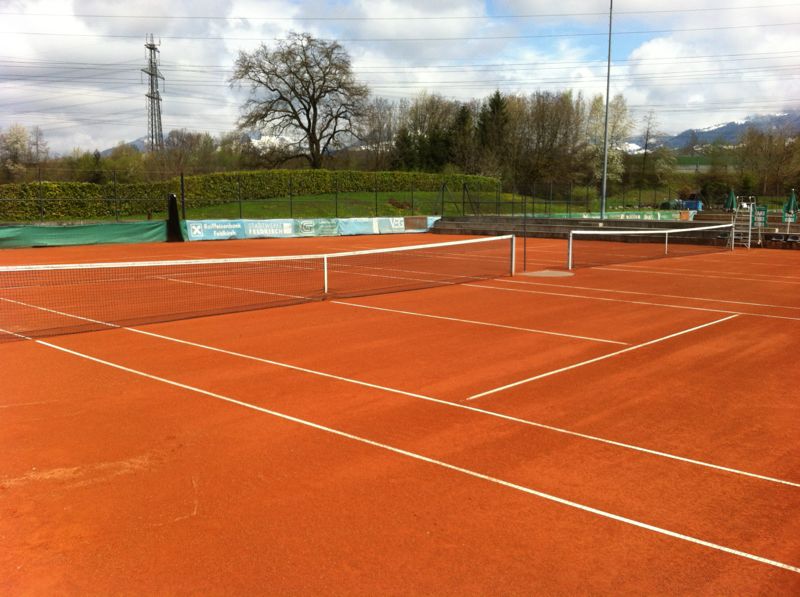
Clay Court Spring Reconditioning in New Jersey
Rolling out of freeze-thaw, scraping dead material, patching, two tons of top dressing and new line tapes: the order that gets a Har-Tru court ready for the season.
Book a Spring Court Visit →By NJ Court Pros · Updated October 27, 2026
Spring reconditioning on a Har-Tru clay court follows a fixed order: firm the court by rolling once it holds footprints-free, clear debris and scrape off the loose “dead” material, patch low spots found with a string line, top dress at roughly two tons per court in passes of no more than one ton (brushing, watering and rolling each time), then lay line tapes only after a tape nail can't be pushed more than an inch into the surface by hand. If water keeps pooling in the same places year after year, the problem is the base or drainage, not the top dressing.
New Jersey clay courts close for the winter, and the freeze-thaw cycle does real work on them. Moisture in the surface freezes and lifts it, wind strips fine material, and leaves and seed pods pile into the corners. By spring the court is soft, uneven and has lost a share of its surface. Reconditioning puts that material back and restores the slope the court was built with.
This guide covers green Har-Tru (crushed metabasalt) courts, the most common clay surface in the Northeast, and follows the steps Har-Tru publishes in its maintenance manual and spring guidance. If you are still choosing a clay system, start with our clay court systems comparison. If you want the cost side of building one, see clay tennis court installation in NJ.
The Reconditioning Sequence, Step by Step
The order matters more than any single step. Top dressing a soft court, or laying tapes before it's firm, wastes material and shortens the season.
- 1
Wait until the court will hold you
Har-Tru says to start once you can walk on the surface without leaving footprints. Working a soft court pushes the clay around and creates the low spots you are about to fix.
- 2
Clear debris
Remove leaves, branches and weeds that collected over the winter. Har-Tru’s maintenance manual calls for a lute or scarifier and a plastic grain shovel so the surface isn’t gouged.
- 3
Brush and roll until smooth and firm
Roll slowly back and forth with as little twisting and turning as possible, adding weight to the roller gradually. Courts coming out of freeze-thaw usually need repeated rolling before anything else happens.
- 4
Scrape off the “dead” material
The larger, lighter-colored particles sitting loose on top have fallen out of the Har-Tru mix and can’t be rolled back in. Lute them into piles and remove them. Har-Tru says a few wheelbarrows per court is typical, and skipping this step can keep new top dressing from bonding.
- 5
Re-level and patch low areas
Brush repeatedly to redistribute what’s left, then find low spots by stretching a mason’s string line across the court. Scribe the area, clean out loose material, lightly scarify, add new surfacing, screed it with a straight edge, brush, water and roll. Baselines and service areas take the most wear.
- 6
Fill the old line locations
Hand-lute new material along the alleys, center, base and service lines to fill old nail holes and level the surface before top dressing. High ridges where tapes sat get scraped down.
- 7
Top dress in one-ton passes
Har-Tru’s annual reconditioning rate is about two tons per court, sometimes more or less depending on condition. The manual says to apply no more than one ton per pass with a spreader, brush immediately, water in gently, and roll after each pass.
- 8
Brush and roll to playable
Alternate slow two-direction brushing (wide turns at the ends) with straight back-and-forth rolling until the surface is smooth and firm enough to play.
- 9
Pass the nail test, then lay lines
If you can push a line-tape nail more than one inch into the clay by hand, keep rolling. Once it passes, lay the tapes, leave nail heads about 1/8 inch proud, and roll them down slowly in a straight line along each tape without turning on it.
- 10
Finish the court
Uncap post sleeves and clear debris from them, reinstall net posts and net, hang windscreens, and check the center-strap anchor.
Why New Jersey Courts Need Extra Rolling
Har-Tru's maintenance guidance singles out freeze-thaw climates: rolling is “particularly important” for courts coming out of winter there, and should happen daily until the court reaches proper compaction. Rolling is most effective in the morning, when the court still holds moisture.
That means the calendar for a New Jersey opening is usually set by the weather, not the schedule. A wet March can keep a court too soft to work for weeks, and pushing ahead anyway leaves roller marks and footprints that become next month's low spots. If you want the court ready on a specific date, roll it yourself as soon as it holds you; Har-Tru suggests owners roll the court as firm as possible before a contractor arrives.
Covers change the timing too. Har-Tru says covered courts can often open two to three weeks earlier because they take on less moisture, heave less and lose less material to wind. Our tennis court covers guide explains what a winter cover involves.
Want the Court Opened for You?
We recondition clay courts across New Jersey: dead-material removal, string-line patching, top dressing, line tapes and net set-up. Tell us the court type and its condition and we'll send a written quote.
Request a Spring Quote →Sprinkler Courts vs. Subsurface Courts in Spring
The surface work above is the same either way. What differs is the irrigation start-up.
Above-ground sprinkler courts
The pressurized lines were blown out and heads stored at close-down. In spring the heads go back on, the system is pressurized and every zone is checked for coverage before the court is top dressed. A dry corner or a stuck head shows up quickly as a hard, slick patch. Daily care stays the same: brush, water and roll.
HydroCourt and other subsurface courts
At close-down, Har-Tru has owners pull float valves and drain plugs and record each control box's water level. Spring start-up reverses that, returning each box to its recorded level. Har-Tru lists reconditioning for HydroCourt and HyQ at about one ton of HydroBlend per court, and says rolling is the main spring task after freeze-thaw.
Close-down done right makes spring much easier. Our winter closing checklist and spring opening checklist cover the parts that apply to every court type, including fences, nets and windscreens.
DIY or Contractor?
Plenty of backyard owners handle daily brushing, watering and rolling themselves. The annual reconditioning is a bigger job. It takes a heavy roller, a spreader, a lute or scarifier, a drag brush, string lines and a straight edge, plus tons of material moved by wheelbarrow, and the line layout has to be measured accurately so corners come out square.
A reasonable split for many homeowners: roll the court firm yourself in early spring, then bring in a contractor for dead-material removal, patching, top dressing and tapes. That way the crew isn't waiting on a soft court, and you get a properly leveled surface for the season.
What to ask for in a reconditioning quote
- How much new material is planned, in tons, and whether that's capped or adjusted on site.
- Whether dead-material removal and string-line patching are included, or top dressing only.
- New line tapes or reuse of existing ones, and who supplies them.
- Irrigation start-up: who checks sprinkler coverage or resets subsurface water levels.
- Net posts, net, center strap and windscreen installation.
- What happens if the court is still too soft on the scheduled day.
Signs the Court Needs More Than Reconditioning
Reconditioning replaces worn surface material and keeps the established slope. It can't fix problems underneath. Call for an on-site assessment if you see:
- The same low spots every spring, even after careful patching, which points to base settlement rather than surface wear.
- Standing water long after rain or soft areas that never firm up, which suggests a drainage or slope problem. Our court drainage guide explains the options.
- Base stone showing through the surface in high-wear areas.
- Uneven moisture on an irrigated court after start-up, from failed sprinkler zones or a subsurface system that isn't holding level.
- Heaving along edges or around posts that returns each winter.
Those jobs need the base, slope and irrigation looked at directly, and sometimes a partial rebuild. We'll tell you which category your court is in after a site visit.
Clay Court Reconditioning FAQs
When should a clay court be opened in New Jersey?+
There’s no fixed date. Har-Tru’s guidance is to start once the surface is firm enough to walk on without leaving footprints, then roll repeatedly because courts coming out of freeze-thaw need compaction before reconditioning. In New Jersey that depends on the winter, the court’s drainage and whether it was covered. Har-Tru says covered courts can often open two to three weeks earlier because they take on less moisture and heave less.
How much Har-Tru does a court need each spring?+
Har-Tru lists annual top dressing at about two tons per court, noting that some courts need more and some less. Its maintenance manual says to apply no more than one ton per pass, brushing, watering and rolling between passes. Subsurface-irrigated HydroCourt courts use a different reconditioning rate; Har-Tru lists about one ton of HydroBlend per court for those.
Can I reuse last year’s line tapes?+
Har-Tru says reusing tapes is acceptable if the texture hasn’t worn off. Curled edges, high spots and smooth, slick tapes are reasons to replace them. Either way, the surface has to pass the nail test first: if a nail goes in more than an inch by hand, the court isn’t firm enough for tapes.
What is “dead material” on a clay court?+
It’s the larger particles of the Har-Tru mix that have separated out through weather, wind, water and play. They look lighter in color, sit loose on top, and can’t be rolled back into the surface. Har-Tru says they must be removed before patching and top dressing, or the new material may not bind to the court.
Should I recondition in the fall instead?+
Some facilities top dress before winter and open about three weeks earlier in spring, but Har-Tru warns against fall top dressing on windy sites with little snow cover, where the new material can blow away. Most New Jersey backyard courts are reconditioned in spring.
When does a clay court need more than reconditioning?+
Reconditioning replaces worn surface material and restores the established slope. If the same areas hold water after every patching, the base shows through, the court drains poorly after rain, or irrigation isn’t delivering water evenly, the problem is below the surface. That calls for an on-site assessment of the base, slope, drainage and irrigation rather than another round of top dressing.
Sources
- Har-Tru — Clay Court Maintenance (daily, periodic and annual reconditioning; two tons per court; freeze-thaw rolling; tape reuse)
- Har-Tru — Full Spring Ahead (footprint test, dead material, string-line patching, one-ton increments, nail test)
- Har-Tru — Spring Maintenance Tips for Clay Courts
- Har-Tru — Closing Your Clay Courts for the Winter (covers, fall top dressing, subsurface close-down)
- Har-Tru — HydroCourt & HyQ maintenance (one ton HydroBlend per court)
- Har-Tru Maintenance Manual, Sections 3.0 Surface Reconditioning and 4.0 Final Tennis Court Preparations (one ton per application, nail heads 1/8 inch above tape, straight-line rolling)
- Hero photo: “Die Anlage des TC Altenstadt, Sommer” by Xfkbg, CC BY-SA 3.0, via Wikimedia Commons.
Get Your Clay Court Ready for the Season
Tell us your court type, irrigation, and what you saw this spring. We'll schedule a visit and send an itemized reconditioning quote, or tell you if the base or drainage needs attention first.
Request a Quote →