Tennis Court Covers in New Jersey
Tennis court covers in New Jersey — seasonal winter tarps for clay and acrylic pads. FieldSaver-class fabric in ounces (6/8 oz poly, 18 oz vinyl). Supply + install + spring take-down quote.
Get a Cover Install Quote →Tennis court covers in New Jersey are seasonal off-season surface tarps: fabric laid over a closed clay or acrylic court in late fall and taken up in spring. NJ Court Pros supplies the cover and installs it — the same class of court work as construction, resurfacing, fencing, and windscreens. This page is the canonical quote path for that job.
- What it is: a winter tarp on the playing surface — not a fence windscreen, not a bubble or retractable roof, and not an acrylic recoat.
- Fabric (oz only): CoverSports FieldSaver-class panels publish weight in ounces per square yard — 6 oz or 8 oz polyethylene (90% UV, two-year prorated fabric warranty) or 18 oz vinyl (96% UV, three-year prorated fabric warranty). We do not invent mil ratings, snow-load numbers, or catalog prices.
- Install vs take-down: late-fall install (pad swept, posts pulled or cut-outs aligned, edges staked or sandbagged); spring take-down (anchors off, fabric folded dry, stored out of the sun). Clubs usually want both on one proposal; backyard owners sometimes want install only.
- How to quote: use the contact form and put “tennis court cover” in the message so it is not triaged as a resurface-only call.
Cost is a site-visit quote for fabric plus labor. We will not invent a price list or a statewide permit rule.
Not Resurfacing — Cover ≠ Recoat
If you searched tennis court covers in New Jersey and landed here, you want a seasonal tarp — not a color-coat job. A cover keeps weather and debris off a closed court. It does not fill cracks, restore texture, rebuild a plane, or replace a worn acrylic system. Resurfacing is clean → patch → resurfacer → color → stripe. Those are different quotes.
Need a recoat instead (or first)? Use the tennis court resurfacing in New Jersey guide. Need both? Put cover-after-resurface on the quote form in one message.
What We Install — and What We Do Not Call a Cover
When someone in New Jersey searches for tennis court covers, they almost always mean a winter tarp: polyethylene or vinyl fabric sized for a tennis pad, held with stakes or sandbags, put down after the last outdoor match and pulled before the first spring booking. That is the product we sell and install. CoverSports' FieldSaver line is the manufacturer page we use as the honest spec sheet — not because we only hang one brand, but because it publishes fabric, size, and hardware instead of a marketing ROI story.
Their standard panel is 54 × 60 feet, half of a standard court, with a 60 × 60 option and custom sizes. Fabrics on that page are 6 oz or 8 oz polyethylene (90% UV resistance, two-year prorated fabric warranty) or 18 oz vinyl (96% UV resistance, three-year prorated fabric warranty). Optional features are pole cut-outs when posts stay up, pull handles at 10–12 foot intervals, and grommets for fastening to a soft court. Anchoring is ground stakes or sandbags. That is the product class a backyard in Bergen or a club in Monmouth is usually pricing: two half-court panels or a custom full-court cover, installed in late fall.
Three things get confused with that product. A fence windscreen cuts wind and adds privacy; it hangs on the chain-link and does not protect the playing surface. We already sell windscreens as a fencing add-on. USTA Tennis Venue Services files windscreens under low-complexity amenities, next to backboards and blended 36- and 60-foot youth lines — not under indoor structures. A bubble, fabric-frame building, or rigid enclosure is the other mix-up. USTA puts those in its high-complexity indoor structures category. They create a playing season. A tarp does not. Our tennis construction page lists lighting, fencing, and windscreens. It does not list retractable roofs. If what you actually want is an enclosure, say so on the quote form — we will source that lead instead of selling you the wrong fabric.
| Product | What it does | What NJ Court Pros does |
|---|---|---|
| Seasonal court cover (tarp) | Protects a closed clay or hard court from weather, wind-blown material, and winter debris | We supply and install it. This page is the quote path. |
| Fence windscreen | Cuts wind and adds privacy on the chain-link | Sold as a fencing add-on. Take it down before ice season. |
| Bubble / fabric-frame / rigid enclosure | Creates an indoor playing season | Different product. Tell us if that is the job — we will source it. We do not treat it as a “cover.” |
Cover specs are from CoverSports' published FieldSaver page (fetched 2026-08-28). Windscreen winter-removal guidance is on our net-post and windscreen guide. Enclosure types follow USTA Tennis Venue Services' indoor-structure category. Benches, storage, and other finishing pieces sit on the court accessories guide — they are not covers either.
FieldSaver Fabric Specs — Ounces, Not Invented Mil Ratings
Search results for tennis court covers in New Jersey often invent a “15-mil northern climate” fabric or an “8–10 mil bargain tarp.” CoverSports FieldSaver — the manufacturer page we use as the honest spec sheet — does not sell tennis court covers that way. It publishes ounces per square yard, tensile and tear values, UV resistance, coating, and a prorated fabric warranty. Those are the numbers we will repeat. Mil thickness that does not appear on that tennis-cover page is omitted.
Standard FieldSaver tennis panels are 54 × 60 feet (half of a standard court) or 60 × 60 feet, with optional pole cut-outs, pull handles at 10–12 foot intervals, and grommets at 3-foot spacing for fastening to a soft court. Two 54 × 60 panels cover a recommended 60 × 120 pad with an overlap at the net line. Custom cuts exist when the pad is not that rectangle. Polyethylene is listed in silver/white; the vinyl line is listed with a color choice. Anchoring is ground stakes or sandbags — not a published snow-load rating, and not a price.
| Fabric (FieldSaver) | Weight | Tensile / tear (published) | UV / warranty |
|---|---|---|---|
| 6 oz polyethylene | 6.0 oz/sq yd | 195 × 160 lb tensile; 71 × 70 tear | 90% UV; 2-year prorated fabric warranty |
| 8 oz polyethylene | 7.8 oz/sq yd | 195 × 195 lb tensile; 70 × 70 tear | 90% UV; 2-year prorated fabric warranty |
| 18 oz vinyl | 18.0 oz/sq yd | 592 × 485 lb tensile; 566.2 × 662.9 lb tear | 96% UV; 3-year prorated fabric warranty |
Figures are from CoverSports' FieldSaver tennis court cover page (fetched 2026-08-28). The product table labels both strength rows “tensil”; the matching FieldSaver poly and vinyl spec sheets list the second row as tongue tear. EnduroCoat is the published coating on all three fabrics. Warranty language on that page is prorated against fabric and manufacturing defects — not an installed New Jersey guarantee and not a snow-load rating. We will not turn those ounces into a “best fabric for Bergen” ranking.
Which fabric we quote is a site visit: tree cover, wind exposure, whether the court is clay or acrylic, how the cover will be stored, and whether you want one custom full-court cut or two half-court panels. Vinyl is the heavier, higher-tensile option on the same page; polyethylene is the lighter panel. Neither is a substitute for a worn acrylic color coat. If the slab already needs a recoat, start on the resurfacing guide and add the cover as a second line after the new system is down.
Why New Jersey Courts Get Covered
New Jersey is a freeze-thaw state. The Office of the New Jersey State Climatologist at Rutgers publishes the official 1991–2020 normals: the statewide annual average temperature is 53.56°F, about 0.7°F warmer than the prior 1981–2010 normal, with statewide precipitation at 47.56 inches. Winter still regularly crosses 32°F. You do not need an invented “cycle count” to see the construction problem: water that sits in a crack, in a clay profile, or under a poorly drained slab will freeze.
ASBA-aligned construction guidelines (Section 2.P, as published by Nova Sports) say improper perimeter drainage lets the subsoil take on water, which makes freeze-thaw heave worse and creates birdbaths. The finished hard-court surface should slope on a true plane — preferably side to side — at not less than 0.83% (1:120) and not more than 1%. A cover does not fix a slab that already holds water. It keeps weather and debris off a closed surface that is already draining, or it keeps Har-Tru from taking on moisture and blowing off in a windy winter. If the original pad was built off those slope numbers, the honest next page is tennis court resurfacing and repair in New Jersey, not a heavier tarp.
Trees are a New Jersey-specific wear factor that national cover ads skip. A backyard court in Essex or Bergen under maples will stain and grow mildew in the shade even if the acrylic is young. SportMaster tells owners to keep vegetation off the edge, keep leaves off all winter, and treat mold with a diluted bleach wash. A cover is one way to keep that litter off a court you are not playing. It is not the only tool, and it is not a substitute for a spring wash on a court that stayed open.
A New Jersey Cover Calendar — Climate, Not a Made-Up Date
People searching for a winter tennis court cover in New Jersey want a week: when do we put it on, when do we take it off. The honest answer is that the clock is freeze-thaw and last outdoor play, not a statewide ordinance. ONJSC / Rutgers 1991–2020 normals put the statewide annual average at 53.56°F and precipitation at 47.56 inches. Winter still regularly crosses 32°F. NOAA station freeze dates shift from the Highlands to the coast. We will not invent “cover by November 15” or “open on April 1” as a rule.
Late summer / early fall — still in play
SportMaster wants leaves and pine needles off the acrylic all season, drains clear, and vegetation off the edge. If the hard court is also due for a 5–8 year recoat, the manufacturer 50°F surface-and-air floor means that work belongs in a spring or fall window — before you cover a brand-new color coat, not after you bury a worn one. Cover after a needed resurface, not instead of one.
After the last outdoor match — close, then cover
Har-Tru’s shutdown list is the clay sequence: nets and posts stored, sleeves capped, pressurized irrigation blown out before the first freeze, sprinkler heads stored, HydroCourt valves pulled. The cover goes on a closed, swept, dry court. Clubs usually pick the week after programmed play ends. Backyard owners pick the week they are done hitting. Both are real install dates; neither is a published FieldSaver calendar.
Winter — leave it, do not treat it like a roof
FieldSaver does not publish a pounds-per-square-foot snow rating. A seasonal tarp sits on the playing surface. Do not walk a loaded cover. Do not scrape ice off acrylic through the fabric with a hard tool — SportMaster already tells owners that hard scrapers and salt damage the coating, cover or no cover. If the court stays open instead of covered, SportMaster still wants winter debris off the color coat.
Spring take-down — dry fold, then inspect
Har-Tru’s published benefit is a 2–3 week earlier clay opening and less heave, moisture, and erosion — not a dollar savings. Take the fabric up when it is dry, fold it, and store it out of the sun. A wet cover stuffed in a shed is how you get mildew in the fold. On acrylic, SportMaster wants an annual spring inspection for cracks, birdbaths, drainage, texture, fading, and mold. That inspection is a resurfacing question if the coat is worn; it is not a reason to leave the tarp on until June.
Thanksgiving-to-April is a habit some backyard owners use. It is not a CoverSports, Har-Tru, or ONJSC rule. Tell us the town, the surface, and when you actually stop playing. We will quote the install week from that, and the spring take-down if you want it in the same proposal. Between recoats, the wash-and-drain work is on the maintenance schedule.
The Same Fabric, Two Different Jobs
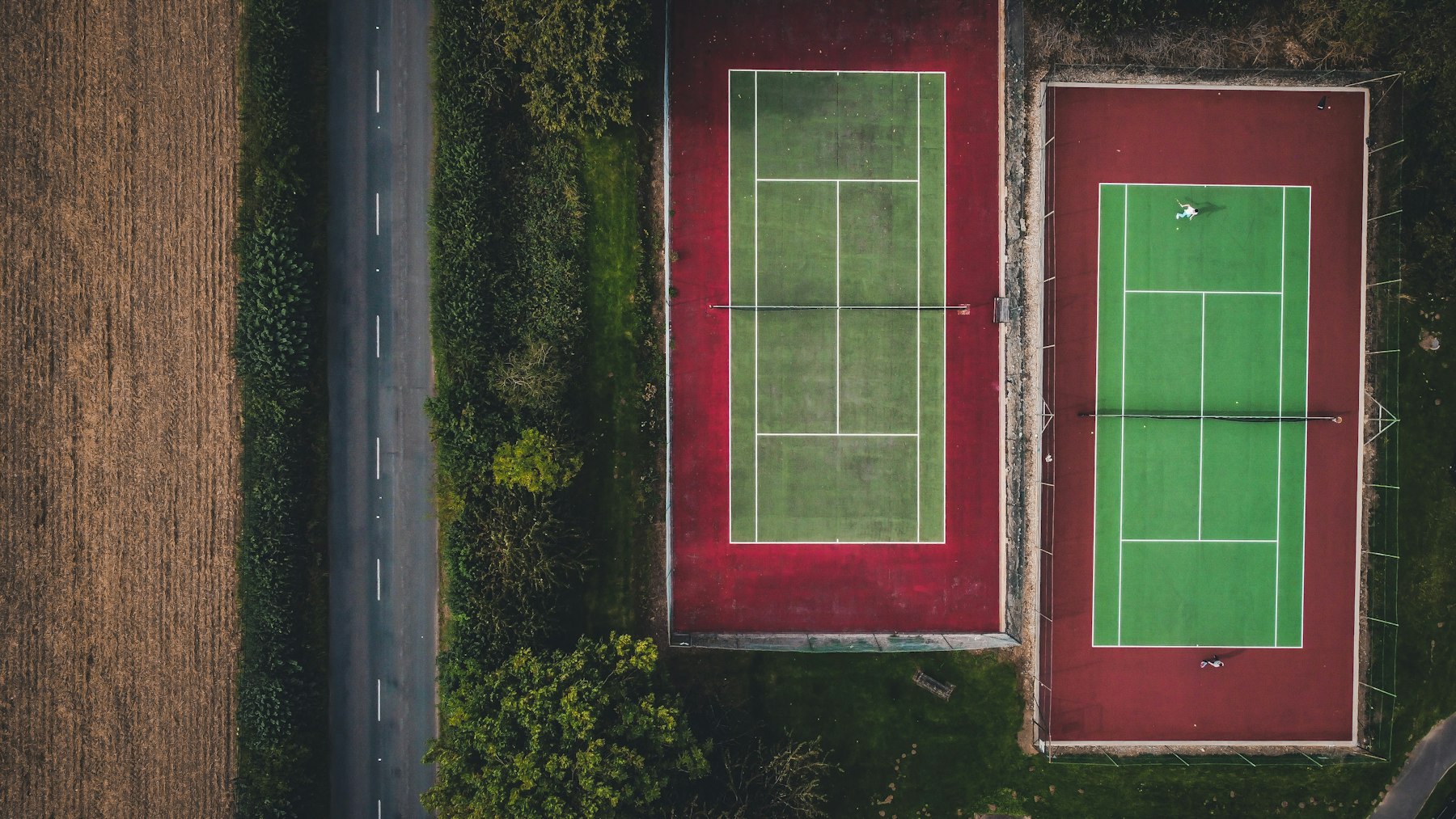
On Har-Tru, a winter cover is part of a proper close. On acrylic, it is optional protection for a closed court — and it never replaces a worn color coat.
- ✓ Clay: less moisture, less heave, earlier spring open
- ✓ Acrylic: keeps winter debris and melt grit off the color coat
- ✓ Cover after a needed resurface, not instead of one
Clay vs. Acrylic — When a Cover Helps
Clay / Har-Tru
This is where a cover earns its keep in New Jersey. Har-Tru's winter-closing guidance is specific: covered courts take on less moisture, heave less during freeze-thaw, erode less, and — in their experience — can be opened two to three weeks earlier in the spring. Covers also keep Har-Tru from blowing off the court in a windy winter. The same shutdown list matters as much as the fabric: nets and posts stored, sleeves capped so water does not sit in them, pressurized irrigation blown out before the first freeze, sprinkler heads stored indoors, HydroCourt float valves pulled and drain plugs opened. A cover over a court whose irrigation was left wet is still a frozen-pipe problem.
Acrylic hard court
SportMaster's maintenance manual is the better primary source than a marketing payback claim. Leaves and pine needles stain and feed mold; they want that debris off the court all winter. Standing water leaves grit that acts like sandpaper underfoot. Snow and ice, if you must remove them, should not be attacked with hard scrapers or salt — salt adds abrasion and can shorten the coating. A winter cover is one way to keep that debris and melt chemistry off a closed backyard court. It is not a published manufacturer promise that a tarp adds a fixed number of years to the 5–8 year recoat cycle. Anyone quoting “two to four extra years” is inventing a number we will not repeat.
New Jersey clay is almost always Har-Tru (crushed metabasalt), not European red brick. You do not squeegee acrylic onto it. Seasonal close, irrigation blow-out, winter cover, then spring rolling, top-dressing, and line tape — that is the year. Build and upkeep details sit in the clay court installation guide. Between recoats on a hard court, the boring work — wash, keep drains open, seal hairlines — is in the maintenance schedule.
When a Cover Delays Resurfacing — and When It Does Not
A winter cover is not a resurface. The two jobs get sold as synonyms, which is how owners buy a tarp for a court that already needs a recoat — or skip a cover-and-close on clay and spend the spring rebuilding a heaved surface.
On clay, a cover can delay the heavy spring rebuild. Har-Tru's published claim is earlier opening and less heave, less moisture, and less erosion — not a dollar savings and not “you will never top-dress again.” Fall top-dressing, in their same article, is a separate tactic some clubs use to open earlier; they do not recommend it on a windy site with little snow cover, because the Har-Tru blows away. A cover is particularly useful in that windy case. If the irrigation was not blown out, the cover will not save the pipes.
On acrylic, a cover keeps a closed court cleaner. It does not reset the 5–8 year cycle. SportMaster publishes that resurfacing interval plus an annual spring inspection for cracks, birdbaths, drainage, texture, fading, and mold. A tarp can keep maple seeds and nor'easter grit off a color coat that is still true. It cannot restore pigment, silica texture, or a plane. If the color coat is already polished, faded, or mapped with cracks, the cover is protecting a surface you are about to replace. Recoat first, then cover the new system for the first winter if the court will sit unused.
Cover after a resurface, not instead of one — unless the court is still true and you are only trying to keep winter off it until you play again. That decision is a site visit, not a rule of thumb we invented. If the slab needs crack repair or a full recoat, start on the resurfacing guide and tell us you also want the cover quoted in the same trip.
Cover vs. resurfacing — a decision checklist
| What you are seeing | The job | Where to go |
|---|---|---|
| Clay / Har-Tru that will sit through freeze-thaw or a windy winter | Seasonal close, then a cover. Irrigation still gets blown out. | This page — cover install. Clay build notes sit on the clay guide. |
| Acrylic still true, court unused in winter, trees dropping litter | Optional cover to keep debris and melt grit off a closed color coat. | This page. SportMaster still wants a spring inspection. |
| Acrylic faded, polished, slippery, or mapped with cracks | Clean, patch, recoat, stripe. A tarp over a dead coat protects a surface you are about to replace. | Resurfacing guide first; cover after the new system if the court will sit. |
| Birdbaths, slope failure, the same crack returning through a good patch | Leveling, overlay, or rebuild — not a heavier fabric. | Resurfacing vs. new-build / drainage guides, not a cover quote alone. |
| You want wind cut and privacy, not surface protection | Fence windscreen. Take it down before ice season. | Net-post and windscreen guide. A screen is not a court cover. |
| You want to play through winter | That is a bubble / fabric-frame / rigid enclosure — USTA indoor structures — not a tarp. | Say so on the quote form. We will source it. Do not budget a bubble from this page. |
Two jobs can share one mobilization: recoat the acrylic, then cover the new system for the first winter. Put both on the quote form. Do not use this checklist as a DIY diagnosis — the slab in front of us is the answer.
Install, Anchor, Take-Down, and Snow
We measure the pad, confirm whether net posts stay up or come out, and order fabric that actually fits — a pair of 54 × 60 panels, a 60 × 60, or a custom cut with pole openings. CoverSports lists pull handles at 10–12 foot intervals so a crew can walk the fabric on and off without tearing it, and grommets when the court is soft and you are fastening into the Har-Tru rather than only weighting the edge. On a hard court, sandbags are often the cleaner anchor because you are not driving stakes at the acrylic edge. On clay or a court with a soft apron, stakes can be the right hardware. Their matching accessory page publishes 14 × 25 inch polypropylene sandbags with a 13 lb maximum suggested fill (sets of 25) and 9-inch stakes in safety yellow or brushed metal. Those are manufacturer hardware specs, not a price.
Install is a late-fall visit: court swept, standing water off, posts pulled or cut-outs aligned, fabric walked out, edges anchored so a November wind does not sail it into the fence. Take-down is a spring visit: anchors off, fabric folded dry, stored out of the sun. A wet cover stuffed in a shed is how you get mildew in the fold and a ruined panel by October. If you want us to store the conversation (where it lives, how it is folded, whether you keep it on-site), that belongs in the quote. Clubs usually want install and take-down on a calendar. Backyard owners sometimes want install only and will pull it themselves in April — say which you want.
Snow load is the claim we will not invent. A seasonal tarp sits on the playing surface. It is not an engineered roof, and the FieldSaver spec sheet does not publish a pounds-per-square-foot snow rating. What it does publish is fabric weight, tensile strength, UV resistance, and stake-or-sandbag anchoring. Do not treat a loaded cover as a walkable structure. Do not scrape ice off acrylic through the fabric with a hard tool — SportMaster already tells owners that hard scrapers and salt damage the coating, cover or no cover. If a heavy wet snow sits on the fabric, the conversation on the site visit is how you want to handle it (leave it, brush it, wait for melt), not a 20 psf number we made up to look technical.
The previous version of this page published mesh-tarp, fixed-structure, and retractable-system dollar bands, a “4–8 extra weeks” season claim, a 20 psf snow-load rating, and a statewide permit story. None of those figures were tied to a manufacturer, a public bid, or a job we could show. They are gone. CoverSports publishes fabric and warranty. Har-Tru publishes a 2–3 week earlier clay opening. SportMaster publishes 5–8 years between acrylic recoats. Those are the numbers that survive a fetch.
Get a Tennis Court Cover Quote
Tell us the town, whether the court is clay or acrylic, and the pad size if you know it. We will quote supply plus install after we see the court.
Request a Cover Quote →Backyard Court vs. Club or Municipal Battery
A backyard court is usually one recommended 60 × 120 pad, used hard on weekends and empty in January. The typical conversation is: do we recoat this year, patch two cracks, add blended pickleball lines, and/or put a cover on after Thanksgiving? Access (can a crew reach the yard?), tree cover, and whether the original builder sloped the slab correctly drive the quote more than the sport. One cover, one install, optional spring take-down, optional windscreen removal so ice does not rack the fence.
A swim-and-tennis club or a parks-and-rec battery is a different mobilization: several courts, programmed play, and a close date that cannot slip a month. Har-Tru's close list — nets labeled by court, posts pulled and painted in the off-season, irrigation blown out, HydroCourt valves stored — is written for that kind of facility. USTA Tennis Venue Services will fund eligible school and public-park resurfacing up to a published per-court cap in its mid-complexity category. That is a grant cap for acrylic work, not a cover price, and it will not fund the same site twice in twelve months. Windscreens sit in a separate, lower-complexity amenity category. Indoor structures are higher-complexity again. A club cover quote is still a contractor bid for fabric and labor.
We install tennis court covers as part of tennis court work — backyard, club, school, and municipal — in New Jersey, with the counties we actually name on the tennis page (Bergen, Essex, Monmouth, Morris, and Hudson) as the core of that work. We do not publish a town-by-town service dump from this guide. If your court is in New Jersey, start with the quote form; we will tell you if the site is in range.
How to Request a Cover Quote
Use the contact form. Put “tennis court cover” in the message so it does not get triaged as a resurface-only call. The useful details:
Town and access
Where the court sits, and whether a crew can roll fabric to the pad without a crane story. Narrow side yards and locked club gates change the visit, not the product.
Surface and size
Clay / Har-Tru or acrylic, and the pad if you know it (playing lines are 78 × 36; the recommended pad is 60 × 120). Photos of the fence, posts, and any birdbaths help.
What stays up
Do net posts come out, or do we need pole cut-outs? Is the windscreen coming down for winter in the same trip? Those are install details, not upsells.
Install only, or install and take-down
Say whether you want us back in spring. Clubs usually do. Some backyard owners store the cover themselves. Either is a real quote line.
If the court also needs a recoat, say that. We would rather quote cover-after-resurface in one visit than sell you a tarp for a color coat we are about to replace. Construction, conversion, and lighting live on the tennis services page.
Permits — Town by Town, Not a Statewide Rule
New Jersey does not publish a statewide “tennis court cover permit.” We looked, and we will not invent one. Construction and zoning are municipal. A seasonal tarp on an existing pad is temporary fabric, not a new building and not new impervious surface. That is why most towns treat it differently from a new court, lighting, or a permanent enclosure — but “most towns” is not a permit. Confirm with your local building department. We will help you make that call before we schedule install.
What does change the review is a different product: a bubble, a fabric-frame building, or a rigid enclosure. USTA files those as indoor structures. They have foundations, blowers or frames, and electrical work. Do not use this page to budget that job. If that is what you want, put it on the quote form and we will source it as an adjacent lead instead of stretching a tarp into a building.
What Drives a Tennis Court Cover Quote in New Jersey
Searchers who type tennis court covers in New Jersey almost always want a number. We will not invent one. CoverSports publishes fabric weight, UV resistance, and warranty length — not an installed New Jersey price. Your quote moves with the pad in front of us. These are the levers we price on the site visit:
Pad size and panel count
A standard tennis pad is often covered with two 54 × 60 ft half-court panels or a custom full-court size. A smaller dedicated pickleball pad uses less fabric. Wrong panel count is the fastest way to waste a quote phone call.
Fabric grade
6 oz vs 8 oz polyethylene vs 18 oz vinyl — UV ratings and prorated fabric warranties differ on the FieldSaver spec sheet. Which grade belongs on your pad is a site decision, not a blog rule.
Anchoring and hardware
Ground stakes vs sandbags, grommets, pole cut-outs when posts stay up, pull handles. CoverSports publishes matching stake and sandbag accessories; we will not invent snow-load ratings that are not on the sheet.
Access and extras
Can a crew reach the yard? Are we also taking windscreens down for winter? Is spring take-down on the same proposal? Club batteries with multiple courts mobilize differently than one backyard pad in Bergen or Essex.
Ready for numbers tied to your court? Use the contact form and write tennis court cover in the message. That keeps the lead from being triaged as a resurface-only call.
Pickleball Pads and Combo Courts
New Jersey backyard projects increasingly mix tennis and pickleball on one slab, or build a dedicated pickleball pad beside a pool. A seasonal cover still means fabric on a closed surface — the sport painted on the acrylic does not change the product class. What changes is sizing: a dedicated pickleball court is a fraction of a tennis footprint, so ordering two tennis half-court panels by habit is how owners overbuy.
If your search was really about building or resurfacing rather than covering, start on the pickleball court installation cost or pickleball resurfacing guides. If the coat is sound and you want winter protection, stay on this page and say pickleball on the quote form.
How to Prep for the Cover Install Visit
A clean, dry pad installs faster and protects the fabric. Before we arrive in late fall:
- Sweep leaves, grit, and standing debris — SportMaster’s maintenance guidance is clear that winter debris left on acrylic is an owner problem, cover or not.
- On clay / Har-Tru, finish the close steps your club already uses (irrigation blow-out, nets labeled, posts pulled or ready for cut-outs) before the tarp goes down. Har-Tru’s winter-close article is the checklist we point clubs to.
- Decide whether fence windscreens come down in the same visit. Ice-loaded screen racks fences; do not leave that as a spring surprise.
- Mark gates and access paths. Backyard installs fail on logistics more often than on fabric choice.
- If the acrylic is already polished, cracked, or birdbathed, talk resurfacing before you buy a cover that will only protect a failing coat. Cover after recoat, not instead of it.
Related Guides
Tennis Court Resurfacing & Repair in NJ
When the color coat is the job — and when to cover after the recoat, not instead of it.
Tennis Court Construction in New Jersey
New builds, resurfacing, conversion, lighting, fencing, windscreens, and covers.
Net Posts & Windscreens
Fence screen is not a court cover. Take it down before ice season.
Clay / Har-Tru Installation
Why New Jersey clay is a winter-close-and-cover surface, not an acrylic recoat.
Court Maintenance Schedule
Wash, drains, and spring inspection between recoats — cover is one winter tool, not the whole year.
Court Accessories
Benches, storage, and finishing pieces — not surface protection.
Sources
Fetched 2026-08-21; FieldSaver fabric table re-checked 2026-08-28; quote-factor and pickleball-pad sections expanded 2026-10-13. We cite manufacturer and official language only. Dollar amounts, mil ratings, and permit rules that do not appear in a source are omitted.
- CoverSports — FieldSaver tennis court covers (fabric types, 54 × 60 ft half-court size, stakes/sandbags, UV and warranty)
- CoverSports — FieldSaver tennis cover sandbags and stakes (14 × 25 in bags, 13 lb fill, 9-inch stakes)
- Har-Tru — Closing Your Clay Courts for the Winter (covers, freeze-thaw, 2–3 week earlier open)
- SportMaster — Tennis Court Maintenance (5–8 year resurfacing cycle; winter debris; snow/ice care)
- American Sports Builders Association — Tennis Court Construction Guidelines (joint ASBA / USTA manual)
- ASBA — Tennis Courts: Construction & Maintenance Manual, 2024 edition announcement
- ASBA guidelines for tennis court construction, Section 2.P (slope, birdbaths, freeze-thaw drainage) as published by Nova Sports
- USTA Tennis Venue Services — facility assistance; windscreens as amenities; indoor structures as a separate category
- Office of the New Jersey State Climatologist (Rutgers) — official state climate normals and station data
- NJ Weather Network / ONJSC — Comparing the 1981–2010 and 1991–2020 Normals (statewide 53.56°F; 47.56 in precipitation)
Tennis Court Covers in New Jersey — FAQs
Do you install tennis court covers in New Jersey?+
Yes. NJ Court Pros supplies and installs seasonal off-season tennis court covers — the fabric that goes over a closed clay or acrylic court. The quote is for the cover plus install (and spring take-down if you want that in the same proposal). This is a court service we offer alongside construction, resurfacing, fencing, and windscreens.
How much does a tennis court cover cost in New Jersey?+
We do not publish a catalog price. Installed cost moves with pad size, fabric grade, whether you need one custom cover or two half-court panels, grommets or pole cut-outs, stakes versus sandbags, yard access, and whether we are also taking windscreen down for the winter. A manufacturer page will give you fabric weight and warranty length — not an installed New Jersey number. Request a quote and we will price the court in front of us.
What is the difference between a tennis court cover and a windscreen?+
A court cover lies on the playing surface to keep weather and debris off a closed court. A windscreen hangs on the chain-link to cut wind and add privacy. We sell both. Windscreens are a fencing add-on; they do not protect the slab. Ice-loaded screen is a common winter fence problem — take the screen down for the season. If you need fence screen, that is a different line item from a surface cover.
Do you install retractable roofs or court bubbles?+
The product on this page is a seasonal surface cover. USTA Tennis Venue Services files air structures (bubbles), fabric-frame buildings, and rigid indoor buildings as indoor structures — a different category from a tarp on the court. Our tennis construction page lists new courts, resurfacing, conversion, lighting, fencing, and windscreens, not retractable roofs. If you need an enclosure rather than a cover, tell us on the quote form and we will source that conversation. Do not budget a bubble from this page.
Will a winter cover delay the next resurfacing?+
On clay or Har-Tru, manufacturer winter-closing guidance is the strongest case: covered courts take on less moisture, heave less in freeze-thaw, erode less, and typically open two to three weeks earlier in spring. On an acrylic hard court, a cover keeps leaves, grit, and standing-water stains off the color coat — the same debris SportMaster tells owners to remove all winter — but it does not rebuild texture, fill cracks, or restore a true plane. If the acrylic is already faded, polished, or cracked, cover it after you resurface, not instead of resurfacing.
Do I need a permit to install a tennis court cover in New Jersey?+
There is no single statewide “tennis court cover permit.” Construction and zoning are municipal. A seasonal tarp is temporary fabric on an existing pad, not a new building. A bubble, fabric-frame, or rigid enclosure is a different review. Confirm with your local building department before we schedule install; we will help you ask the right question. We will not invent a statewide rule or a permit fee.
How is a tennis court cover installed and taken down?+
A typical FieldSaver-class cover is a 54 × 60 ft half-court panel (or a custom full-court size) with optional pole cut-outs, pull handles, and grommets. Anchoring is ground stakes or sandbags — CoverSports publishes 9-inch stakes and 14 × 25 in polypropylene sandbags (13 lb suggested fill) as the matching hardware. We stretch and anchor the fabric in late fall, then take it up in spring, fold it, and talk through dry storage. Walking a snow-loaded cover like a roof is not the job.
Is a cover for a backyard court, a club, or both?+
Both. A backyard pad is usually one 60 × 120 court, covered after the last outdoor match and opened when you want to play again. A swim-and-tennis club or parks battery is several courts, a close-and-open calendar, and often a windscreen take-down in the same visit. The product is the same class of fabric. The quote is not, because mobilization and panel count change.
When should I install a winter tennis court cover in New Jersey?+
There is no statewide cover-by date. The Office of the New Jersey State Climatologist 1991–2020 normals still show winter regularly crossing 32°F, and freeze dates shift from the Highlands to the coast. Clubs typically cover after the last outdoor match and after irrigation is blown out — before the first hard freeze. Backyard owners often wait until they are done playing. We will not invent a November 1 or April 1 rule. The quote visit is when we pick the week.
Do Har-Tru clay courts in New Jersey need a winter cover?+
Har-Tru winter-closing guidance is the reason most New Jersey clay courts get covered: covered courts take on less moisture, heave less in freeze-thaw, erode less, and — in their experience — can open two to three weeks earlier in spring. Covers also keep Har-Tru from blowing off in a windy winter. A cover is not a substitute for blowing out irrigation or storing nets and posts. Uncovered clay is a real choice; it usually means a heavier spring rebuild.
What fabric weight do tennis court covers use, and do you sell by mil thickness?+
CoverSports FieldSaver, the spec sheet we cite, publishes fabric in ounces per square yard: 6 oz or 8 oz polyethylene (90% UV resistance, two-year prorated fabric warranty) or 18 oz vinyl (96% UV resistance, three-year prorated fabric warranty). We do not quote invented “15-mil” or “8–10 mil” ratings. Standard panels are 54 × 60 ft (half a court) or 60 × 60, with custom sizes. Which fabric belongs on your pad is a site visit, not a catalog rule.
How much do tennis court covers cost in New Jersey?+
There is no honest catalog price. Installed cost moves with pad size, fabric grade (6/8 oz polyethylene vs 18 oz vinyl), one custom cover vs two half-court panels, grommets or pole cut-outs, stakes vs sandbags, yard access, windscreen take-down in the same visit, and whether spring take-down is included. We quote after seeing the court — we will not invent a statewide dollar band.
Do you cover pickleball courts as well as tennis courts?+
Yes, when the pad needs a seasonal surface tarp. A dedicated pickleball pad is smaller than a tennis court, so panel count and custom sizing change. The product class is the same FieldSaver-class fabric conversation. Put “pickleball court cover” on the quote form so we size the right panel, not a full tennis half-court set by default.
Can you install a cover and take down windscreens in one visit?+
Often yes, and clubs usually want that. Ice-loaded fence screen is a common winter fence problem. Combining cover install with windscreen take-down (and spring reverse) is one mobilization instead of two. Say so on the quote form.
Request a Cover Supply & Install Quote
Seasonal tennis court covers in New Jersey — we supply the fabric and install it. Tell us the town and the surface. Free on-site assessment. No invented price list.
Get a Cover Quote →