Best Ball Machines for Backyard Tennis & Pickleball Courts
Six tennis and pickleball machine lines compared on published specs, plus the outlet, fence and storage details to build into a New Jersey court so the machine actually gets used.
Get a Free Site Visit →By NJ Court Pros · Updated October 26, 2026
For a backyard tennis court, the machines worth shortlisting are the Lobster elite series (150 balls, 10–80 mph, battery or plug-in), the Spinshot Player HS (120 balls, 12 drills you can program from a phone) and the lighter Tennis Tutor ProLite (29 lb with battery). For pickleball, buy a pickleball machine: Lobster the pickle or the pickle two (125 balls, 10–60 mph), the Pickleball Tutor Spin, Plus or 24-lb Mini, or the Spinshot Player Pickleball Machine (85 balls, app drills). Choose on movement (random, 2-line, programmable), power (battery vs. an outlet at the court) and how far you have to carry it, not top speed. If you're building a court, plan a GFCI outlet, enough fence height and a dry place to store the machine. That part is our job.
Disclosure: NJ Court Pros builds and resurfaces tennis and pickleball courts and earns money when you hire us. We don't sell ball machines, we aren't a dealer for any brand on this page, and nobody paid for placement. Every machine spec below comes from the manufacturer's own product page or spec chart, linked in Sources. We didn't test these machines, and we haven't invented ratings, reviews or prices.
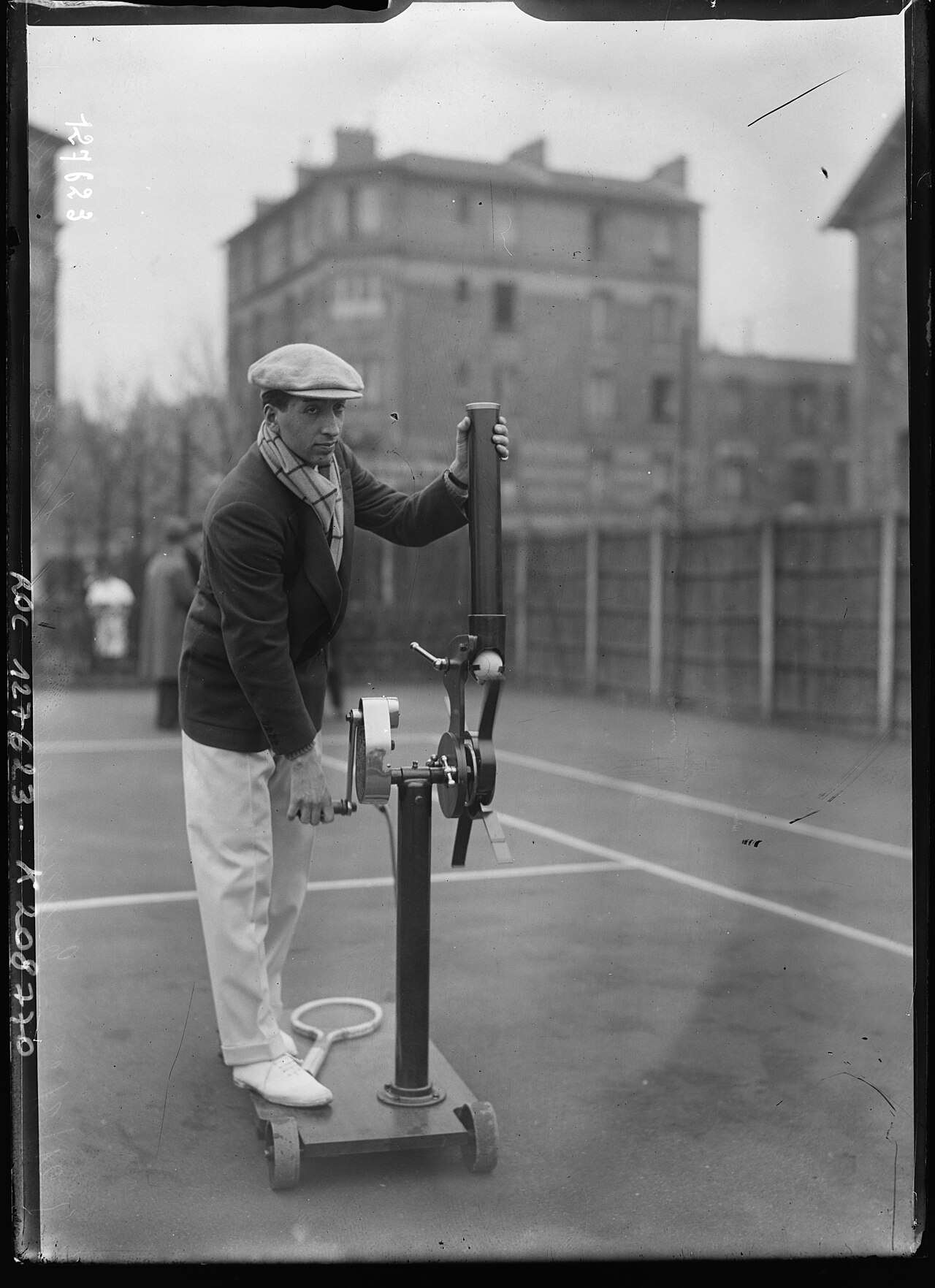
Hero photo: René Lacoste testing a ball-throwing machine at the Asnières tennis club, March 1928, Agence Rol, public domain, via Wikimedia Commons / Gallica (BnF).
How We Picked
A ball machine is the most-used accessory on many private courts. It turns a court that only gets used when four people are free into one you can use alone on a Tuesday night. It's also easy to buy the wrong one. A machine that's too heavy to roll out of the garage, or that dies after two hours with no outlet nearby, ends up in the corner of the shed.
We limited this page to manufacturers that publish full specifications on their own sites: Lobster Sports, Spinshot Sports and Sports Tutor. We compared each machine line on:
- Sport: tennis machines and pickleball machines are separate products and aren't interchangeable
- Ball capacity and feed rate: how long a drill runs before you pick up balls, and how fast the next ball comes
- Movement: fixed, random horizontal, vertical, 2-line, or fully programmable drills
- Power and published run time: internal battery, external battery, plug-in, or combo
- Weight: what you'll be lifting into a car or rolling across a lawn
- Warranty as published
Speed is in the table, but it's rarely the deciding factor. Most home players train well below a machine's top speed. For the court itself, see our how to build a backyard pickleball court guide and the best court surface systems page.
Ball Machines Compared
| Machine | Sport | Capacity | Speed | Feed | Movement | Power / run time | Weight | Warranty |
|---|---|---|---|---|---|---|---|---|
| Lobster elite one / elite two / elite three Lobster Sports (made in USA) | Tennis | 150 balls | 10–80 mph | 2–12 sec | One: random horizontal. Two: random horizontal, vertical, or both. Three: adds narrow/wide 2-line | Battery (4–8 hr listed), plug-in electric, or combo | 42 lb (one, two); 44 lb (three) | 2 years |
| Spinshot Player HS Spinshot Sports | Tennis | 120 balls | 18–80 mph | Set per drill (12 preset drills, customizable in the app) | Horizontal and vertical oscillation; random mode; programmable drills | Internal battery (2–3 hr), external battery, mains, or hybrid | 41 lb without battery; 49 lb with internal battery | 2 years |
| Tennis Tutor ProLite / ProLite Plus Sports Tutor | Tennis | 125 (ProLite) / 110 (Plus) | 10–70 mph / 10–75 mph | 1.5–10 sec | Random oscillator optional (ProLite), included (Plus); manual elevation | Battery (2–3 hr ProLite; 3–4 hr Plus) or AC-only version | 29 lb / 38 lb with battery | 3 yr machine, 1 yr battery |
| the pickle / the pickle two by Lobster Lobster Sports (made in USA) | Pickleball | 125 balls | 10–60 mph | 2–12 sec | pickle: random horizontal, manual 0–50° elevation. pickle two: adds 2-line, electronic elevation | pickle: battery (2–4 hr). pickle two: internal or external battery, AC, or AC/DC | 35 lb / 42 lb | 2 years |
| Pickleball Tutor Spin / Plus / Mini Sports Tutor | Pickleball | 125 (Spin) / 110 (Plus) / 60 (Mini) | 10–60 / 10–65 / 10–50 mph | 1–6 sec (Spin, Plus); 2–10 sec (Mini) | Random oscillator included (Spin, Plus), optional (Mini). Sidespin (Spin) or topspin/backspin (Plus) | Battery (3–4 hr typical; Mini about 3 hr) or AC-only version | 29 / 34 / 24 lb with battery | Ask the dealer for current terms |
| Spinshot Player Pickleball Machine Spinshot Sports | Pickleball | 85 pickleballs | 10–60 mph | 1–10 sec | Full-width horizontal and vertical oscillation; 12 drills, customizable in the Drill Maker app | Rechargeable battery, mains, or hybrid | 41 lb excluding battery | Ask the dealer for current terms |
Not ranked against each other. Specs checked against each linked manufacturer page on October 26, 2026. No prices, because manufacturers set and change them, and we only quote courts.
The Machines, One by One
Lobster elite one, two and three: the simple, big-hopper tennis option
Lobster Sports lists all three elite models with the same core: a 150-ball hopper, 10 to 80 mph, a 2-to-12-second feed, top and back spin, electronic elevation from 0 to 60 degrees, and a 2-year warranty. They're made in the USA. The difference is movement. The elite one does random horizontal oscillation (corner to corner). The elite two adds random vertical and combined horizontal-and-vertical oscillation, so balls come short and deep as well as side to side. The elite three adds narrow and wide 2-line drills that alternate forehand and backhand. None of them has custom or pre-loaded drills, which some players will see as a plus. Lobster lists 4 to 8 hours of battery court time on the elite models (its FAQ gives 3 to 6 hours depending on model and settings). It also sells an all-electric version that runs from a plug-in power pack, and a combo that does both. The elite one and two weigh 42 pounds, the elite three 44.
Spinshot Player HS: programmable drills from your phone
Spinshot's Player HS holds 120 balls and delivers 18 to 80 mph. Spinshot says the HS (high spin/high speed) motors hold speed even with heavy spin, and that it has stopped making the regular-speed Player. It has 12 pre-programmed drills you can customize in the Drill Maker app or on the touch panel, plus random mode and horizontal and vertical oscillation. An optional Remote Watch starts and stops the feed. Spinshot lists 2 to 3 hours of play from the included internal battery. You can add an external battery, mains power, or a hybrid mains and external battery module. It measures 20 by 18 by 12 inches and weighs 41 pounds without a battery, 49 with the internal battery. The warranty is 2 years. Pick it if you want drills that mimic match patterns and don't mind setting them up in an app.
Tennis Tutor ProLite and ProLite Plus: the lightest full-size tennis option
Sports Tutor describes the ProLite as a full-featured machine that stands only 12 inches tall and weighs under 30 pounds (29 with battery, 22 as an AC model). It holds 125 balls, throws 10 to 70 mph, and feeds from every 1.5 seconds for volleys up to every 10 seconds. Elevation is manual, from groundstroke to lob, and the random oscillator is optional. The ProLite Plus adds fixed topspin and underspin, a larger battery and an included oscillator. It holds 110 balls, reaches 75 mph and weighs 38 pounds with battery. Battery play time is 2 to 3 hours (ProLite) and 3 to 4 hours (Plus), and both come as AC-only versions. Sports Tutor lists a 3-year machine and 1-year battery warranty, and calls the controls simple, with no programming or app required. It's the one to look at if the machine lives in a garage up a slope from the court.
Lobster the pickle and the pickle two: a big hopper for pickleball
Lobster's pickleball machines hold 125 balls, throw 10 to 60 mph with heavy top and back spin, and work with indoor and outdoor balls. They feed every 2 to 12 seconds. The pickle has random horizontal oscillation, manual 0-to-50-degree elevation, a battery rated for 2 to 4 hours, a 2-function remote, and weighs 35 pounds. The pickle two adds 2-line oscillation (narrow, medium and wide), electronic elevation, and more power choices: internal or external battery, all-electric AC, or AC/DC. It weighs 42 pounds. Lobster's description says the larger battery runs 6 to 8 hours, while its spec list says 4 to 6, so confirm which battery you're getting. Both carry a 2-year warranty and are made in the USA.
Pickleball Tutor Spin, Plus and Mini: spin choices and a small option
Sports Tutor splits its full-size pickleball machine by spin. The Spin model puts right or left sidespin on the ball and holds 125 balls at 10 to 60 mph. The Plus does topspin and backspin, holds 110 balls and reaches 65 mph. Both feed every 1 to 6 seconds, include a random oscillator and a start-up delay, and run 3 to 4 hours on a battery (or come AC-only). They weigh 29 and 34 pounds with battery. The Pickleball Tutor Mini is the company's most compact model: 24 pounds, a 60-ball hopper (one standard pickup basket), 10 to 50 mph, a 2-to-10-second feed, about 3 hours of play, and an optional oscillator. All of them throw indoor and outdoor balls.
Spinshot Player Pickleball Machine: app drills, smaller hopper
Spinshot lists its pickleball machine at the same compact 20 by 18 by 12 inches as its tennis Player, and it weighs 41 pounds without battery. It holds 85 pickleballs (Spinshot recommends Franklin X-40 outdoor balls), throws 10 to 60 mph, feeds every 1 to 10 seconds, reaches a 60-degree trajectory for lobs, and oscillates both horizontally across the full court width and vertically. It comes with 12 popular drills that you can edit in the Drill Maker app, with an optional Remote Watch. Power options match the tennis Player: internal or external battery, mains, or a mains and battery hybrid. The smaller hopper means more pickup breaks than the Lobster or Tutor, so the trade is programmability for capacity.
Build the Court Around the Machine
Most of what makes a ball machine pleasant to use at home is decided when the court is designed, not when the machine is bought. If you're planning a court in New Jersey, these are the details to put in the scope:
- An outlet at the court. Every manufacturer here sells a plug-in or hybrid option, so you never run out of battery mid-drill. Outdoor receptacles at a home need GFCI protection under the National Electrical Code as adopted in New Jersey's electrical subcode, and a receptacle in a wet location needs a weatherproof cover that stays closed with a cord plugged in. A licensed electrician pulls the permit. Run the conduit while the base is open. Our court lighting guide covers the same trenching, and you can often share it.
- Fence height and backstop. A machine on random oscillation sprays balls to every corner. Full perimeter fencing, or at least tall end fences, keeps them in the court and out of the neighbor's yard. See our court fence material comparison.
- A smooth path to storage. These machines weigh 24 to 49 pounds before balls. Plan a paved or compacted path and a gate wide enough to roll the machine through, instead of carrying it across a lawn.
- Dry storage. Lobster recommends recharging the battery after every session and once a month in the off-season. That means the machine should winter somewhere dry with an outlet, like a garage or a court-side shed, not under a tarp. Pair it with our winter closing checklist.
- Lines for both sports. If the family plays both, a combined tennis and pickleball layout lets one court serve two machines. Our tennis-to-pickleball conversion guide covers line layouts.
Which Machine Fits Your Court
A family tennis court used by kids and adults
Start with a simple random-oscillation machine with a big hopper, like the Lobster elite one or a Tennis Tutor ProLite with the oscillator. Simple controls mean anyone in the house can use it without the app.
A competitive junior or league player
Look at drill-based machines. The Lobster elite two and three add vertical oscillation and 2-line drills, and the Spinshot Player HS lets a coach program patterns into the app. Ask the coach which drills they actually assign before you decide.
A dedicated backyard pickleball court
Buy a pickleball machine. Lobster's pickle line has the biggest hopper here, the Pickleball Tutor Plus or Spin lets you choose the spin you need to practice against, and the Spinshot is programmable. If storage is up a flight of stairs, the 24-pound Pickleball Tutor Mini is the easiest to carry.
A tennis court with pickleball lines
Two machines, or one for the sport that gets more practice. Both Lobster and Spinshot build tennis and pickleball machines on related designs, so accessories and habits carry over.
Ball Machine FAQs
What is the best ball machine for a backyard tennis court?+
There is no single best machine, so match it to the player. For a family court where people mostly want rallies and footwork, a simple random-oscillation machine like the Lobster elite one or a Tennis Tutor ProLite with the oscillator does the job. For a player who wants match-like patterns, the Lobster elite two and three (vertical oscillation and 2-line drills) and the Spinshot Player HS (12 programmable drills from a phone app) go further. All specs on this page come from the manufacturers, and the right choice usually depends more on power, weight and storage at your house than on top speed.
What is the best pickleball machine for a home court?+
Pickleball needs a machine built for pickleballs, not a tennis machine. The options compared here are Lobster the pickle and the pickle two, the Pickleball Tutor Spin, Plus and Mini, and the Spinshot Player Pickleball Machine. Lobster lists 125-ball hoppers at 10 to 60 mph. Sports Tutor offers sidespin (Spin) or topspin and backspin (Plus) and a 24-pound Mini. Spinshot holds 85 balls with full-width horizontal and vertical oscillation and app drills. If you mostly practice dinks and resets, feed rate and low-speed control matter more than top speed.
Should I get a battery or plug-in ball machine?+
If your court has a weatherproof outlet near the net post, an AC or AC/DC machine gives unlimited run time and saves battery replacements. Lobster sells all-electric and combo versions, Sports Tutor offers AC-only models, and Spinshot offers mains and hybrid modules. Battery run times as published range from about 2 to 3 hours (Spinshot, ProLite) to 4 to 8 hours (Lobster elite). Lobster says most players get about 3 to 4 years from a battery and recommends recharging after every session and monthly in the off-season.
Do I need an outdoor outlet at my court for a ball machine?+
Not required, but it helps. If you are building a court, have a licensed electrician add a GFCI-protected receptacle with a weatherproof in-use cover near the net post or the storage area. Outdoor receptacles at homes need GFCI protection under the National Electrical Code that New Jersey adopts, and the work needs an electrical permit. It is far easier to run conduit while the base is open than to trench later.
Can I use a tennis ball machine for pickleball?+
Not as is. The manufacturers on this page sell separate pickleball machines that feed pickleballs, which are larger, lighter and perforated. Several pickleball models are built on the same chassis as a tennis machine. Spinshot lists the same 20-by-18-by-12-inch dimensions for its pickleball machine and its tennis Player, and Lobster says the pickle two follows the design of its tennis machines.
How much does a ball machine and court setup cost in New Jersey?+
NJ Court Pros quotes courts after a site visit and does not publish price ranges, and we are not a ball machine dealer. Machine prices are set by each manufacturer and change with options. For the court side, including an outlet, fencing height and storage for a machine, ask us for a written, itemized quote.
More guides: practice walls (the other solo-practice option), best NJ court builders, and best court surfaces for NJ winters.
Sources
- Lobster Sports — elite one specifications
- Lobster Sports — elite two specifications
- Lobster Sports — elite three specifications
- Lobster Sports — FAQ (battery run time, life and charging)
- Lobster Sports — the pickle specifications
- Lobster Sports — the pickle two specifications
- Spinshot Sports — Player HS tennis ball machine
- Spinshot Sports — Plus-2 HS vs. Player HS (weights, power options)
- Spinshot Sports — Player Pickleball Machine specifications
- Sports Tutor — Tennis Tutor ProLite / ProLite Plus specifications
- Sports Tutor — Pickleball Tutor Spin, Plus and Mini specifications
Planning a Court Around a Ball Machine?
Tell us about your yard. We'll schedule a site visit and send an itemized quote covering the court, fencing, an outlet location for your electrician, and a path to storage.
Request a Quote →