Backyard Basketball Court Dimensions & Layout in New Jersey
A regulation full court is 84 × 50 ft. Almost no NJ backyard has that. Here's how the real numbers — key width, rim height, overhang, clear space — translate to a lot that actually exists.
Get a Layout Assessment →A regulation high school or college court is 84 ft × 50 ft; the NBA plays on 94 ft × 50 ft. Neither fits a typical New Jersey backyard once you account for setbacks. Most residential half-courts we build hold the full 50 ft width but shorten the depth to 30–35 ft — enough for a real 12 ft key, a regulation 10 ft rim, and honest driving lanes without needing three-quarters of an acre. The dimension people skip is the clear space behind the baseline, and it's the one that gets players hurt when it's missing.
The Numbers a Builder Actually Works To
Basketball dimensions aren't as fixed as pickleball's — the lane width alone changes between high school and NBA rules. For a backyard or driveway court, we build almost exclusively to the high school/college spec below; it plays true for pickup games, kids learning the game, and serious training alike, and it fits a residential lot far better than NBA sizing does.
| Element | Dimension | Notes |
|---|---|---|
| Full court (high school / college) | 84 ft × 50 ft | The benchmark most people mean by "regulation." NBA courts are larger — 94 × 50 ft — and not something we build in a backyard. |
| Typical NJ backyard half-court | 30–35 ft × 50 ft | Full width, shortened depth. This is the size that actually fits most residential lots, not a true 47 ft half-court. |
| Free-throw lane ("the key") | 12 ft wide (HS/college) / 16 ft wide (NBA) | Runs 19 ft from the baseline to the free-throw line at either width. |
| Free-throw line | 15 ft from the backboard | Measured from the face of the backboard — same distance at every level above youth play. |
| Rim height | 10 ft | Standard once you're past an adjustable youth hoop. |
| Backboard | 6 ft × 3.5 ft, ~4 ft overhang | Regulation glass or acrylic backboard, overhanging roughly 4 ft out from the baseline toward the court. |
The Numbers That Fit a Real Yard
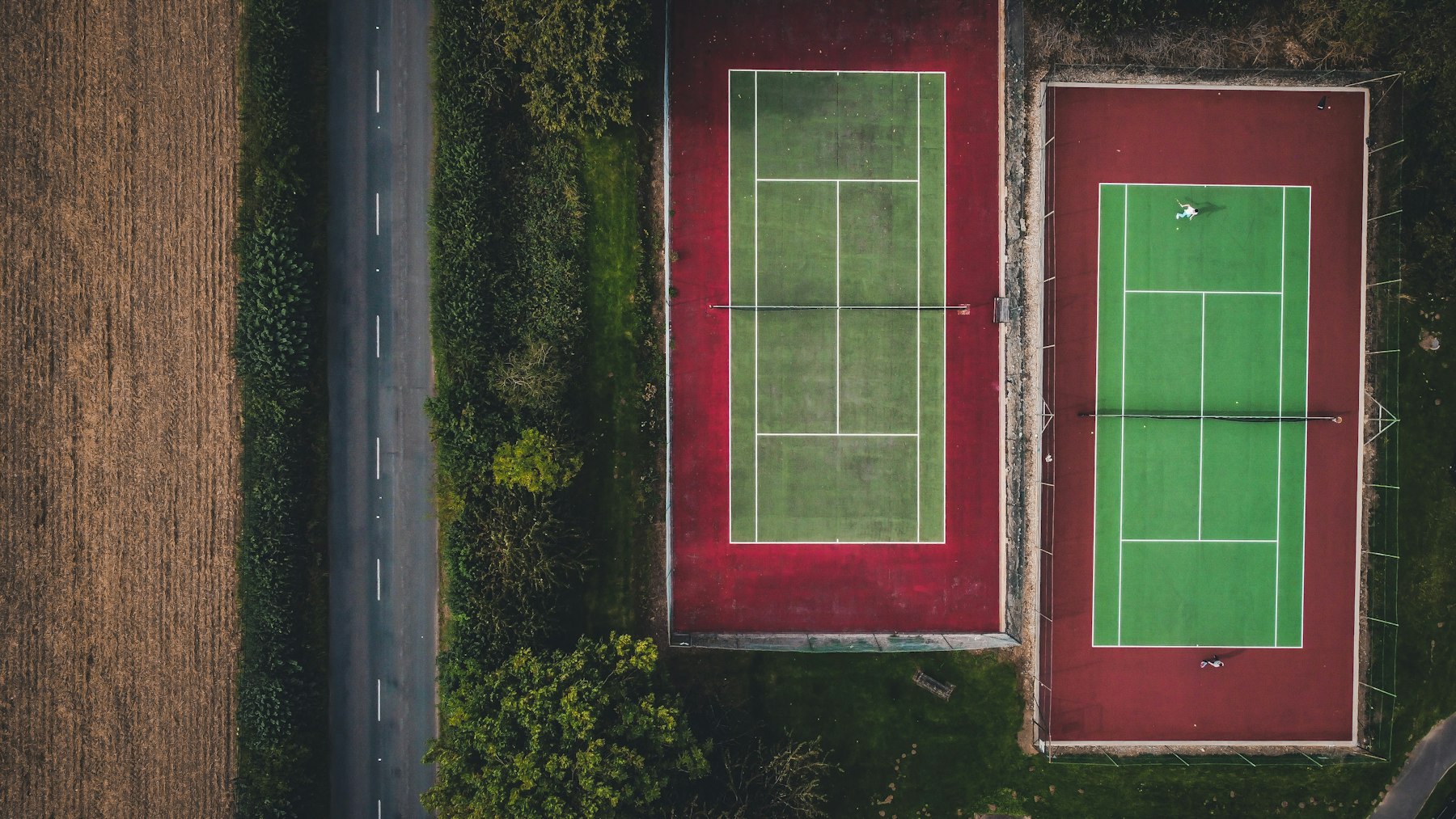
Most NJ backyards can't hold a full 84 × 50 ft court, so we build a half-court at full 50 ft width and a shortened 30–35 ft depth — keeping a real 12 ft key, a 10 ft rim, and honest driving lanes without needing three-quarters of an acre.
- ✓ Full-width half-court sized to your lot
- ✓ Clear run-out behind the baseline
- ✓ Footings poured below the NJ frost line
What Actually Determines Your Layout
Clear Space Behind the Baseline
Players follow through past the paint on a drive. Crowd the baseline against a fence, wall, or slope and you've built a court people get hurt on, not just a smaller one.
Hoop Placement & Overhang
The backboard hangs about 4 ft out from the baseline. Set an in-ground pole without accounting for that overhang and the rim ends up in the wrong spot relative to your painted key.
Footing Depth
In-ground hoop footings need to sit below New Jersey's frost line — typically 30–36 inches, more in the northern counties. Shallow footings heave over successive winters.
Sideline Buffer
Give at least 3–5 ft of clearance along the sidelines for out-of-bounds recovery and fencing, more if the court sits close to a driveway or landscaping you'd rather not damage chasing a ball.
Where Backyard Basketball Layouts Go Wrong
The mistake we see most on courts someone else laid out — or tried to lay out from a tape measure and a Saturday afternoon — isn't the slab. It's the pole. An in-ground hoop set dead-center on a pad without factoring the backboard's roughly 4 ft overhang puts the rim closer to the baseline than the key lines suggest, and every shooting drill run off that layout is subtly wrong. Chalk the actual key and free-throw line on the slab before the footing goes in, not after — moving a cored footing is not a five-minute fix.
Footing depth is the second failure point, and it's invisible for years. A pole set in a shallow footing looks perfectly plumb the day it's installed. Two or three New Jersey winters of frost heave later, it's leaning a degree or two, and by the time that's visible to the eye the concrete anchor has usually already cracked. Going below the frost line costs more concrete and more digging up front. It is not a place to save money — a hoop you have to reset in five years costs more than doing it right once. See our basketball hoop and backboard installation guide for footing specs by backboard type and real installed cost.
Orientation matters less here than it does for pickleball or tennis — basketball doesn't have a serve that needs the sun out of your eyes at a specific moment — but it isn't irrelevant. If you're adding court lighting, aim the fixtures to avoid throwing a hoop's shadow across the free-throw line at the hours you actually play; a shadow line running through your shooting spot is a small thing that gets annoying fast.
If a half-court still feels tight against your actual yard, see our guide to how small a backyard can be and still fit a court — it covers the realistic minimum footprint across pickleball, tennis, and basketball side by side, so you can see where basketball\'s trimmed-depth half-court option actually lands.
If the court you're laying out is a full-size 84–94 ft slab that's sitting underused, it's also worth working the numbers the other direction: our guide to converting a basketball court to pickleball covers how many regulation pickleball courts actually fit on that same footprint and what a conversion costs versus a fresh basketball layout.
Not Sure What Fits Your Yard?
Send us your rough yard dimensions and we'll lay out a half-court or full court that fits the site, the setbacks, and your budget — with a fixed quote after a visit.
Request a Quote →Related Guides
Basketball Court Installation Cost in NJ
How half-court vs. full-court sizing and surface choice roll up into a build price.
Sport Court Surface Types for New Jersey
Acrylic vs. modular tile options once your layout and base are settled.
Court Drainage Systems in New Jersey
Why the slab under a basketball court needs the same drainage slope as any other court.
Pickleball Court Dimensions & Space Requirements
The same kind of dimension breakdown, for a pickleball build instead of basketball.
Basketball Court Resurfacing in NJ
If the layout is already right and it's the worn coat or cracked base that needs attention.
We Build Basketball Courts Across New Jersey
Bergen County
Half-court and full-court layouts fit to North Jersey lot sizes and setbacks.
Bergen County court installation →Essex County
Backyard court builds for Montclair, the Oranges, and surrounding towns.
Essex County court installation →Monmouth County
Shore-area residential courts, sized around drainage and coverage limits.
Monmouth County court installation →Morris County
Court installation for Morristown, Madison, Chatham, and nearby communities.
Morris County court installation →Hudson County
Space-efficient half-court layouts for tighter Hoboken and Jersey City lots.
Hudson County court installation →Basketball Court Dimension FAQs
What are the dimensions of a backyard basketball court in New Jersey?+
There isn't one fixed backyard size — that's the whole design decision. A true high school/college full court is 84 ft × 50 ft, which needs more land than almost any NJ residential lot has to offer once you add setbacks. Most backyard builds we do are a half-court at full 50 ft width but a shortened 30–35 ft depth, which keeps the shooting and driving lanes regulation-accurate while cutting the footprint roughly in half.
How wide does the free-throw lane need to be?+
High school and college rules call for a 12 ft wide lane; the NBA uses 16 ft. Both run 19 ft from the baseline to the free-throw line. For a backyard court we almost always build to the 12 ft standard — it reads as a proper key without eating extra width you probably don't have to spare.
How high should the hoop be, and how much overhang does the backboard need?+
Ten feet, measured from the court surface to the rim, is the standard once a player is out of youth-adjustable territory. A regulation backboard is 6 ft wide by 3.5 ft tall and overhangs about 4 ft from the baseline — that overhang has to clear whatever pole or wall-mount structure is holding it up, which is where DIY layouts most often go wrong.
How much clear space do you need behind the baseline?+
More than people plan for. A player driving to the rim doesn't stop at the paint — they follow through past the baseline, and a hoop crowded against a fence or retaining wall turns every layup into a collision risk. We push for at least 8–10 ft of clear run-out behind the baseline where the site allows it, the same logic as leaving run-off space on a pickleball or tennis court, just applied to a sport where the movement is toward the basket instead of away from a baseline.
How deep do in-ground hoop footings need to be in New Jersey?+
Below the frost line, which across most of New Jersey falls somewhere in the 30–36 inch range in a typical winter, deeper in the colder northern counties. A footing poured shallower than that will heave as the ground freezes and thaws around it, and a hoop that leans a little more every winter is a footing problem, not a pole problem — by the time it's visibly crooked, the concrete anchor has already cracked or shifted. Backboard material and rim type also factor into footing and pole sizing — see our dedicated hoop and backboard installation guide for the full breakdown.
Get a Basketball Court Installation Quote
Tell us your yard size and how you want to use the court — we'll fit the layout, check your town's setbacks, and send a fixed quote after a site visit.
Request a Quote →