Grants and Funding for Tennis & Pickleball Courts in New Jersey
Where NJ towns, schools, counties, and nonprofits actually find money for resurfacing and new courts, what each source pays for, and how to build a scope a funder will approve.
Get a Fundable Scope & Quote →Public courts in New Jersey are usually paid for by stacking sources, not by one grant. For tennis, the biggest outside source is USTA Tennis Venue Services: its 2026 guide funds resurfacing at up to $8,000 per court, lighting up to $15,000 per court, fencing up to $12,000 per court, and new construction or reconstruction up to $35,000 per court, never more than 50% of the project, paid as a reimbursement after completion. For parks, NJ Green Acres offers matching grants and low-interest loans to local governments and nonprofits for recreation development. County open space funds, municipal capital budgets, school facility budgets, and community fundraising usually cover the rest. The projects that get funded have a clear, written scope from the start: what is wrong with the courts, what will be done, and what it costs.
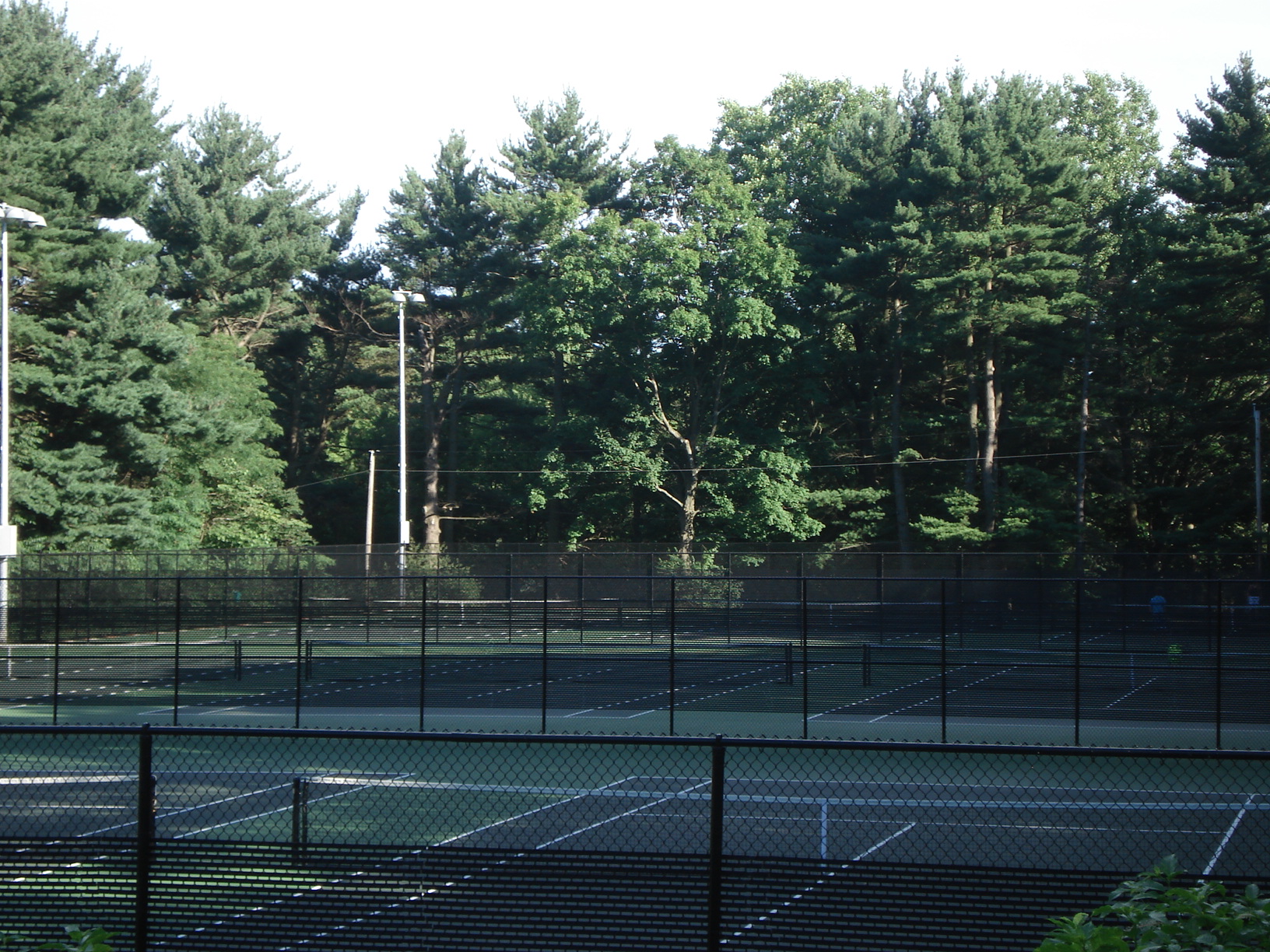
Photo above: “Tennis courts at Brookdale Park (2006)” by Blondhairblueeyed, CC BY-SA 3.0, via Wikimedia Commons.
Who This Guide Is For
Most of our guides are written for homeowners building a backyard court. This one is for the people who run public and community courts: municipal recreation directors, county park staff, school business administrators and athletic directors, nonprofit park conservancies, and the volunteer tennis or pickleball groups who keep showing up at council meetings asking when the cracked courts will be fixed.
Backyard courts don’t qualify for any of the programs below. If that’s you, our court financing guide covers how homeowners usually pay for a build. HOA and condo boards sit in between, and we cover them at the end.
One rule shapes everything that follows: grant money for courts almost always covers part of the cost, and often arrives after the work is done. A town that waits for a grant to cover the whole project tends to wait a long time. A town that has a scope, a quote, and a local match in hand can apply to several sources at once and move when the money lines up.
USTA Tennis Venue Services: The 2026 Numbers
USTA Tennis Venue Services (TVS) offers competitive grants, plus technical and business support, to tennis facilities that are open to the public. Funding depends on the scope and complexity of the project, the number of courts, and, for the largest projects, a completed technical review. The 2026 guide sorts projects into three categories:
| Category | Project type | 2026 USTA contribution |
|---|---|---|
| Category 1 | Amenities | Maximum $5,000 |
| Category 1 | Tennis court tech | Maximum $10,000 |
| Category 1 | Inclusive access | Maximum $10,000 |
| Category 2 (max $60,000) | Lighting (ASBA Class I–III) | Up to $15,000 per court |
| Category 2 (max $60,000) | Fencing (new or repair) | Up to $12,000 per court |
| Category 2 (max $60,000) | Resurfacing | Up to $8,000 per court |
| Category 3 (max $150,000) | New construction & reconstruction | Up to $35,000 per court |
| Category 3 (max $150,000) | Indoor structures | Up to $50,000 per court |
Source: USTA, 2026 Guide to Tennis Venue Services. Every category is capped at 50% of total project cost. These are funding caps, not construction prices.
The rules that matter most for budgeting: the maximum award never exceeds 50% of total project cost; applications are reviewed on a rolling basis; funding is paid as a reimbursement after the project is complete and has passed a final accountability review; and an organization can receive funding once in a 12-month period per site. Inclusive access and court tech grants can be combined with a Category 2 grant.
What “resurfacing” covers. USTA’s definition is broader than a fresh color coat. Its 2026 guide says resurfacing can include crack repair systems, overlay treatments, patching birdbaths, and leveling high areas to reestablish the court’s evenness, in addition to acrylic resurfacing. That matters because on many older municipal courts the color coat is the cheap part; the crack and low-spot work is what decides whether a resurfacing lasts. Our tennis court resurfacing guide explains that work in detail.
Lighting needs photometrics. USTA says lighting projects within ASBA Class I–III levels fall under Category 2, Class IV can be considered for Category 1 amenity funding, and photometric plans are reviewed by its technical team to set the class. Have a lighting layout before you apply. Our court lighting guide covers the planning side.
New Jersey falls under two USTA sections, USTA Eastern in the north and USTA Middle States in the south. Sections sometimes run their own facility support on top of the national program, so ask your section’s staff what’s open before you apply. Questions about TVS itself go to facilities@usta.com.
Send us the facility name, the number of courts, and a few photos of the worst cracks and low spots. We will walk the site and send a written scope and quote broken out by resurfacing, crack repair, fencing, and lighting, so each line maps to a funding category.
NJ Green Acres and Other Public Sources
Green Acres (NJDEP). New Jersey’s Green Acres Program funds land acquisition and park development by local governments and nonprofits. Its development rules list, as eligible examples, a facility for outdoor games and sports, lighting for an existing recreation facility, parking and restrooms that support outdoor recreation, a structure that partially encloses an outdoor recreation facility, and restoration or rehabilitation of facilities originally built with Green Acres or other qualifying funding 20 or more years earlier. Courts fit squarely within that.
Green Acres awards are matching funds. The local share and the mix of grant and loan depend on the municipality (Urban Aid municipalities receive a larger grant share) and on the terms of the current funding round. Two practical consequences: the town still needs its own money, and land improved with Green Acres funding carries Green Acres restrictions that keep it in public recreation use. Read the current park development application and talk to your Green Acres project manager before assuming a percentage.
County open space trust funds. Many New Jersey counties collect a dedicated open space tax and run grant rounds for municipal park projects. Rules, eligible uses, and deadlines differ by county. Some favor acquisition, some fund recreation development, and some require the project to be on land already preserved. Check your county park or open space office for the current round.
Municipal capital budgets and school facility budgets. These are usually the local match. A capital ordinance, a recreation trust, or a school facilities line pays the share the grants don’t, and covers the full cost up front when a grant reimburses later. Public owners also have to bid the work under New Jersey’s public contracting rules, which our public court bidding guide explains.
Community fundraising and sponsors. Local tennis and pickleball groups, booster clubs, and businesses often fund windscreens, benches, nets, or a share of the match. Some funders score applications higher when community support is documented, so keep letters and pledges on file.
A Scope a Reviewer Can Approve
Grant reviewers are not court builders. A scope they can understand, tied to photos of the current condition and a clear cost breakdown, moves faster than a single lump-sum number.
- ✓ Photos and measurements of cracks, low spots, and fencing damage
- ✓ Line items that map to each funder’s categories
- ✓ Surface, lighting, and fence specifications with product data
- ✓ A realistic schedule that fits reimbursement timing
Building a Fundable Project, Step by Step
Document the condition
Before anyone talks money, photograph and measure what is wrong: crack widths and lengths, birdbaths after rain, heaved or settled areas, fence and post damage, and light levels if the courts are lit. That record supports every application and shows whether you need resurfacing or a full reconstruction.
Decide resurfacing versus reconstruction honestly
A court with wide, recurring structural cracks or a failing base may not be a resurfacing project, and funding a color coat over it wastes the grant. Our crack repair vs. resurfacing and resurfacing vs. new build guides explain the line. USTA treats reconstruction as Category 3, with a technical review.
Get a line-item scope and quote
Break the work out the way funders do: resurfacing and crack repair, fencing, lighting, amenities, accessibility. A single lump sum makes it hard to claim the per-court caps in each category.
Line up the match and the cash flow
USTA pays after completion and Green Acres requires a local share, so the owner needs the full project cost available to pay the contractor on schedule. Identify the capital line, trust fund, or bridge source before applying.
Settle lines and use before you apply
If the courts will carry pickleball lines, blended 10-and-under tennis lines, or be converted, raise it with each funder in writing. Line plans can affect eligibility or scoring in some programs.
Plan the schedule around NJ weather and reporting
Acrylic resurfacing needs dry weather and warm enough temperatures, which in New Jersey usually means late spring through early fall. Leave time after completion for the funder’s final accountability review and reimbursement paperwork.
Pickleball Projects and Converted Courts
USTA TVS funding is for tennis facilities. A pickleball-only project, or the pickleball part of a conversion, usually has to be funded from park, county, municipal, or community sources instead. That doesn’t make pickleball harder to fund locally; Green Acres and most county open space programs are written around outdoor recreation generally, not one sport.
Converted and shared courts need care. Some USTA section grants restrict funding for courts that carry permanent pickleball lines. USTA Mississippi’s 2026 facility grant, for example, says courts built or resurfaced with its money cannot contain pickleball lines and gives priority to facilities that have not reduced tennis-only courts, while allowing 10-and-under blended tennis lines. That is one section’s rule, not a national one, but it shows why line plans should be settled with funders early. Our guide to converting a tennis court to pickleball covers dedicated, blended, and shared layouts.
HOAs, Condos, and Private Clubs
Courts that aren’t open to the public generally fall outside the programs above. USTA TVS requires public access, and Green Acres funds public parkland. Community associations and clubs usually pay for courts through capital reserves, a special assessment, or a phased plan that spreads the work over several years (resurface now, lights next season). Our HOA amenity court guide and phased construction budget guide cover those approaches. If a club offers real public access, ask USTA TVS directly whether it could qualify before you rule it out.
We don’t publish court prices on this page, and the dollar figures above are funding caps set by USTA, not what a project costs. The cost of your project depends on the condition of the courts and the scope you choose, which is what a site assessment and written quote are for.
Related Guides
Public Court Construction Bidding in NJ
How towns and schools bid court work under New Jersey public contracting rules.
Tennis Court Resurfacing in New Jersey
Crack repair, birdbath patching, and acrylic systems, step by step.
Court Crack Repair vs. Resurfacing
When a patch is enough and when the court needs more.
Resurfacing vs. a New Build
How to tell whether a tired court is a resurfacing or a reconstruction.
Court Grant & Funding FAQs
Are there grants to resurface public tennis courts in New Jersey?+
Yes. The main national source is USTA Tennis Venue Services. Its 2026 guide lists resurfacing as a Category 2 project funded at up to $8,000 per court, with a $60,000 Category 2 maximum, and no project funded above 50% of its total cost. Applications are reviewed on a rolling basis and paid as a reimbursement after the project is complete and passes a final accountability review. Facilities must be open to the public, and an organization can be funded once in a 12-month period per site.
Can a New Jersey town use Green Acres money for tennis or pickleball courts?+
Green Acres, run by NJDEP, funds park development by local governments and nonprofits, and its rules list facilities for outdoor games and sports, lighting for existing recreation facilities, and rehabilitation of older facilities among eligible development. Awards are matching funds, not full grants, and the share depends on the municipality and the funding round. Read the current Green Acres park development application for match percentages, loan terms, and deadlines.
Can a private club or HOA get a USTA court grant?+
USTA Tennis Venue Services funding is for facilities that are open to the public. A members-only club or a gated HOA court generally will not qualify unless it offers meaningful public access, which is a question to raise with the USTA TVS team at facilities@usta.com before you apply. HOAs and clubs usually fund courts through reserves, special assessments, or phased capital plans instead.
Does a USTA grant pay up front?+
No. USTA says TVS funding is distributed as a reimbursement after project completion and a final accountability review. The owner pays the contractor first and is reimbursed afterward, so the full project cost has to be covered in the budget or a bridge source before work starts.
Will adding pickleball lines to a tennis court affect grant eligibility?+
It can, depending on the program. Some USTA section grants restrict funding for courts with permanent pickleball lines; USTA Mississippi’s 2026 facility grant, for example, says courts built or resurfaced with its grant cannot contain pickleball lines, while allowing 10-and-under blended tennis lines. Ask the funder in writing about line plans before you finalize the striping layout.
Does NJ Court Pros write grant applications?+
No. We are a court builder. For a town, school, county, or nonprofit, we provide what applications usually ask the contractor for: a site assessment, a written scope with quantities, surface and lighting specifications, a quote, and photos of the existing condition. Your grants staff, recreation director, or engineer prepares and submits the application.
Sources
- USTA — 2026 Guide to Tennis Venue Services (categories, per-court caps, 50% limit, reimbursement, 12-month rule)
- USTA — Tennis Facility Assistance (resurfacing scope, lighting classes)
- USTA — Tennis Program Grants & Assistance
- N.J.A.C. 7:36-21.2 — Green Acres eligible development projects
- NJDEP Green Acres Program — local government and nonprofit funding
- USTA Mississippi — 2026 Community Tennis and Facility Grant guidelines (pickleball line restriction example)
Have Public or Community Courts to Fix?
Tell us the facility, how many courts, and what the funding timeline looks like. We will assess the courts, recommend resurfacing or reconstruction honestly, and send a line-item scope and quote your grants team can use.
Request a Quote →