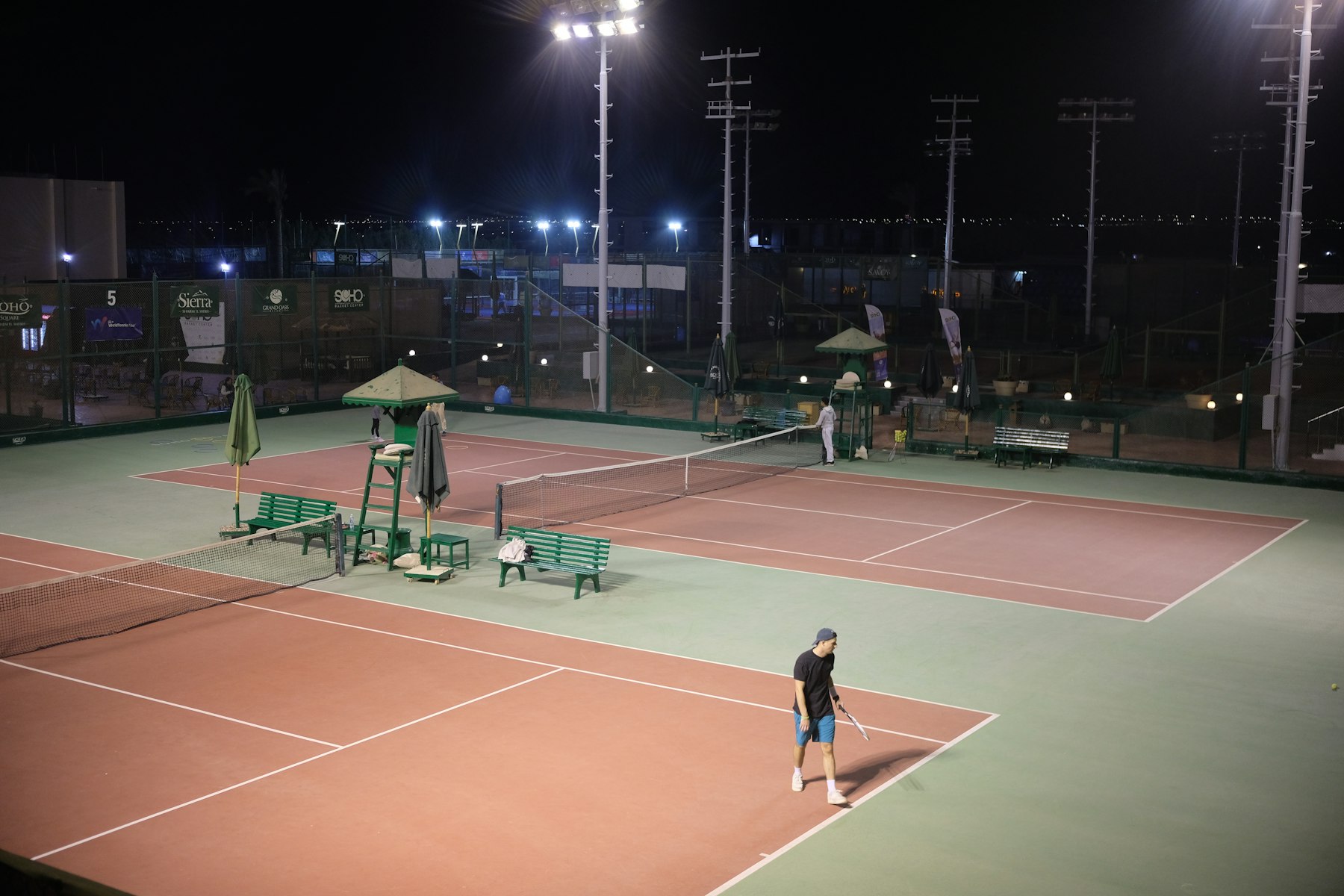
Solar-Powered Court Lighting in New Jersey
No trench, no panel upgrade, no electric bill for the court — off-grid solar LED lighting for pickleball and tennis, and where it beats running new service.
Get a Lighting Quote →Solar court lighting pairs a self-contained LED fixture, panel, and battery on its own footing — no trenching, conduit, or panel tie-in required. Manufacturer fixtures deliver 11,500–15,000 lumens per head, enough to hit the 30–50 footcandle range recreational courts are designed to, and a full charge typically runs a fixture for about three nights. It costs more per fixture than a grid-tied LED head, but on a court set back from the house — especially with a septic field, driveway, or mature trees between the court and the panel — skipping the trench often makes solar the cheaper option overall, not just the greener one.
What's in a Solar Court Lighting System
Photovoltaic Panel
Mounted on or near the pole, angled for New Jersey's latitude and sun path. Charges the battery all day regardless of whether the court is being used.
Battery Bank
Stores the day's charge and discharges through the fixture at night. Sized for roughly three nights of runtime on a full charge — the buffer for a cloudy stretch.
LED Fixture
11,500–15,000 lumens is typical for single-court coverage at 80–100 watts. Full cutoff optics keep light on the court instead of spilling onto a neighbor's yard.
Timer or Photocell Control
Turns the light on at dusk and off at a set time or after a period of no motion, which is what makes the three-night battery buffer stretch as far as it does.
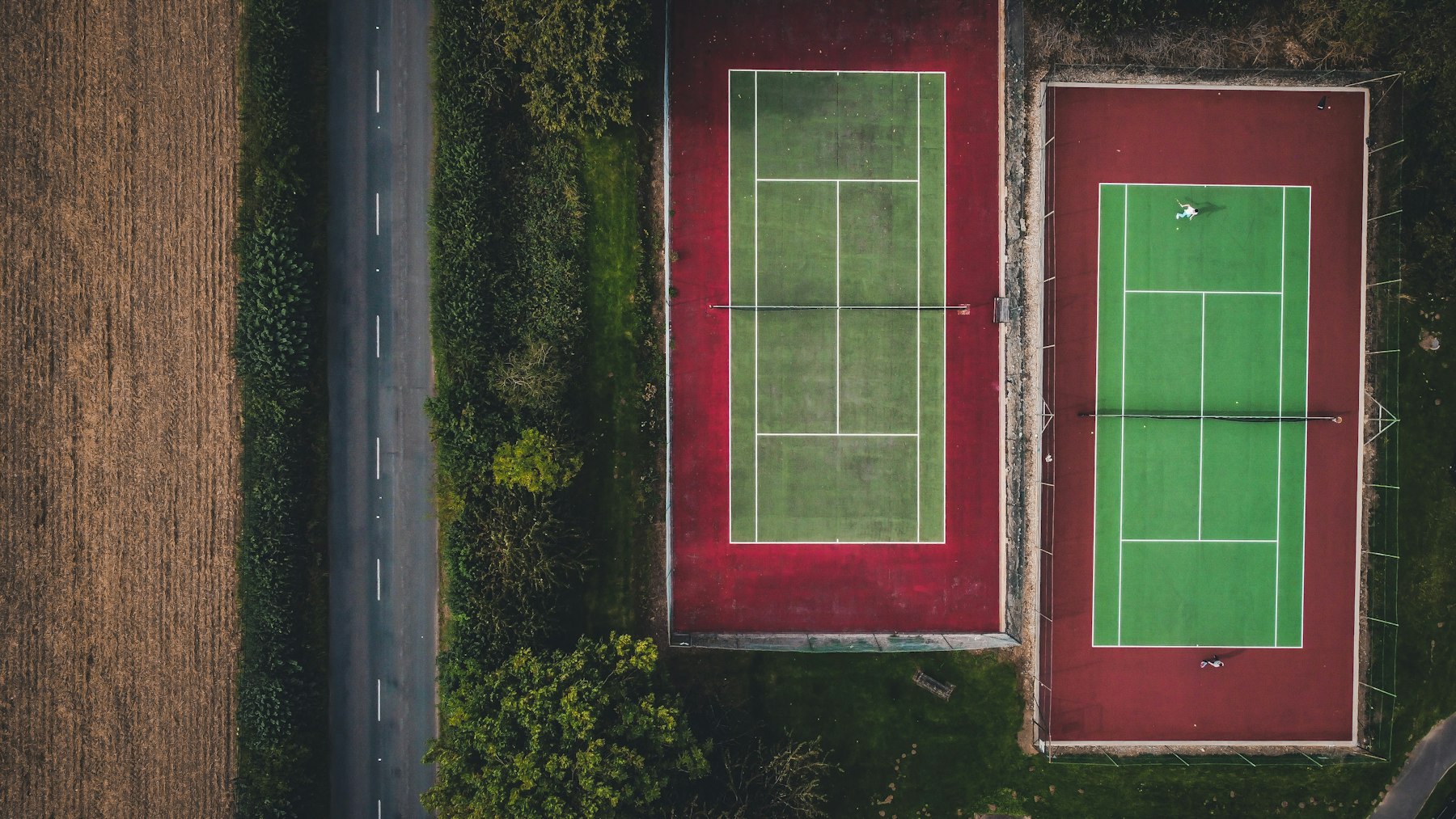
Off the Grid, Not Off the Court
A solar system is a standalone pole and footing — it doesn't touch your electrical panel or run a wire across the yard. That's what makes it a fit for courts set back from the house.
- ✓ 30–50 footcandle target with a 2.0 max/min uniformity ratio
- ✓ IP66 waterproof, IK08 impact-rated fixtures
- ✓ L70 rated at roughly 150,000 hours of LED life
Where Solar Beats Trenching New Electrical Service
The comparison people usually want to make is fixture-to-fixture — solar LED vs. grid-tied LED — but that misses where most of the money actually moves. A grid-tied fixture is cheaper on its own, sometimes significantly. What it needs behind it is a trench from the court to your panel (or a sub-panel closer to the court), conduit, direct-burial wire, a permit for the electrical work, and a licensed electrician to make the tie-in. On a court close to the house with an easy, obstruction-free trench line, that full package is often still cheaper than solar. That math flips fast once the trench has to go around something.
New Jersey lots complicate that trench line more often than people expect going in. A court set back from the house on a larger lot — the kind of build we do regularly in Sussex County, Hunterdon County, and Warren County — frequently has a septic field, a well and its protective radius, mature tree roots, or a stone wall between the panel and the court. Trenching through or around any of those adds cost, and in the case of a septic field or well setback, it may not be allowed at all without engineering sign-off. See our well and septic setback guide for how that clearance question gets handled before a shovel goes in the ground. Solar sidesteps the question entirely because there's no wire to route.
There's also a running-cost side that doesn't show up in an installed-price comparison. A grid-tied court adds a small but permanent line to your electric bill and depends on your service staying up during a storm outage. A solar system has no monthly draw and, because the battery is sized for multiple nights of buffer, keeps working through a short outage that would take a grid-tied court dark unless it was on a generator circuit.
Not Sure Which Lighting Route Fits Your Lot?
Distance from the panel, what's in the trench path, and how many nights a week you'll actually use the court all factor in. We'll walk the site and tell you honestly which option is cheaper for your yard.
Request a Site Visit →Sizing a System for New Jersey's Latitude
A solar spec written for a southern climate doesn't automatically transfer to New Jersey. Shorter winter daylight hours and a lower sun angle mean the panel collects less charge per day for a good stretch of the year, which is exactly when courts get used latest in the evening. The three-night battery buffer manufacturers publish assumes typical use and a reasonably sunny recent history — a run of overcast days in December or January eats into that buffer faster here than it would in a longer-daylight climate. This is why we size the battery bank and panel count around actual local sun data during the site visit rather than installing off a generic spec sheet.
Two to four fixtures is the normal range for a single court, with placement and pole height doing as much work as raw lumen output — a fixture mounted too low or aimed poorly creates glare and shadow even at full brightness. We set final fixture count and pole height against your court's orientation and any tree cover, the same site variables that already shape a build's daytime sun and glare profile.
On the hardware side, the durability specs matter more here than in a milder climate. IP66 covers the wind-driven rain a Nor'easter throws at a fixture; IK08 impact resistance covers a mishit ball or branch strike. Snow accumulation on the panel is the one factor that's genuinely regional — panel angle gets set steep enough that snow sheds rather than sitting and blocking charge for days after a storm, which we account for at install rather than leaving to chance.
Related Guides
Court Lighting Cost in New Jersey
Grid-tied LED lighting cost drivers — wiring runs, pole count, and fixture wattage.
Court Fencing & Lighting Installation in NJ
How lighting fits into a full fencing and lighting installation budget.
Well & Septic Setback for Court Construction in NJ
Why a septic field or well radius can rule out a trench path on rural lots.
Backyard Court Cost in Sussex County, NJ
Rural, larger-lot builds where solar lighting comes up most often.
Sources
- Access Fixtures — Solar-Powered Pickleball Court Lighting Design (lumen output, footcandle targets, uniformity ratio)
- Access Fixtures — Solar-Powered Tennis Court Lights: Complete Guide
- Access Fixtures — Pickleball Court Lighting Cost: Solar vs. Grid-Connected LED
- Sol by Sunna Design — Why Solar Lighting Is a Fit for Pickleball and Other Sports
Solar Court Lighting FAQs
How does solar-powered court lighting actually work?+
A solar fixture pairs an LED light head with an integrated or pole-mounted photovoltaic panel and a battery bank. The panel charges the battery during daylight hours regardless of whether the court is in use, and the battery discharges through the LED at dusk, either on a timer or a motion/photocell trigger. There is no trench, no conduit run, and no tie-in to your electrical panel — the fixture is self-contained on its own pole footing.
How many lumens or footcandles do I need to light a court for night play?+
Recreational pickleball and backyard tennis lighting is generally designed to 30–50 footcandles across the court with a max-to-min uniformity ratio of about 2.0, meaning the darkest spot on the court shouldn't be less than half as bright as the brightest spot. Manufacturer solar fixtures for single-court coverage typically run 11,500–15,000 lumens per fixture at 80–100 watts, with higher-output options up to roughly 39,000 lumens for larger or multi-court layouts. Two to four fixtures per court is the usual range depending on pole height and placement.
Does solar lighting hold up through a New Jersey winter, including cloudy stretches?+
Manufacturer specs generally state a full charge runs the fixture for about three nights of typical use, which is the buffer that gets a court through a stretch of overcast days. New Jersey averages meaningfully less winter daylight and lower sun angle than a southern install, so battery bank sizing matters more here — undersizing the battery for our latitude is the most common reason an owner ends up disappointed with a solar system. This is a sizing conversation we have during the site visit, not a spec you can pull off a manufacturer page and assume applies to your yard.
Is solar lighting cheaper than running electrical service to the court?+
It depends entirely on how far the court sits from your electrical panel and what's between the two. Solar fixtures cost more per unit than a comparable grid-tied LED head, but they eliminate trenching, conduit, wire, and often a licensed electrician's labor for the panel tie-in — costs that scale with distance and with obstacles like a driveway, septic field, or mature tree roots the trench would have to cross. On a court close to the house with a clear trench path, grid power is usually cheaper. On a court set back from the house, especially on a rural lot with well and septic in between, solar frequently wins even at a higher fixture cost, because there's no trenching bill and no ongoing electric charge.
Are solar fixtures durable enough for outdoor NJ conditions year-round?+
The commercial-grade solar sport fixtures we install carry an IP66 waterproof rating (fully dust-tight, protected against high-pressure water jets) and an IK08 impact rating, which covers wind-driven debris and incidental ball strikes. LED life is commonly rated L70 at 150,000 hours, meaning the diode still outputs at least 70% of its original brightness at that point — well beyond the pole and panel hardware's own service life. Snow load on the panel is the one seasonal factor worth asking about directly; panel angle and mounting height are usually adjusted at install specifically for that.
Can solar lighting be added to an existing court, or only a new build?+
Both. A solar pole-and-fixture system is a standalone footing, so it can be added to a court that already exists without disturbing the playing surface, which makes it a common add-on during a resurfacing project when a crew is already on site. It also installs cleanly on a new build alongside fencing and net posts. Either way, footing depth still needs to clear frost line and any underground utilities on the property, which we confirm before digging.
Get a Solar or Grid Lighting Quote
Tell us where the court sits relative to your panel and how the site is laid out — we'll recommend the lighting route that actually makes sense for your lot.
Request a Quote →