Tree Root Damage to NJ Tennis & Pickleball Courts
A ridge along the edge nearest the oaks, a crack that keeps coming back in the same line, a panel tipping toward a tree. Here's how to tell if roots are the cause, and what actually fixes it.
Get a Site Assessment →By NJ Court Pros · Updated November 16, 2026
Roots crack courts by thickening under the slab over years, so the damage shows up as a raised ridge or a crack that follows the tree line. Crack filler and resurfacing alone won't hold over an active root. The lasting fixes are dealing with the root first (careful root work by a licensed tree professional, a root barrier at least 18 inches deep per Iowa State Extension, or removing the tree), then repairing or rebuilding the affected section, ideally over a root-excluding base such as washed coarse gravel or foam board. Root cuts too close to the trunk can destabilize a tree; extension guidance puts the line at about three times the trunk diameter. Quote-only: we price after seeing the court and the trees.
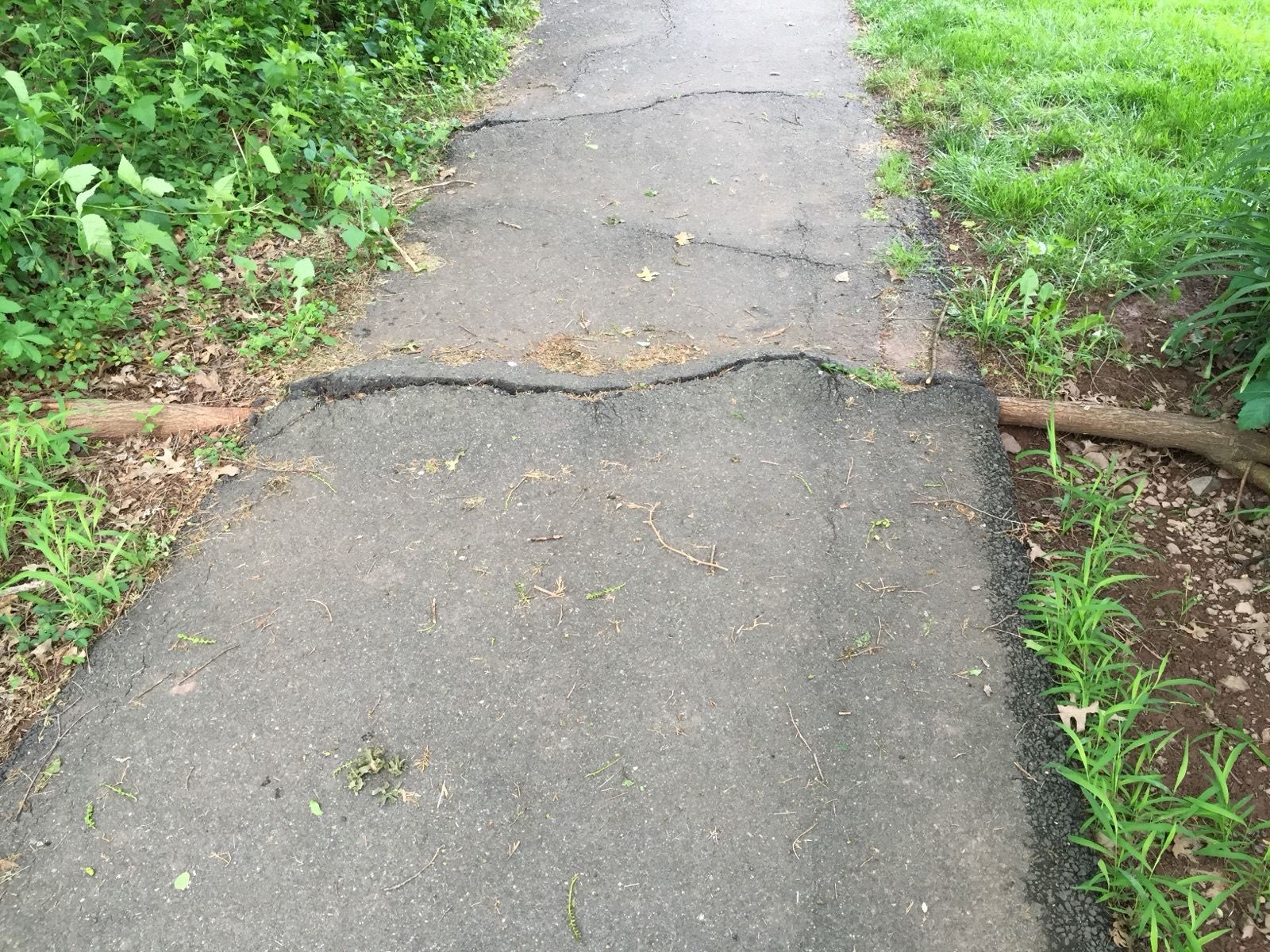
Photo: a red mulberry root buckling an asphalt path in Chantilly, Virginia, by Famartin (CC BY-SA 4.0, Wikimedia Commons), resized. The same mechanism lifts asphalt court edges. Not a New Jersey project.
How Roots Get Under A Court
Iowa State University Extension describes the process plainly: roots grow under pavement when there is oxygen, water and space for them, they start very small, and they increase in diameter as the tree grows. That last part is why root damage seems to arrive suddenly on a court that was fine for ten years. The root was there all along. It just got big enough to lift the slab.
Courts give roots what they want. The base under a court is usually compacted stone, and the edge where the pavement meets the lawn stays moist. Water sheeting off a court surface soaks the soil right along the perimeter. Many New Jersey backyard courts were built near mature oaks, maples and other shade trees because that is where the flat ground was, or because the trees made the spot pleasant. In older neighborhoods, the trees often came first.
Asphalt courts show root damage faster than post-tensioned concrete, because asphalt flexes and cracks over a growing root while a stiff, tensioned slab tends to bridge small movement. That doesn't make concrete immune; a big enough root will lift a slab edge or crack it at a weak point.
Is It Roots, Settlement, Or Frost?
Three things lift or crack a court from below in New Jersey, and the fix differs for each, so the diagnosis matters.
| Clue | Points to roots | Points to something else |
|---|---|---|
| Location | Damage on the side nearest a large tree, often within its canopy | Damage at a low corner, along a drainage path or over an old utility trench |
| Shape | A raised ridge or hump, sometimes with a crack running along its crest toward the trunk | A dip or tilt (settlement), or a lift that comes and goes with winter (frost heave) |
| Timing | Slow, steady growth year over year, regardless of season | Worse after winter, or appearing after a wet season |
| Edge check | Roots visible at the court edge, or found when the soil along the edge is probed | Soft or washed-out soil at the edge, standing water nearby |
Courts can have more than one problem at once. If the damage looks like a dip rather than a hump, start with our slab settlement and heave guide. If it's a surface crack that doesn't move, our crack repair vs. resurfacing guide is the better place to start.
Your Options, From Least To Most Invasive
1. Monitor and patch, knowing it will come back
On a court with a small ridge and a tree you want to keep, some owners choose to fill the crack, keep playing and revisit it each spring. That is a legitimate choice as long as everyone understands the patch is temporary and the ridge isn't a trip hazard. Crack systems designed to tolerate movement are covered in our crack repair systems comparison.
2. Root work plus a barrier
This is the most common way to keep both the tree and the court. A trench is cut between the tree and the court, the offending roots are dealt with, and a root barrier goes in before the court section is repaired. The guidance on this step is specific, and it is about protecting the tree as much as the court:
- Distance from the trunk. Iowa State Extension recommends not cutting buttress roots closer to the trunk than three times the trunk diameter, and says removing the tree is more prudent if roots must be cut at 1.5 times the diameter or closer. Bartlett's research lab prefers five to six times the trunk diameter as a minimum, or three times for cuts on one side only.
- Root size. Iowa State advises avoiding cuts on roots over 2 inches in diameter where possible, making clean saw cuts rather than tearing roots with a machine, and not letting exposed roots dry out.
- Barrier depth. Barriers must be at least 18 inches deep with the top above the soil and mulch surface, per Iowa State. A research review in Arboriculture & Urban Forestry found 24-inch barriers had measurable effects on roots where 12-inch barriers did not. MSU Extension notes a widely cited study in which roots grew under a 1-foot barrier and back up on the other side.
A barrier lowers the odds of a repeat, not to zero. MSU Extension also points out that trenching near existing trees has to be done carefully to avoid excessive root loss and is best handled by a professional arborist.
3. Rebuild the damaged section over a root-excluding base
Where the slab is broken or lifted too far to repair, the affected section comes out and the base is rebuilt. Iowa State Extension describes two base layers that successfully exclude roots under pavement: washed coarse gravel (1 to 1.5 inch stone with no fines), at least 4 inches thick and only in well-drained soil, or foam insulation board. On a court, that base detail has to work with the court's own drainage and slope design, so it is something the court builder and the tree professional should agree on. Our base preparation guide explains how the rest of the base is built.
4. Remove the tree, then rebuild
Sometimes the tree is too close to the court to cut roots safely, or it is declining anyway. Removal makes the court repair permanent but changes the site: stumps and large roots left under a base decay and can leave voids, which is why stumps and major roots are normally ground out and excavated before the base is rebuilt. Many New Jersey towns regulate tree removal, so check your municipality before anyone cuts. Our land clearing and tree removal guide covers how stumps and roots are handled under a court.
Roots Lifting Your Court?
Send us photos of the damage and the nearby trees. We'll come out, check whether roots, settlement or frost are behind it, and give you an itemized repair or rebuild quote that works with your tree professional's plan.
Get a Site Assessment →Licensing: Who Can Do The Tree Part
In New Jersey, root pruning is tree care, and tree care is licensed. The NJ Board of Tree Experts says it is mandatory to hire a tree care business that is registered with the state and employs a Licensed Tree Expert or Licensed Tree Care Operator, depending on the services offered. Its consumer guidance says to ask for the business registration, proof of insurance, and the name and license number of the licensed person. Tree company ads are required to include the business's NJTC registration number.
That has a practical consequence for court repairs. A court contractor can excavate, rebuild the base and resurface, but decisions about which roots get cut, and whether a tree stays, belong with a licensed tree professional. The two trades should be coordinated so the root work happens before the base goes back, and so the barrier location works for both the court and the tree.
Building A New Court Near Trees
Most root problems are cheaper to prevent than to fix. If you are planning a court near mature trees, a few design decisions up front go a long way:
- Site the court as far from large trees as the yard allows. Distance is the most reliable protection there is.
- Have a licensed tree professional look at the trees before layout, not after the excavator arrives.
- Plan root barriers and a root-excluding base into the design on the tree side, rather than adding them later.
- Think about leaf and sap drop too. Courts under a canopy stay damp and stain faster, which affects maintenance.
- Make sure drainage carries water off the court away from the trees' root zone where possible.
Our guide to preparing your yard for court construction covers the rest of the pre-build checklist. If the damage is widespread enough that you are weighing a full rebuild, see our resurfacing vs. new build guide.
Frequently Asked Questions
Can tree roots really crack a tennis or pickleball court?
Yes. Roots grow under pavement where they find oxygen, water and space, and they start small. As they thicken over the years they lift the slab above them, which shows up as a raised ridge, a crack running parallel to the tree line, or a panel that tilts toward the trunk. Asphalt courts are especially prone to it because asphalt flexes and cracks over a root rather than bridging it.
Can you just cut the roots and patch the court?
Sometimes, but cutting is the step that can hurt or destabilize the tree. Iowa State University Extension recommends not cutting buttress roots closer to the trunk than three times the trunk diameter, and says removal is the more prudent option if roots must be cut at 1.5 times the diameter or closer. Bartlett Tree Experts’ research lab prefers a minimum of five to six times the trunk diameter for cuts, or three times when cutting only one side. A licensed tree professional should assess the tree before any root is cut.
Do root barriers work next to a court?
They can help, but depth matters. Iowa State Extension says barriers must be at least 18 inches deep with the top above the soil and mulch surface to be effective. A review of root barrier research in Arboriculture & Urban Forestry found that 24-inch barriers had measurable effects while typical 12-inch barriers did not. Even with a barrier, roots can sometimes find a way under, so a barrier reduces risk rather than eliminating it.
Who is allowed to prune tree roots in New Jersey?
The New Jersey Board of Tree Experts says it is mandatory to hire a tree care business that is registered with the state and employs a Licensed Tree Expert or Licensed Tree Care Operator, depending on the services offered. Ask for the business registration number, the license number of the licensed person and proof of insurance. Root work near a court is tree care, not just excavation.
Will resurfacing fix a court with root damage?
Not by itself. A new acrylic surface or crack filler over an active root will crack again as the root keeps growing. The root has to be dealt with first, whether that means root work, a barrier, removing the tree, or rebuilding the affected section with a root-excluding base. Once the movement source is addressed, the surface can be repaired and recoated.
How much does it cost to fix root damage on a court?
We quote these jobs after a site visit rather than publishing a price, because the scope varies too much: a single ridge at one edge is a very different job from a court that needs a section removed and rebuilt, and tree work is usually a separate contract. What moves the price is how much of the court is affected, whether the base needs to be rebuilt, access for equipment, the tree work required and the surface system going back on top.
Get A Court Repair Plan That Holds
Tell us about your court, the surface, and the trees nearby. We'll inspect, explain what's lifting it, and send an itemized quote for repair, partial rebuild or resurfacing. No prices published here; every root job is different.
Request a Quote →Sources
- Iowa State University Extension — How to Manage Trees Near Sidewalks (barrier depth, root size, 3x and 1.5x trunk-diameter guidance)
- Iowa State University Extension — Sidewalk Repair Near Trees (root-excluding gravel and foam bases, root shaving)
- Arboriculture & Urban Forestry (ISA) — A Review of Root Barrier Research
- Michigan State University Extension — Reducing damage caused by tree roots
- Bartlett Tree Research Laboratories — Technical Report: Root Pruning
- New Jersey Board of Tree Experts — What Consumers Should Look For
Sources accessed November 16, 2026. This guide is general information. Tree work decisions belong with a New Jersey licensed tree professional, and your municipality may regulate tree removal.