Best Tennis Court Crack Repair Systems for NJ Courts
Fabric overlays, elastic fillers and flexible resurfacers compared on how they work and what each maker publishes, for courts that crack open every New Jersey winter.
Get a Free Court Assessment →By NJ Court Pros · Updated November 10, 2026
For the long, straight cracks that reopen every spring on an older New Jersey asphalt court, a fabric or membrane overlay installed over a filled crack and then resurfaced is the repair that lasts: Armor (Har-Tru), Guardian (California Sports Surfaces) and RiteWay are the named systems. Novacaulk is a two-part elastic filler with a fiber bridge coat, Laykold NuSurf is a flexible resurfacer for minor cracking, and a trowel filler such as SportMaster Acrylic Crack Patch buys time rather than solving the crack. None of them fixes failed pavement; a court that is heaving or cracked everywhere needs an overlay or rebuild. Table order is not a ranking.
Disclosure: NJ Court Pros repairs and resurfaces courts and earns money when you hire us. No manufacturer paid for placement. Product facts come from each maker's page (or, for RiteWay, a distributor listing), linked in Sources; claims are labeled as the maker's. Quote-only — no prices.
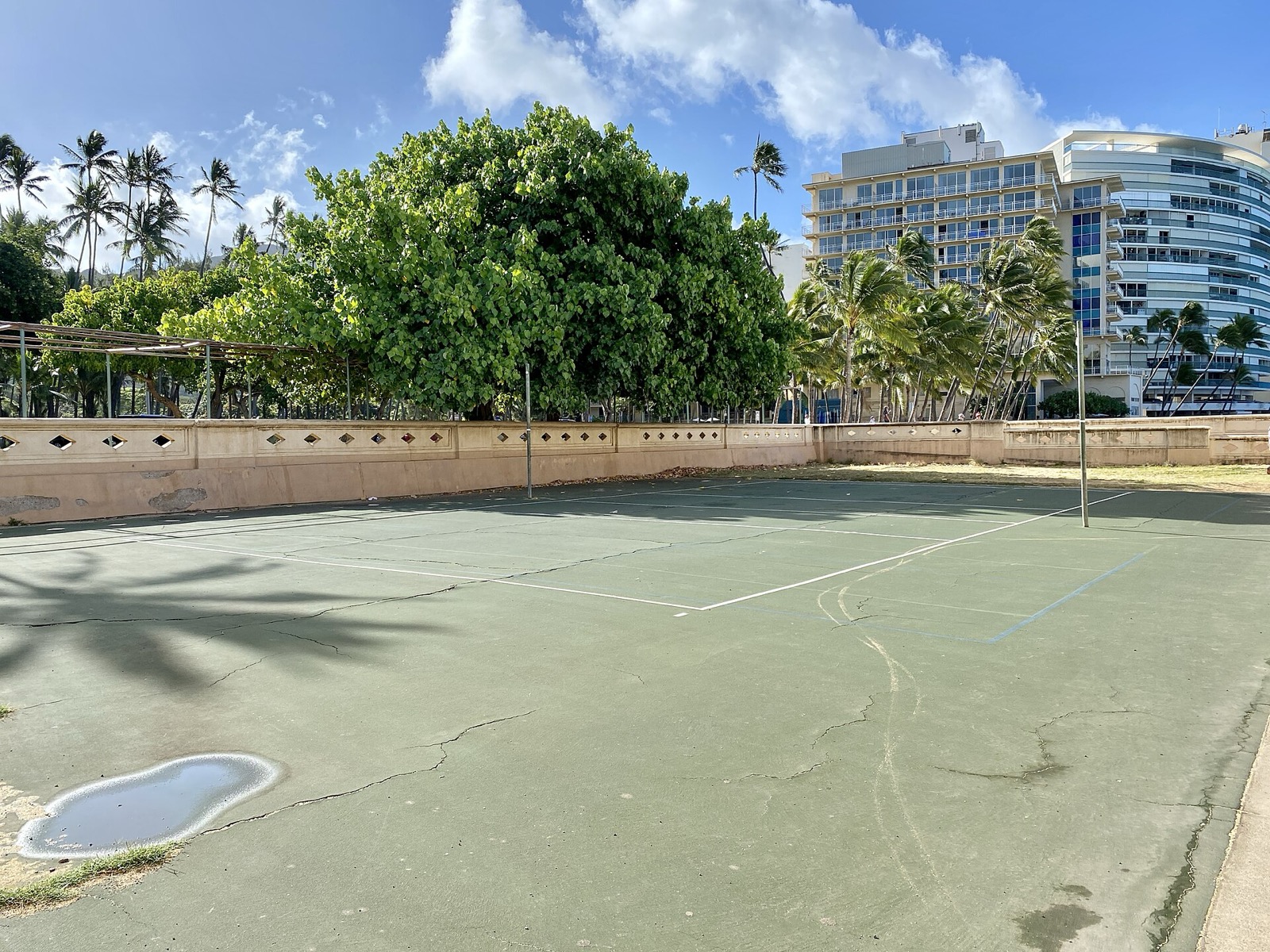
Photo: an aging hard court with structural cracks and a standing puddle at the Waikiki Natatorium War Memorial, Honolulu, May 2022 (w_lemay, CC BY-SA 2.0, Wikimedia Commons) — illustrative of the crack pattern, not a New Jersey project.
Read The Crack Before You Pick A Product
Every outdoor court cracks eventually. Har-Tru puts it down to asphalt's natural tendency to shrink and turn brittle as it ages, made worse by the expansion and contraction of outdoor temperature swings. In New Jersey, the freeze-thaw cycle is the part that hurts: water gets into a crack, freezes, widens it, and the crack that was hairline in October is a quarter inch in April.
California Sports Surfaces describes three broad kinds of cracking, and each one points to a different fix:
- Small surface cracks early in a court's life. Often tied to compaction or moisture in the asphalt. Fiberglass mesh or a flexible resurfacer under the color coats keeps them from getting worse.
- Linear structural cracks that come with age, or pavement joints that have cracked over time. This is the job fabric overlay systems were built for: fill the crack, bridge it, coat over it.
- Cracks wide enough to be a safety issue on a surface past its lifespan. At that point the conversation is about a full-court mat overlay, an asphalt overlay or a rebuild, not a crack product.
If you are still deciding between spot repair and a full resurface, start with our crack repair vs. resurfacing guide. This page assumes you have a court worth saving and want to know which named system belongs on the bid.
How We Compared
- What kind of repair it is: filler, elastic bridge coat, flexible resurfacer, or fabric overlay.
- How the maker says it goes in, from crack prep to coating.
- Published figures (elongation, coverage, temperature limits) and any stated warranty.
- What each maker says the product will not do.
- Fit for New Jersey freeze-thaw cycles and a short warm-weather coating season.
Crack Repair Systems Compared
| System | Type | How it works | Published figures / claims | Limits the maker states |
|---|---|---|---|---|
ARMOR Crack Repair System Har-Tru (acquired Armor) | Expandable fabric overlay | Crack is filled, then covered with a knitted fabric that expands as the crack widens, spreading the stress over a wide band; coated and painted to hide the repair | In use since 1993 in climates "from Canada to the Caribbean"; maker says most repairs last more than 15 years (maker claim) | Maker says it will not prevent new cracks elsewhere on the court or stop a crack from growing in length beyond the repair; written for asphalt courts |
Guardian Crack Repair System California Sports Surfaces | Self-adhesive fabric overlay | Crack is filled with a harder patch material, then a self-adhesive expansive fabric tape is applied, covered with mesh and coated with standard acrylic court coatings | 300% elongation; maker cites performance from below freezing to over 200°F; waterproof | Maker positions it for linear age cracks and cracked pavement joints; can also go over expansion joints or saw cuts on newer surfaces |
RiteWay Crack Repair System RiteWay (sold through court-surfacing distributors) | Overlay membrane, certified-installer system | Overlay that waterproofs the crack and lets it move underneath without breaking the membrane ("Micro Sealant technology," per the product listing) | Product listing describes a 2-year warranty on repaired cracks when installed by a Certified RiteWay Contractor, and claims no dead spots or bubbling | Warranty terms and contractor certification belong in your written bid; the playability claims are the seller's, not independent tests |
Novacaulk #1 + #2 Nova Sports U.S.A. | Two-part elastic filler and bridging coat | #1 fills the crack over backer rod or sand set 3/16 in below the surface; #2, fortified with fibers that cure into a non-woven fabric, is feathered 3 to 6 in past each side | 70 linear ft per gallon per coat; minimum 50°F and rising; #1 also sold in caulk tubes | Nova says it does not guarantee results and that some major cracks will reappear as smaller cracks |
Laykold NuSurf Laykold | Flexible acrylic resurfacer / elastomeric filler | Acrylic concentrate batch-mixed with silica sand and water as a flexible filler coat; mixed with sand at equal ratios it can serve as an elastomeric crack filler for very minor cracks | Up to 800% greater elongation than conventional acrylic resurfacers (maker figure); about 2 to 4 hours drying time | Designed for asphalt; aimed at surface movement and minor cracking, not a substitute for a membrane over a structural crack |
Acrylic Crack Patch SportMaster | Trowel-grade acrylic crack filler | 100% acrylic filler worked into the crack with a trowel or scraper, then coated over | Cracks up to 1 in wide on asphalt, concrete or existing acrylic; roughly 75 to 150 ft of crack per gallon; above 50°F during application and for 24 hours after | A filler, not a bridging system. California Sports Surfaces says basic acrylic fillers buy time (maybe six months, maybe a couple of years) before cracks return |
The Fabric Overlay Systems
Armor (Har-Tru). Armor is the oldest of the named overlays. Har-Tru, which bought the system, says it has been used since 1993 and that it relies on a knitted fabric that expands as the crack widens, spreading the stress across a wide band instead of concentrating it at the crack line. The filled crack is hidden under the repair and painted. Har-Tru says most Armor repairs last more than 15 years; treat that as the maker's claim, and ask your contractor how long their own Armor installs have held up. Har-Tru is also clear about the limits: Armor will not stop cracks forming elsewhere or a crack growing past the end of the repair.
Guardian (California Sports Surfaces). Guardian pairs an expansive fabric with what the maker calls an ultra-aggressive adhesive, applied as a self-adhesive tape over a crack that has been filled with a harder patch material, then covered with mesh and standard acrylic court coatings. California Sports Surfaces publishes 300% elongation, performance from below freezing to over 200°F, and stresses that the system is waterproof, which matters because keeping water out of the crack is what slows its deterioration. The maker positions it for linear age cracks and cracked pavement joints, and says it can go over expansion joints or saw cuts on a newer surface.
RiteWay. RiteWay is sold through court-surfacing distributors rather than a single surfacing brand. A distributor listing describes it as an overlay that waterproofs existing cracks and lets them move without breaking the membrane, installed by Certified RiteWay Contractors, with a 2-year warranty on repaired cracks. The same listing claims no dead spots, bubbling or hollow-sounding areas. Those are the seller's claims, so if a bidder proposes RiteWay, ask for proof of certification and the warranty document itself.
Cracks Back Again This Spring?
We'll walk the court, measure every crack, check for birdbaths and drainage problems, and send an itemized quote that names the repair system and the linear footage, with resurfacing priced as a separate line.
Request a Quote →Elastic Fillers And Flexible Resurfacers
Novacaulk #1 and #2 (Nova Sports U.S.A.). Novacaulk is a liquid alternative to fabric tape. The crack is cleaned, backer rod or clean sand goes in to within 3/16 inch of the surface, and Novacaulk #1 is pressed in to refusal. Once it sets, Novacaulk #2, which contains fibers that cure into a non-woven fabric film, is spread over the top, thicker over the crack and feathered 3 to 6 inches past each side. Nova publishes 70 linear feet per gallon per coat and a 50°F-and-rising minimum. It is also unusually candid: it does not guarantee results, does not present the system as a cure-all, and expects some major cracks to come back as smaller ones.
Laykold NuSurf. NuSurf is not a crack membrane in the Armor or Guardian sense. It's a flexible acrylic resurfacer for asphalt courts that Laykold says has up to 800% greater elongation than conventional resurfacers, meant to move with the pavement instead of turning brittle. Mixed with silica sand at equal ratios it can also act as an elastomeric filler for very minor cracks and depressions. On a resurfacing job with widespread minor cracking, it is a reasonable thing to ask about as the filler coat; on a court with a few open structural cracks, it belongs alongside a bridging system, not instead of one.
SportMaster Acrylic Crack Patch. This is a trowel-grade 100% acrylic filler for cracks up to an inch wide on asphalt, concrete or an existing acrylic surface, with SportMaster quoting roughly 75 to 150 feet of crack per gallon. It is the standard tool for prep before color coats and small repairs. California Sports Surfaces describes fillers in general as cost-effective and easy, buying anywhere from about six months to a couple of years before the crack returns. Har-Tru, which sells a competing overlay, goes further: it says crack filler or fiberglass fabric alone will fail within one year almost without exception. If the only crack treatment in a bid is filler, assume you will see the crack again.
When Crack Repair Is The Wrong Answer
Crack systems treat cracks; they don't treat pavement failure. California Sports Surfaces points to full-surface mat systems, such as its Premier Court or the Rebound Ace Air Cushion, for older courts near the end of their life when the budget does not allow a rebuild. These are glued around the perimeter and float in the middle, allowing some movement underneath. The most durable fix is new pavement: milling and repaving, an asphalt overlay, or tearing out and replacing the slab.
Signs you are past crack repair include cracks in a map or alligator pattern across large areas, heaving or settling where the court is no longer flat, and repeated birdbaths. Low spots need their own treatment, covered in our birdbath repair guide. Concrete courts are a different case again, because cracks often follow control or expansion joints; see control joints and expansion joints before you put tape over a joint that is supposed to move.
Matching The System To The Court
A backyard asphalt court, 10 to 20 years old, with a few long cracks. This is the classic overlay job. Fill and patch, install Armor, Guardian or RiteWay over each crack, then resurface and color coat. Get the linear footage measured, because overlay systems are bid by the foot.
A club or HOA court with dozens of hairline cracks and one or two open ones. A flexible resurfacer such as NuSurf across the court plus a bridging system on the open cracks is a sensible combination to ask about, so the hairlines and the structural cracks each get the right treatment.
A court that is due for color coats but has only small, stable cracks. Filler before the coats may be enough for now. Budget for the overlay at the next resurfacing if those cracks start moving.
A court with cracks everywhere, heaving at the fence line and a birdbath in each service box. Price the overlay or rebuild before you spend money on crack products. Our tennis court resurfacing guide covers what a full resurface involves in New Jersey.
What To Specify On A Bid
- The named crack repair system for each crack type, not just "crack repair."
- Total linear feet of crack treated, measured on site.
- Crack prep: cleaning, vegetation removal, filling or patching material.
- Whether resurfacer and color coats follow, and which products.
- Any manufacturer or installer warranty, in writing, and the installer's certification if the system requires it.
- Weather limits: minimum temperatures and dry-time windows for every product in the system.
FAQ
What is the best way to repair cracks in a tennis court?
It depends on the crack. Hairline surface cracks can be filled or covered with a flexible resurfacer. Linear structural cracks that open and close with the seasons usually need a fabric or membrane overlay system such as Armor, Guardian or RiteWay, installed over a filled crack and then coated. Widespread cracking, heaving or a court past its service life points toward a cushioned mat overlay, an asphalt overlay or a rebuild. California Sports Surfaces lays out that same ladder, from filler to rebuild.
Do crack repair systems stop cracks from coming back?
They hide and bridge the existing crack; they do not fix the pavement under it. Har-Tru says Armor will not prevent cracks from developing elsewhere on the court or from growing beyond the repair, and Nova says some major cracks treated with Novacaulk will reappear as smaller cracks. Expect a well-installed membrane to last far longer than a filler, not forever.
Why do my court cracks come back every spring?
Because a rigid filler can't move with the crack. Asphalt shrinks and gets more brittle as it ages, and New Jersey freeze-thaw cycles open and close cracks every winter. Har-Tru calls extreme heat and freeze-thaw the most damaging conditions for courts. Filler that cracks loose lets water back into the crack, and the cycle repeats. Fabric overlays are designed to let the crack move underneath without the surface coating splitting.
Can crack repair be done before resurfacing?
Yes, and that is the usual order. The crack is cleaned, filled and patched, the membrane or fabric goes on, and then the court gets its acrylic resurfacer and color coats so the repair disappears under the new surface. Doing crack repair after color coating means the patch stays visible.
What temperature do you need for court crack repair in NJ?
Acrylic products need warm, dry weather. Nova lists a minimum of 50°F and rising for Novacaulk, and SportMaster says Acrylic Crack Patch needs temperatures above 50°F during application and for 24 hours after. In New Jersey that usually limits crack repair and resurfacing to roughly mid-spring through early fall, depending on the year.
How much does tennis court crack repair cost in New Jersey?
We quote after a site visit and do not publish price ranges. The number moves with total linear feet of crack, crack width and type, whether the court also needs birdbath patching, the system specified and whether full resurfacing and color coating follow. Ask every bidder to name the system and the linear footage in writing.
Sources
- Har-Tru (acquired Armor) — ARMOR Crack Repair System
- California Sports Surfaces — Guardian Crack Repair System
- RiteWay (sold through court-surfacing distributors) — RiteWay Crack Repair System
- Nova Sports U.S.A. — Novacaulk #1 + #2
- Laykold — Laykold NuSurf
- SportMaster — Acrylic Crack Patch
Manufacturer and distributor pages accessed November 10, 2026. The crack-type ladder and filler lifespan comments come from California Sports Surfaces' "Repairing surface cracks" article. Quote-only; no prices.
Cracked Court In New Jersey?
Tell us the court type, its age and what the cracks look like. We'll measure every crack, check for low spots and drainage issues, and send an itemized quote that names the repair system, the linear footage and the resurfacing products.
Request a Quote →