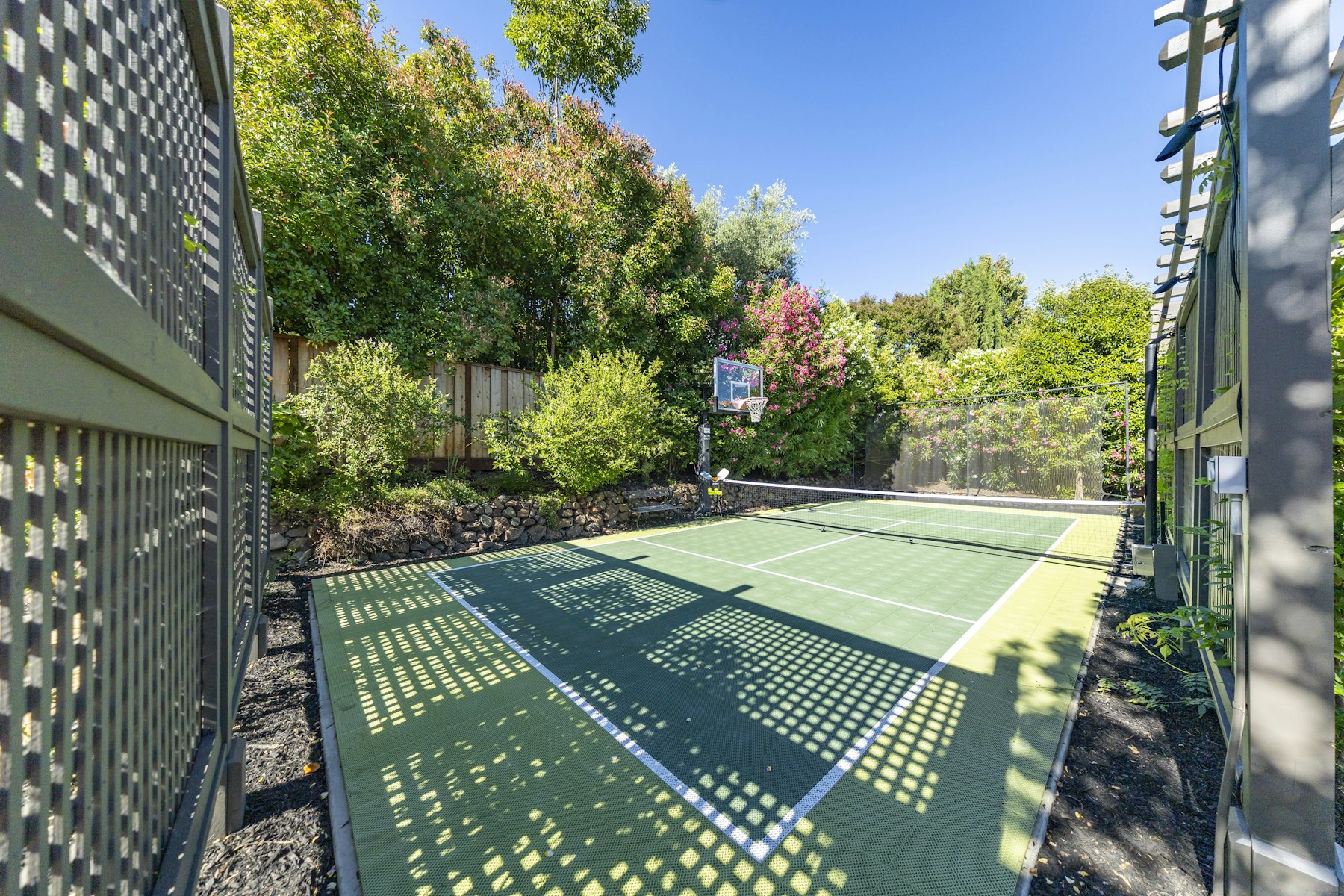
Pickleball Court Noise Reduction in New Jersey
The paddle-on-ball crack is what drives complaints, not the surface. Here's what installation choices actually cut noise for neighbors — and what's a waste of money.
Talk Through Your Site →Pickleball noise mostly comes from the paddle striking the ball, not the court surface, so resurfacing does almost nothing to quiet a court. What actually helps: sound barrier fencing (which costs more per linear foot than standard chain-link), maximum setback and orientation away from the nearest bedroom windows, and a dense planted buffer as a supplement — not a substitute — for a physical barrier. Combining two or three of these is far more effective than any one alone.
Why Pickleball Courts Draw Noise Complaints Tennis Courts Don't
A tennis ball hitting a strung racket produces a relatively low, dull thock that doesn't travel far. A pickleball paddle striking a hard plastic ball produces a sharp, high-frequency crack — closer in character to a starter pistol than a tennis stroke — and that frequency range carries much farther through open air and reflects off hard surfaces like siding and driveways. Four courts packed into one former tennis footprint (a common conversion layout) means four times the strikes in the same space, which is why converted courts are a frequent source of new complaints in previously quiet neighborhoods. Orientation does double duty here, too — the same layout decision that keeps sun out of players' eyes also affects which direction the loudest part of the court points. See our court orientation and sun glare guide for the sun-glare side of that same design choice.
This matters for what you spend money on. Surface choice, cushioned acrylic systems, and even court color have essentially no effect on this noise, because the sound isn't coming from the court — it's coming from the paddle and ball in the air above it. Anyone marketing a resurfacing job as a noise fix is selling you the wrong solution.
Installation Choices That Actually Reduce Noise
Sound Barrier Fencing
Solid or absorptive composite panels along the sides facing homes, instead of open chain-link. This is the single most effective retrofit for an existing court — it directly blocks and absorbs sound at the source instead of relying on distance.
Orientation & Setback
Positioning the court as far as practical from the nearest bedroom windows, and angling it so the loudest sightline (down the length of the court) doesn't point straight at a neighbor's yard. Free to plan for on a new build; expensive to fix after the fact.
Dense Planted Buffer
A thick row of evergreens or a berm softens sound and, just as important, removes the court from a neighbor's sightline — out of sight measurably reduces how much noise registers as annoying, separate from the actual decibel drop.
Play-Hour Limits
Not a construction choice, but the cheapest lever available: a written or HOA-enforced curfew (commonly no play before 8 a.m. or after dusk) prevents the complaints that come from early-morning or late-evening games specifically.

Barrier, Distance & Orientation
The paddle crack happens in the air, so the fixes that matter are physical: a sound barrier along the sides facing homes, maximum setback from bedroom windows, and a layout angled away from the neighbor.
- ✓ Sound barrier fencing on the exposed sides
- ✓ Maximum practical setback and screening
- ✓ Orientation away from the nearest yard
Planning a Court Near Close Neighbors?
We'll walk the site with you, flag where noise is likely to be an issue, and lay out barrier and orientation options before you submit for approval.
Request a Site Visit →What This Costs, and What Isn't Worth Buying
Sound barrier fencing costs more per linear foot than standard chain-link, and the price depends on the material and height — see our full court fencing and lighting installation guide for the rest of the fencing budget. You don't need to barrier the entire perimeter; fencing the two sides facing the closest homes and leaving the rest as standard chain-link is usually enough to meaningfully cut complaints for a fraction of a full-perimeter cost. A dense evergreen buffer adds a modest landscaping line item on top of that, but shouldn't replace it.
What we'd steer you away from: paying a premium for a "sound-reducing" or "quiet" surfacing system marketed for pickleball. We haven't seen one that changes the paddle-crack noise enough to matter, and the money is better spent on barrier fencing or a better-oriented layout. If a neighbor has already complained, don't start with landscaping — it's the slowest and weakest fix, and it won't read as a serious response to someone who's already upset.
It also helps to know what's actually at stake beyond an annoyed neighbor. New Jersey has a statewide noise standard and a separate private nuisance legal doctrine that can apply to a court sited too close to a property line — see our guide to what happens if a neighbor complains about your court for the ordinance limits, a real New Jersey example, and how a complaint actually escalates if it isn't addressed early.
Where Noise Fits Into Approval
Noise is one of the most common objections HOA boards raise when reviewing a court submission, and it comes up in municipal review too when a project is close to neighboring homes. Addressing orientation, buffer landscaping, and (where relevant) barrier fencing in your submission — rather than waiting for a board member or neighbor to raise it — is what separates a proposal that clears in one pass from one that gets sent back for revisions. See our guides to HOA approval for a court in NJ and HOA & zoning rules in Essex County for how boards evaluate this alongside setbacks and coverage limits.
Related Guides
Court Fencing & Lighting Installation in NJ
Full fencing cost breakdown, including where barrier panels fit into the budget.
Getting HOA Approval for a Court in NJ
What boards look for and the most common reasons proposals get rejected.
Convert a Tennis Court to Pickleball in NJ
Why four-court conversions are a frequent source of new noise complaints.
Sport Court Surface Types for New Jersey
What surface choice does and doesn't change about how a court sounds and plays.
Court Installation in Colts Neck, NJ
Why multi-acre horse-country lots rarely turn noise into a neighbor dispute in the first place.
Noise Reduction FAQs
Does resurfacing a pickleball court make it quieter?+
Barely, and don't pay extra for a "quiet" coating claim. The dominant noise is the paddle striking the ball, which happens in the air above the surface — the surface itself has almost nothing to do with it. A cushioned acrylic system softens footstep and bounce sound slightly, but it will not meaningfully change what a neighbor two yards over hears. If noise is the concern, put the budget toward a barrier or setback instead of a surfacing upgrade.
What is sound barrier fencing and does it actually work for pickleball?+
Sound barrier fencing uses solid or absorptive panels — often a dense composite or mass-loaded material — instead of open chain-link, and it's mounted along the sides of the court facing the nearest homes. It noticeably reduces how far the sharp paddle-on-ball crack carries to adjacent yards, but it doesn't eliminate it, especially straight through gate openings or over the top on two-story properties. It works best as one part of a plan that also includes distance and orientation, not as a standalone fix.
How far should a pickleball court be from property lines to avoid noise complaints?+
There's no universal number — it depends on the town's setback rule, the topography, and how sound-sensitive the neighboring property is. As a practical matter, the farther a court sits from the nearest bedroom windows and the more it's screened by structures, grade changes, or dense planting, the fewer complaints we see. If your town or HOA has a required setback, treat that as a floor, not a target — pushing further back when the lot allows it is cheap insurance against a complaint later.
Can landscaping alone fix a noise complaint?+
Not on its own. A dense evergreen buffer softens the sound somewhat and helps visually, but plantings alone don't block or absorb enough of a paddle strike's sharp, high-frequency crack to satisfy a neighbor who's already upset. Landscaping is a reasonable supplement to a physical barrier and adequate setback — treating it as the whole solution is the most common mistake we see in HOA submissions that get sent back.
Do New Jersey towns have noise ordinances specific to pickleball?+
Some do, most don't yet — it's handled inconsistently. A growing number of NJ municipalities have added play-hour restrictions (commonly something like no play before 8 a.m. or after dusk/9 p.m.) in response to complaints, rather than a blanket decibel standard for the sport. Check your specific town's noise ordinance and, if you're in a governed community, your HOA's rules — see our guide to HOA approval for a court in NJ for how noise typically factors into that review.
Get a Noise-Conscious Court Plan
Tell us about your lot and nearest neighbors — we'll factor orientation, setback, and barrier fencing into the layout before you submit for approval.
Request a Quote →