
Building a Court Near an Existing Pool
Keeping the pool and adding a pickleball or tennis court next to it — pool barrier code, drainage direction, and what actually decides whether it fits.
Check What Fits →A court can go in next to a pool you're keeping if the lot has room for the court's footprint plus clearance for drainage and any pool-barrier fencing overlap. New Jersey pool barrier code (2018 ISPSC under N.J.A.C. 5:23) sets a 48-inch minimum barrier height and tight gap limits; if your court fence doubles as part of that barrier, it has to meet those specs. There is no single statewide court-to-pool setback — that number comes from your town and a site visit, not a table on this page.
What Actually Decides Whether It Fits
Remaining yard shape
A pool that's already sited takes a bite out of the buildable area and often forces an irregular shape for the court footprint rather than a clean rectangle. We measure what's actually left, not just total square footage.
Pool equipment location
Filters, heaters, and pumps need service access and their own clearances. A court laid out without accounting for that access is a court someone has to work around every time the pool needs maintenance.
Existing yard drainage
How the yard currently sheds water — toward the pool, away from it, or through a drain system — determines how much regrading the court needs so its runoff doesn't end up in the pool.
Fence and barrier overlap
Whether the court's perimeter fence can double as part of the required pool barrier, or whether the pool needs its own separate barrier regardless of the court fence, changes the fencing scope and cost.
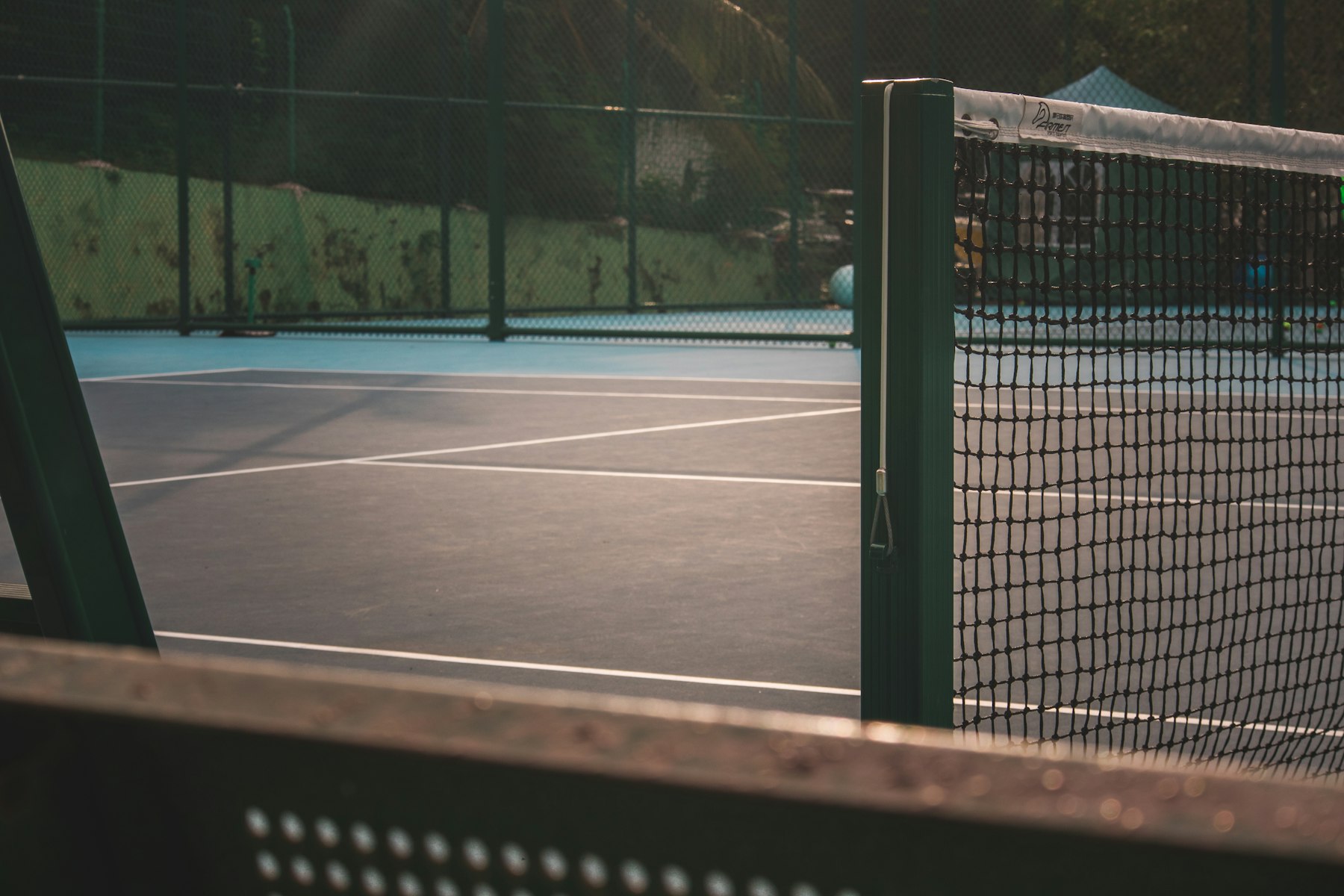
If the Court Fence Is Also the Pool Barrier, It Has to Meet Pool Code
New Jersey's pool barrier rules (2018 ISPSC, N.J.A.C. 5:23) set a 48-inch minimum height and strict gap limits — tighter in some respects than a standard sport-court fence spec. That overlap only applies when one fence is serving both jobs, and it's a call your local construction office makes for your layout.
- ✓ 48-inch minimum barrier height
- ✓ Gaps under 1¾ inches between ground and barrier
- ✓ No opening large enough to pass a 4-inch sphere
Drainage: Away From the Pool, Every Time
A court slab is graded to shed water off its own surface at a controlled slope — the same drainage principle behind any NJ court build, detailed in our court drainage systems guide. Next to a pool, that grading plan gets one additional, non-negotiable requirement: runoff has to route away from the pool deck and equipment pad, not toward it. Water sheeting toward a pool deck creates a standing-water and slip hazard on the deck itself, and water reaching the equipment pad can interfere with filtration and electrical equipment that was never designed to sit in runoff.
This is one of the first things we check on a site visit when a pool is already on the property, because it constrains which side of the pool the court can realistically go on before layout, dimensions, or cost are even part of the conversation. A lot where the natural grade already falls away from the pool toward the rest of the yard is a much simpler drainage problem than one where the pool sits at the low point.
None of this changes based on which sport you're building — the same drainage-away-from-the-pool principle applies whether you're planning a pickleball court or a full tennis court footprint next to the pool.
If the Yard Doesn't Have Room for Both
Some lots genuinely don't have room for a full-size court next to an existing pool without removing it. If that's the situation you're looking at, the comparison isn't court-vs-nothing — it's worth reading our pool removal for court installation guide alongside this one before deciding, since full demolition and partial fill-in are priced and scoped very differently, and one may make the pool-removal question moot if the yard has more usable space than it first appears.
A smaller footprint is the other option worth pricing before ruling a project out — see our guide to how small a yard can be and still fit a court for real minimum footprints by sport, not just regulation dimensions.
Have a Pool and Want to Add a Court?
Tell us your yard layout and whether the pool is staying — we'll check drainage, barrier overlap, and what actually fits.
Check What Fits →Related Guides
Removing a Pool to Build a Court
Full demolition vs. partial fill-in if the pool has to go instead.
Court Drainage Systems in New Jersey
Slope requirements and how NJ courts are engineered to shed water.
How Small Can a Yard Be and Still Fit a Court?
Real minimum footprints by sport if the pool is staying and space is tight.
Pickleball Court Dimensions & Space Requirements
The footprint you're trying to fit alongside the pool.
Court Construction Insurance in New Jersey
What changes on a homeowner's policy after adding a court near a pool.
Getting HOA Approval for a Court
Relevant if your HOA already has pool-adjacent construction rules.
Sources
Court Near a Pool FAQs
Can I build a pickleball or tennis court next to my pool without removing it?+
Yes, if the lot has room for both the court's footprint and the setback and drainage separation between them. This is a different project from removing a pool to make room for a court — here the pool stays, and the question is whether the remaining yard fits a properly drained, code-compliant court next to it. Lot shape, existing pool equipment location, and how the yard currently drains all factor into whether it fits and what it costs.
Does New Jersey pool barrier code affect where I can put a court?+
New Jersey adopts the 2018 International Swimming Pool and Spa Code under N.J.A.C. 5:23, which sets barrier requirements for pools — a minimum 48-inch barrier height, no more than 1¾ inches between the ground and the bottom of the barrier, and openings that don't allow a 4-inch sphere to pass through. If a court's perimeter fence is also serving as part of the required pool barrier, that fence has to meet pool-barrier code, which is stricter in some respects than a standard sport-court fence spec. Whether that overlap applies to your layout is a site-specific call your local construction office makes, not a statewide blanket rule.
How far does a court need to be from a pool?+
There is no single statewide setback between a court and a pool — pool equipment clearances, court fencing setbacks, and property-line setbacks are each governed separately and vary by municipality. As a practical matter, a court needs enough separation from the pool and its equipment pad to grade drainage away from the pool (not toward it) and to keep the court's fence from interfering with required pool-access clearances. We confirm your specific numbers with your local construction office as part of the site visit rather than publishing a number that may not apply to your town.
Which way should drainage run if a court sits near a pool?+
Away from the pool, always. A court slab is graded to shed water off its own surface, and that grading plan needs to route runoff away from the pool deck and equipment pad rather than toward it — water pooling against a pool deck or backwashing toward pool equipment is a drainage design mistake, not a rare edge case. This is one of the first things we check on a site visit when a pool is already on the property.
Does adding a court near a pool affect my homeowner's insurance or pool inspection?+
It can affect what your town's construction office reviews together, since a new impervious surface, new fencing, and any electrical work for lighting near an existing pool can all come up in the same permit review. It's also worth flagging to your insurance carrier along with the pool itself, the same way any major yard improvement is. Our guide to court construction insurance covers what typically changes on a homeowner's policy after adding a court.
Get a Site Visit for Your Pool-Adjacent Yard
Tell us your yard layout and pool location — we'll confirm drainage, fencing, and footprint before you commit to a design.
Request a Quote →