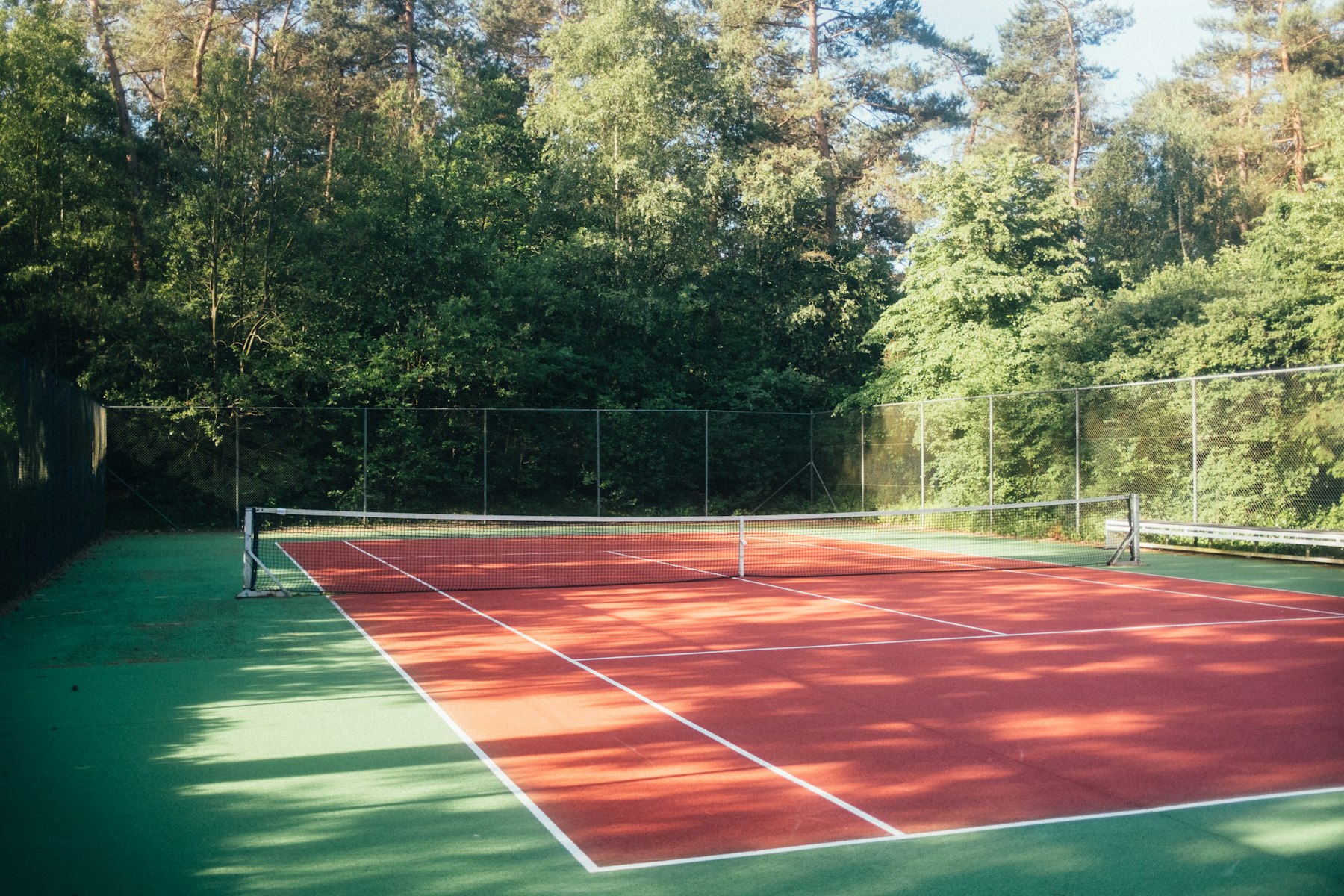
Grass Tennis Courts in New Jersey
Wimbledon makes it look effortless. Here's the maintenance schedule behind that surface, and why we point most New Jersey clients toward clay or cushioned acrylic instead.
Talk Through Your Surface Options →A real grass tennis court needs mowing three to four times a week to an 8–10mm blade height and rolling with a ballast roller at least weekly through the season, plus watering after every use. New Jersey's humidity, storm pattern, and winter dormancy all fight against that upkeep holding. We can build one, but for the overwhelming majority of NJ homeowners we recommend a clay court for surface feel or cushioned acrylic for low maintenance.
What a Grass Court Actually Requires
Mowing
Three to four cuts a week during the growing season, held to roughly 8–10mm blade height. Miss a week and the bounce noticeably changes.
Rolling
A ballast roller pass at least weekly to keep the turf dense and firm. This is the step most homeowners aren't equipped for — it takes different gear than a mower.
Watering & Recovery
Watering after nearly every use, plus overseeding and recovery time each spring after winter dormancy takes the court out of play.
This is the routine that keeps a tournament-grade grass court playable. Skip any one of these for more than a couple of weeks and the surface stops behaving like a grass court — it just becomes an uneven lawn with lines painted on it.

It's Not the Build. It's Every Week After.
Grass is one of the few tennis surfaces where the ongoing labor costs more attention than the construction did. A mower and a roller become part of your weekly schedule, not an occasional weekend job.
- ✓ Mowed 3–4x/week in season
- ✓ Rolled weekly with a ballast roller
- ✓ Watered after most sessions
Why New Jersey's Climate Fights You
Most grass courts that hold up long-term sit in climates with mild, even summers and short, mild winters. New Jersey has neither. Summer here swings between humid stretches that push fungal disease into dense turf and sudden thunderstorms that can wash out a match and leave the surface soft for a day or two afterward. Grass wants consistency; our weather doesn't give it that.
Winter is the bigger problem. Cool-season turf varieties — the ones that can survive a New Jersey winter at all — go fully dormant once temperatures drop, which means the court simply isn't playable for several months. Come spring, it needs weeks of recovery, overseeding, and careful mowing before it's back to a firm, true-bouncing surface. Warm-season grasses that tolerate heavier play don't reliably survive our winters in the first place, so that option is mostly off the table here. Compare that to a clay or acrylic court, both of which are ready to play on again within days of a freeze-thaw cycle passing, not weeks.
There's also the honest labor math. A grass court isn't a set-it-and-forget-it install — it's closer to owning a second, higher-maintenance lawn that also needs to be dead flat and firm enough for a true bounce. Most residential clients aren't looking to take that on, and most club-level facilities that could staff for it already have other surfaces that serve members better across a longer season.
What We'd Actually Recommend Instead
If what you actually want is the slower, softer game grass gives you — the ball sitting up a little lower, less strain on the knees during long rallies — a clay court gets you most of that feel with a fraction of the weekly labor. True clay still needs regular watering and rolling, but nowhere near the mowing schedule grass demands, and it doesn't go dormant for a season. Har-Tru, the crushed-stone version most NJ clay courts actually use, cuts the maintenance further while keeping the same playing character.
If low maintenance matters more than matching that specific feel, a cushioned acrylic surface on a post-tension concrete base is the practical call for most New Jersey backyards. It's ready to play on the day after a rainstorm, doesn't need weekly rolling, and the cushioned layer takes real pressure off knees and ankles — see our installation cost guide for how that option prices out against a standard build.
We won't talk a client out of grass who has the property, the staff, and genuinely wants it — a handful of estate-scale properties in New Jersey do maintain one well, usually with a dedicated groundskeeper on payroll already. For nearly everyone else, the honest recommendation is a surface that survives our weather without a full-time maintenance schedule behind it.
Not Sure Which Surface Fits Your Yard?
Tell us how you actually plan to use the court and how much upkeep you want to take on — we'll walk through clay, acrylic, and cushioned options before you commit to a build.
Request a Quote →The Rare Cases Where Grass Still Makes Sense
None of this means grass is never the right call in New Jersey — it means the honest list of people it's right for is short. It fits an estate-scale property that already carries a full-time groundskeeper for the rest of the grounds, where a few more hours a week of mowing and rolling gets absorbed into an existing routine rather than becoming a new one. It fits an owner who genuinely values the surface's look and feel over year-round availability, and who's comfortable losing several months a year to winter dormancy plus spring recovery.
It doesn't fit a family that wants a court the kids can use on a random Tuesday after school, a household without existing grounds staff, or anyone comparing surfaces mainly on upfront construction cost — grass isn't usually the most expensive surface to build, but it's consistently the most expensive to keep in playable shape over the years that follow. Before signing off on grass, it's worth pricing out a season of professional turf maintenance alongside the build itself, not just the build in isolation, since that ongoing number is what actually determines whether the surface stays enjoyable or turns into a chore nobody wants to keep up with.
If after all that you still want it, we'll build it — a New Jersey grass court engineered on a proper sand base with real subsurface drainage plays as well as any other, provided the maintenance schedule above actually gets followed. What we won't do is quote it as a low-maintenance option, because for this specific surface, that would simply be inaccurate.
Related Guides
Clay Tennis Court Installation Cost in NJ
Real clay vs. Har-Tru, cost, and the maintenance routine — a lower-upkeep alternative to grass with a similar feel.
Sport Court Surface Types in New Jersey
Asphalt, concrete, cushioned acrylic, and modular tile compared for NJ conditions.
Best Court Surfaces for New Jersey Winters
How different surfaces actually hold up through a NJ freeze-thaw season.
Court Maintenance Schedule & Cost
Weekly, seasonal, and annual upkeep tasks for the surfaces we actually build.
Grass Tennis Court FAQs
Can you build a grass tennis court in New Jersey?+
Physically, yes — but almost nobody should. A grass court needs a specific, dense turf grown on an engineered, dead-flat sand base, mowed several times a week and rolled to keep the surface firm. New Jersey's humidity, summer thunderstorm pattern, and winter freeze cycle all work against that turf staying in playable shape without daily attention. We'll build one if a client insists after seeing the real maintenance picture, but we steer almost everyone toward clay or a cushioned acrylic court instead.
How often does a grass tennis court need to be mowed?+
Championship-level grass courts are mowed three to four times a week during the growing season, kept to a blade height around 8–10mm. Skip a few cuttings and the ball bounce changes enough that play feels different court to court, which is part of why grass courts fell out of favor everywhere except a handful of clubs with full-time groundskeeping staff.
How often does a grass court need rolling?+
At least once a week during the season, with a ballast roller, to keep the surface firm enough for a true bounce. A grass court that's only mowed and not rolled turns soft and uneven fast — rolling is the step homeowners underestimate most, because it takes different equipment than a mower and has to happen on a schedule regardless of whether anyone's traveling or busy that week.
What's a realistic alternative to grass that still feels different from a hard court?+
Clay is the honest answer. It gives a similar slower, lower-bouncing game with a softer feel underfoot, and it holds up to New Jersey's weather far better than turf — see our clay tennis court installation guide for real cost and upkeep. If low maintenance matters more than surface feel, cushioned acrylic gets you a joint-friendly surface with a fraction of the weekly labor.
Does grass even survive a New Jersey winter?+
Cool-season turf goes dormant in winter here, which is fine for a lawn but means the court simply isn't playable for several months and needs recovery time each spring before it's back to tournament firmness. Warm-season grasses that hold up better in southern climates don't reliably survive a New Jersey winter at all. Either way, you're budgeting for a shorter playing season than clay or a hard court gives you.
Get a Real-World Surface Recommendation
Send us your yard and how often you plan to play — we'll tell you straight which surface actually fits, grass included if it truly makes sense.
Request a Quote →