Best Court Divider Netting & Ball-Stop Systems for NJ Courts
Douglas and Carron divider and barrier nets compared on published mesh, break strength, height and outdoor finishes — for multi-court backyard and community pads.
Get a Free Site Visit →By NJ Court Pros · Updated November 9, 2026
For an outdoor New Jersey multi-court pad, start with a custom divider sized for pickleball or tennis mesh — roughly 1-1/2 to 1-3/4 inch — at 10 or 12 feet high, with an outdoor-weighted bottom hem and weather-treated black netting. Douglas publishes those builds with 125 lb (#420 pylon) and 250 lb (HTPP) break-strength figures. Use a separate perimeter ball-stop net when the job is keeping balls out of a yard, pool or street. Table order is not a ranking.
Disclosure: NJ Court Pros builds and outfits courts and earns money when you hire us. No netting manufacturer paid for placement. Every product fact below comes from the manufacturer's own page, linked in Sources. Quote-only — no prices.
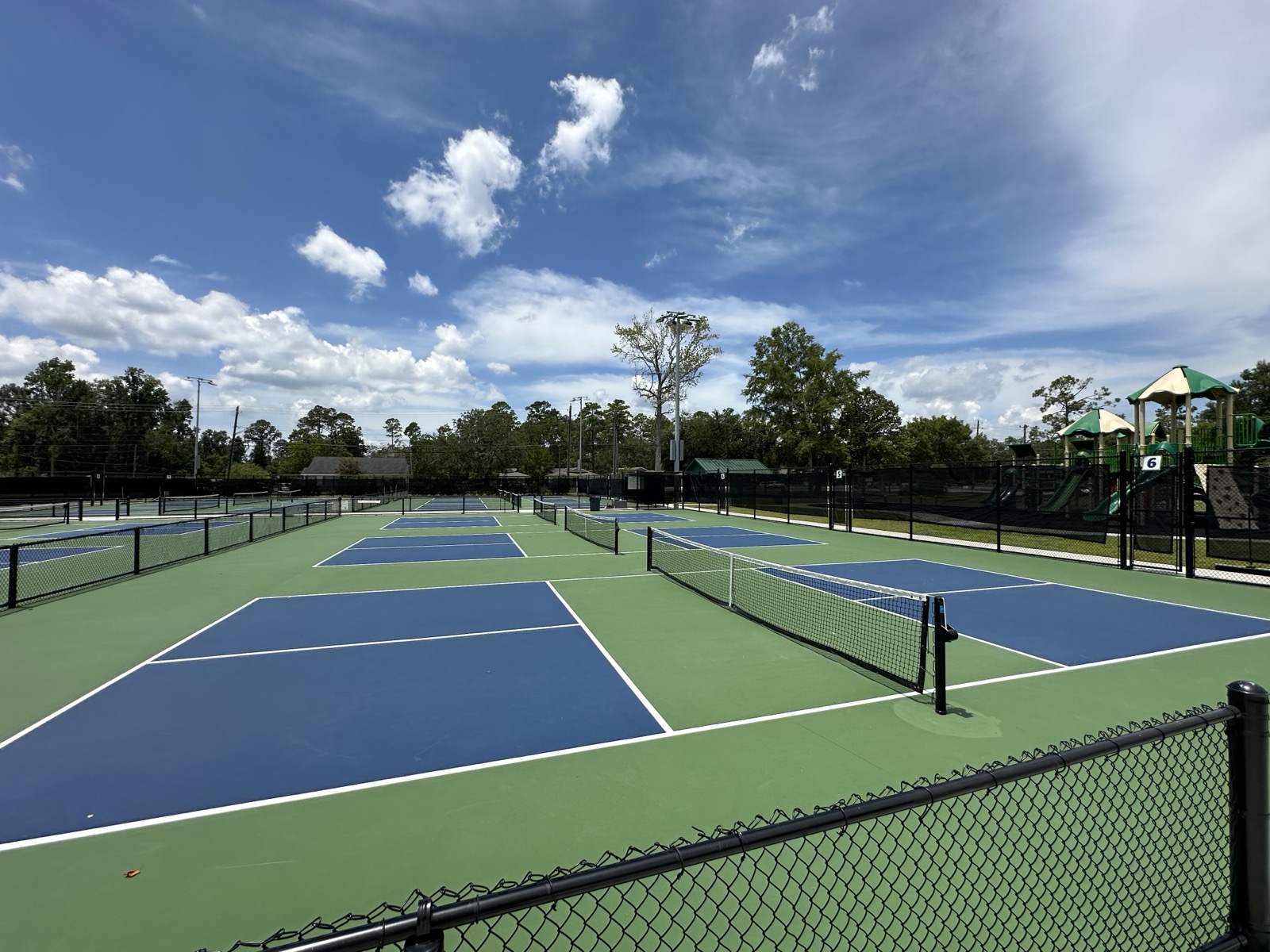
Photo: pickleball courts 4–6 at the Harry B. Anderson Tennis Center in Valdosta, Georgia, split by low chain-link dividers (GA Kevin, CC0, Wikimedia Commons) — an illustrative multi-court layout, not a New Jersey project or a product endorsement.
Why Multi-Court NJ Pads Need Both Jobs Named
A shared concrete or asphalt pad with two or four pickleball courts looks efficient on a plan set. In play, every lob that clears the sideline becomes the next court's problem, and every ball that clears the fence becomes a neighbor problem. Those are two different netting jobs:
- Court divider netting hangs between courts so games do not collide. Douglas describes it as a barrier for ball control between tennis, pickleball and multi-sport courts while still allowing ventilation.
- Perimeter ball-stop / barrier netting rings the outside. Carron separates ball-barrier nets from court dividers and says mesh selection is usually dictated by the smallest object in play.
This page is a product comparison for those systems. It is not a windscreen or fence guide — see our net, post and windscreen installation guide and net-post systems comparison for those.
How We Compared
- Published mesh size and fiber (pickleball needs a small mesh).
- Published break strength when the maker states one.
- Standard heights and whether custom sizes are offered.
- Indoor kickplate vs outdoor weighted-hem details.
- Clear divider vs perimeter-barrier product families.
Divider & Ball-Stop Systems Compared
| System | Job | Mesh | Break strength | Height / finish notes |
|---|---|---|---|---|
Custom divider netting — #420 knotless pylon Douglas Sports | Court-to-court divider (tennis, pickleball, multi-sport) | 1-1/2 in square, knotless pylon (black or white) | 125 lb break strength (maker figure) | Standard 10 ft or 12 ft; custom heights available. Black weather-treated for outdoor UV/moisture; white indoor only; brass grommets every 18 in; outdoor bottom hem with weighted leaded rope |
Custom divider netting — premium HTPP Douglas Sports | Higher break-strength divider for outdoor multi-court pads | 1-3/4 in square, knotless polypropylene HTPP (black or white) | 250 lb break strength (maker figure) | Standard 10 ft or 12 ft; custom heights available. Same border/grommet system; outdoor weighted hem; indoor 12 in solid-vinyl kickplate (18 in VCP mesh or 24 in netting options) |
Light-duty court divider — #15 nylon Carron Net | Elementary / rec-center / tennis & pickleball dividers (maker use list) | 1-3/4 in mesh, #15 nylon (#77708) | Not published as a single break-strength figure on the divider page | Made to order (commonly ordered around 10 ft for tennis; confirm on quote). 100% nylon; light-weight; all Carron barrier nets made to order |
Standard-duty court divider — #21 nylon, 1-3/4 in Carron Net | Ball containment and area separation for baseball, softball, basketball, volleyball and multi-sport rooms | 1-3/4 in mesh, #21 nylon (#77702) | Not published as a single break-strength figure on the divider page | Made to order. Heavier #21 nylon than the light-duty divider; select mesh for the smallest ball you need to stop |
Standard-duty court divider — #21 nylon, 4 in Carron Net | Football, soccer, volleyball containment where a larger mesh is enough | 4 in mesh, #21 nylon (#77703) | Not published as a single break-strength figure on the divider page | Made to order. Too open for pickleball balls — use only when the smallest object is larger than a pickleball |
Standard-duty ball barrier — #21 nylon, 1-1/2 in Carron Net | Perimeter ball-stop / containment (maker lists lacrosse, hockey, multi-sport) | 1-1/2 in mesh, #21 nylon (#77701) | Not published as a single break-strength figure on the barrier page | Made to order for the run. Carron says all ball barrier nets are 100% nylon, weather treated and UV stabilized for indoor and outdoor use; fixed or walk-drawn |
Heavy-duty ball barrier — #36 nylon, 1-3/4 in Carron Net | Impact barrier (maker lists baseball, softball, basketball, volleyball, multi-sport) | 1-3/4 in mesh, #36 nylon (#77705) | Not published as a single break-strength figure on the barrier page | Made to order for the run. Heaviest twine in Carron's barrier list; weather treated and UV stabilized per the maker |
Light-duty ball barrier — #420 knotless nylon, 1-3/4 in Carron Net | Containment and ceiling barriers (maker lists baseball, softball, basketball, volleyball, multi-sport) | 1-3/4 in mesh, #420 knotless nylon (#77711) | Not published as a single break-strength figure on the barrier page | Made to order for the run. Knotless construction, lighter than the #21 and #36 barrier twines; weather treated and UV stabilized per the maker |
Douglas Custom Divider Netting
Douglas Sports manufactures custom divider netting in the USA for indoor and outdoor tennis, pickleball and multi-sport facilities. Its product page lists two primary mesh builds: #420 knotless pylon at 1-1/2 inch square mesh with a 125 lb break strength, and premium HTPP polypropylene at 1-3/4 inch square mesh with a 250 lb break strength, each in black or white.
Outdoor details matter in New Jersey. Douglas says black netting is weather-treated for moisture and sunlight, white is indoor-only, brass grommets sit every 18 inches along the top for a tension-cable hang, and outdoor bottoms use a weighted leaded rope in the hem so the panel stays down in wind. Indoor builds add a kickplate — 12-inch solid vinyl as the standard, with taller vinyl-coated polyester mesh or coordinated netting options — so balls do not slide under. Standard heights are 10 or 12 feet; custom heights are available. Douglas suggests planning length around a 120-foot tennis-court run, often split into two 60-foot sections for handling.
Carron Court Dividers & Ball Barriers
Carron Net (Two Rivers, Wisconsin) sells made-to-order nylon court divider nets and a separate ball-barrier family. Its divider page lists a light-duty #15 nylon, 1-3/4 inch mesh commonly used for elementary schools, church and recreation multi-purpose rooms, and tennis or pickleball dividers; a standard-duty #21 nylon, 1-3/4 inch mesh for broader multi-sport containment; and a 4-inch #21 nylon option for football, soccer and volleyball — too open for pickleball.
Carron's divider page frames these nets mainly for gyms, recreation centers and multi-sport rooms, and it says netting selection is usually dictated by the smallest ball in play. All Carron barrier nets are made to order, so the height and length come from your site measurements rather than a catalog size.
Carron Ball Barriers For The Perimeter
The perimeter job is a separate Carron product family. Its ball-barrier page says the nets can be fixed in position or walk-drawn, and that all of them are 100% nylon, weather treated and UV stabilized for indoor and outdoor use. Three styles have a mesh small enough to matter for pickleball: a standard-duty #21 nylon at 1-1/2 inch (#77701), a heavy-duty #36 nylon at 1-3/4 inch (#77705) that Carron calls an impact barrier, and a light-duty #420 knotless nylon at 1-3/4 inch (#77711) that it lists for containment and ceiling barriers. The 4-inch #21 barrier is again too open for a pickleball.
Carron does not publish a single break-strength figure for these styles on the page, so the twine number is the practical guide: a higher number means a heavier twine. On a New Jersey backyard pad that backs up to a pool, a patio or a street, the perimeter barrier is usually the second line item after the mid-court divider, and the heavier twine is worth asking about wherever hard-hit balls reach the net on the fly.
Douglas Fabrication Details That Change The Bid
Douglas finishes its divider perimeters with 1-1/2 inch double-sewn vinyl-coated polyester tape in black or white, and spaces heavy-duty brass grommets every 18 inches along the top for a tension cable, with custom spacing on request. For indoor courts the kickplate can be sewn on permanently or attached with Velcro; Douglas notes that the Velcro option lets you replace a worn kickplate later without replacing the whole panel. Kickplates come as 12-inch solid vinyl, 18-inch vinyl-coated polyester mesh or 24-inch coordinated netting, and the 18 oz vinyl comes in sixteen listed colors.
On length, Douglas says a tennis-court divider should run the length of the court, 120 feet, and can be split into two 60-foot sections or custom sections for handling and storage. It also recommends adding some length to each net to allow for natural bunching when hung. A pickleball pad is shorter than a tennis court, so ask for a length based on your actual run, plus that allowance, rather than a tennis default. Douglas also publishes bid specifications for its #420 knotless pylon netting on the same page, which is useful if an HOA or club board wants a written spec to bid against.
Matching The Net To The Yard
Two pickleball courts on one backyard slab. The usual answer is a single outdoor divider between the courts in black weather-treated netting, about 1-1/2 to 1-3/4 inch mesh, with a weighted bottom hem. If one side faces a pool or the house, add a perimeter barrier on that side only.
An HOA or club block of four courts. Expect several dividers plus a perimeter barrier along any parking lot, walkway or road. This is where a written spec matters, because the board will compare bids. Name the mesh, twine or break strength, height, top hardware and bottom finish for every run.
An indoor court in a barn, garage or pole building. Indoors, Douglas's white netting and vinyl kickplates become options, and Carron's light-duty nylon dividers are aimed at exactly this kind of multi-purpose room. Check the clear height under beams and lights before choosing 10 or 12 feet.
A tennis court with pickleball lines. If you play both sports on one surface, the divider has to come down or be pulled aside for tennis. Ask about walk-drawn or removable hardware rather than a fixed panel across the court.
What To Specify On A Bid
- Divider vs perimeter barrier (or both), with lengths measured on site.
- Mesh size small enough for a pickleball (about 1-1/2 to 1-3/4 in).
- Height (10 ft, 12 ft, or custom) and indoor vs outdoor finish.
- Top hardware: cable, track, or building attachment; grommet spacing.
- Bottom treatment: weighted hem outdoors; kickplate indoors.
- Posts, sleeves and frost-line footings when the net is not building-mounted.
Related reading: modular tile vs poured surfaces, pickleball surface systems, and court shade structure costs.
FAQ
What is the best court divider netting for a New Jersey backyard or HOA pad?
There is no single best SKU. For outdoor pickleball or tennis dividers, Douglas publishes two clear outdoor-ready builds: #420 knotless pylon at 1-1/2 in mesh with a 125 lb break strength, and premium HTPP at 1-3/4 in mesh with a 250 lb break strength, both in standard 10 or 12 ft heights with a weighted outdoor bottom hem. Carron makes light-duty and standard-duty nylon dividers to order and says mesh choice should follow the smallest ball you need to stop. Match height, mesh and mounting to the pad — then get a site quote.
Do I need divider netting or perimeter ball-stop netting?
Different jobs. A divider hangs between two courts on the same slab so balls and players stay out of the next game. A perimeter ball-stop / barrier net rings the outside of a court or practice area to keep balls out of a yard, pool, parking lot or street. Carron lists them as separate product families. Many multi-court New Jersey pads need both.
How tall should a pickleball court divider be?
Douglas lists standard divider heights of 10 ft and 12 ft, with custom heights available. For pickleball, taller is usually better because lobs and mishits clear a tennis-height windscreen easily. Measure the space under any existing cable or beam before you order.
Indoor vs outdoor divider netting — what changes?
Douglas says black netting is weather-treated for moisture and sunlight and that white netting is for indoor use only. Outdoor bottoms get a weighted leaded rope in the hem; indoor builds add a kickplate (12 in solid vinyl standard, with taller mesh or netting options) so balls do not roll under. Order the finish for the climate you actually have.
Will 4-inch mesh stop a pickleball?
No. A pickleball will pass through 4-inch mesh. Carron lists its 4-inch #21 nylon divider for football, soccer and volleyball containment. For pickleball, stay with roughly 1-1/2 in to 1-3/4 in mesh — the sizes Douglas and Carron publish for tennis/pickleball dividers.
How much does court divider netting cost in New Jersey?
We quote after a site visit and do not publish price ranges. The number moves with height, length, mesh grade, indoor kickplates vs outdoor weighted hem, cable hardware, posts or building attachment, and access. Compare written bids that name the exact mesh and height.
Sources
- Douglas Sports — Custom divider netting — #420 knotless pylon
- Douglas Sports — Custom divider netting — premium HTPP
- Carron Net — Light-duty court divider — #15 nylon
- Carron Net — Standard-duty court divider — #21 nylon, 1-3/4 in
- Carron Net — Standard-duty court divider — #21 nylon, 4 in
- Carron Net — Standard-duty ball barrier — #21 nylon, 1-1/2 in
- Carron Net — Heavy-duty ball barrier — #36 nylon, 1-3/4 in
- Carron Net — Light-duty ball barrier — #420 knotless nylon, 1-3/4 in
Manufacturer pages accessed November 9, 2026. Quote-only; no prices.
Netting Between or Around Your Courts?
Tell us how many courts share the pad and what sits beyond the fence. We'll measure each run, check posts and footings, and send an itemized quote that names the mesh, height, hardware and bottom finish for every divider and barrier.
Request a Quote →