Tennis Court Birdbath Repair
Puddles that won't dry, what the industry's nickel test says, how low spots actually get fixed, and when patching stops making sense.
Book a Flood Test →By NJ Court Pros · Updated October 29, 2026
A birdbath is a low spot that still holds water deep enough to cover a nickel (about 1/16 inch) one hour after the court is flooded, at 70°F or warmer in sunlight. That is the American Sports Builders Association (ASBA) definition. Shallower puddles that dry within the hour are within tolerance. Real birdbaths get fixed by flood-testing, chalking, tacking and filling the low spot with a patch mix leveled to a straightedge, or by grinding a high spot next to it, then re-flooding to check. Patches work only to about 1/2 inch deep and can shrink, so deep or widespread birdbaths are a sign to talk about an overlay or a rebuild instead.
Disclosure: NJ Court Pros resurfaces and repairs tennis, pickleball and basketball courts in New Jersey and earns money when you hire us. The definitions, causes and repair limits on this page come from ASBA's published position paper and guidelines and a surfacing manufacturer's guidance, linked in Sources. We don't publish prices; every job is quoted after a site visit.
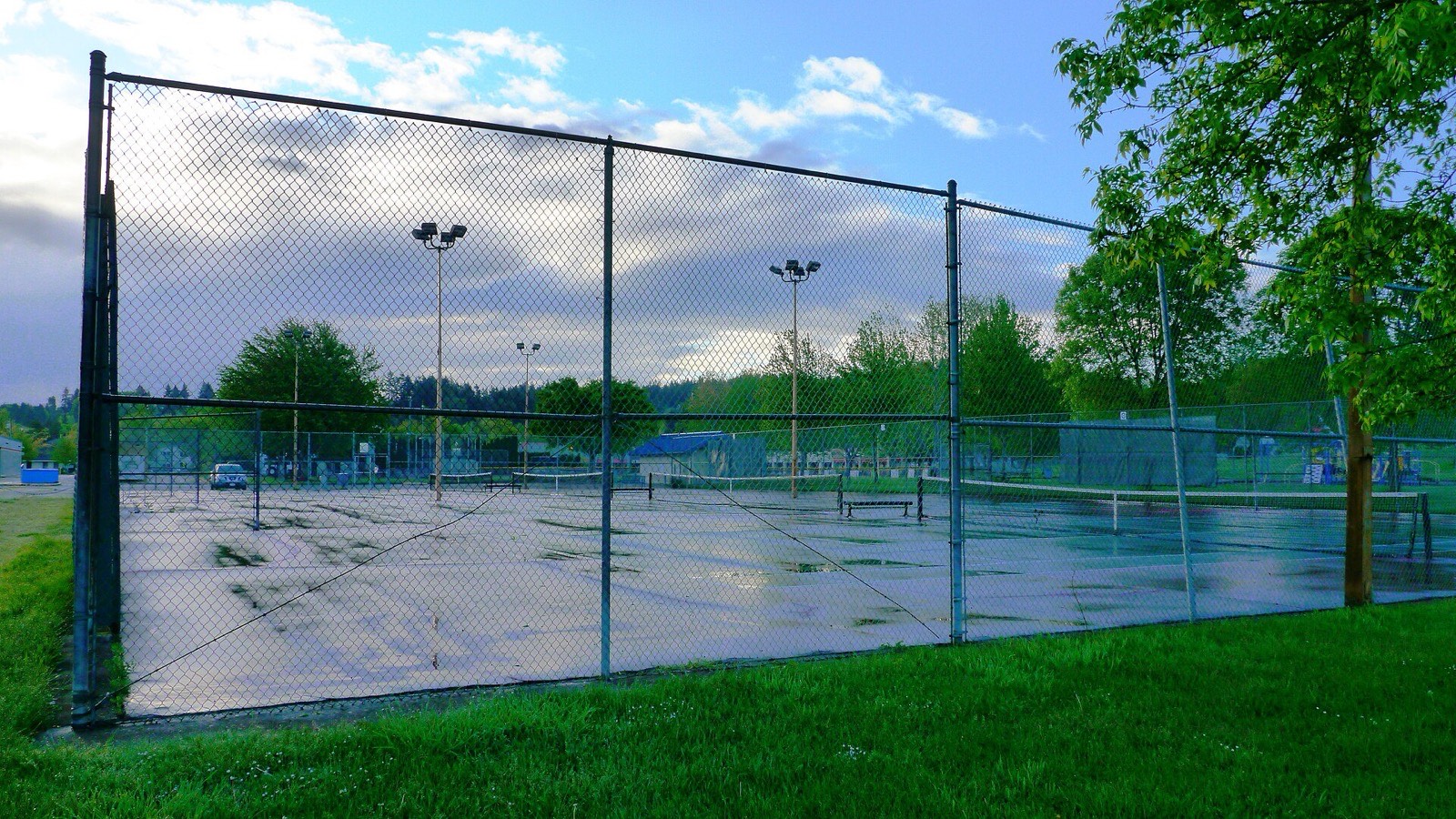
Hero photo: “Too wet to play tennis,” Churchill High School courts, Eugene, Oregon, by Rick Obst, CC BY 4.0, via Wikimedia Commons. Not one of our courts.
The Nickel Test: Is It Really a Birdbath?
Every outdoor hard court gets wet patches after a storm. That alone isn't a defect. The question is whether water is still sitting there after the court has had a fair chance to drain and dry. ASBA's position paper on birdbaths gives the industry definition: any area where standing water more than 1/16 inch (2 mm) remains after drainage has stopped, or after one hour of drying at 70°F in sunlight, commonly measured with a nickel.
You can run a rough version yourself on a warm, sunny day:
- Flood the court with a hose, or check it after a real rain once the rain has fully stopped.
- Wait one hour. The air should be at least 70°F with the court in sun. On a cool or cloudy day, the test reads worse than the court really is.
- Lay a nickel flat in each remaining puddle. If the water covers it, mark the spot with chalk and note it on a sketch of the court.
- Photograph the marked court from the fence. Those photos are what a contractor needs to scope the job.
ASBA is clear that perfection isn't a reasonable expectation. Minor depressions under 1/16 inch, or ones that dry in under an hour, are considered within tolerance even on a new court. On a new or recently resurfaced court, though, the position paper says the contractor should correct true birdbaths.
Why Courts Develop Birdbaths
ASBA lists five common causes. Which one you have decides whether a patch will last:
| Cause (per ASBA) | What it means on the court | What it means for the repair |
|---|---|---|
| Unsuitable subsoil | Organic or unstable material under the base keeps moving | Patched spots may reappear as settlement continues |
| Inadequate drainage around the court | Water has nowhere to go once it reaches the edge | Fix the outlet first, or the surface keeps getting wet from the edges in |
| Improper slope or grade | The court isn't a true single plane | Filling one spot can move the water to another |
| Inadequate subgrade compaction | The base has settled under traffic and weather | Like bad subsoil, a patch can sink again |
| Paving error | A dip left in the asphalt or concrete when it was placed | Usually the best candidate for a lasting patch |
ASBA also notes that even well-designed courts can develop birdbaths over time, and that courts are sometimes built on reclaimed or marginal sites where soil, grade or drainage were never ideal. In New Jersey, add freeze-thaw: water that sits in a low spot through a winter night freezes, and repeated cycles are hard on an acrylic surface. ASBA says birdbaths delay play and may cause staining or peeling of the surface, which is often where homeowners first notice the problem.
If water is coming onto the court from the surrounding yard, or pooling along one whole edge, it is a site drainage problem more than a birdbath problem. Our court drainage guide covers how courts are pitched on a single plane and where the water should go.
How a Contractor Fixes a Birdbath
1. Clean, flood and map
The surface is cleaned, sometimes power washed if landscaping or fence work left mud and debris, then flooded and allowed to drain. Quality Court's surfacing guidance describes this flood step as the check for planarity before any coating goes down.
2. Low spot or high spot? The string test
Before filling anything, a good contractor asks whether the birdbath is really a low area, or a normal area trapped by a high spot beside it. The same guidance describes a simple string test to answer that. High areas get leveled by scraping or grinding; low areas get patched and leveled following the color-surface manufacturer's recommendations. Filling a “low” spot that is really caused by a bump next to it just builds the court up in the wrong place.
3. Chalk, sweep, tack, fill, strike off
The repair method in the ASBA tennis court guidelines (as reproduced by Nova Sports) is specific: outline any area holding enough water to cover a five-cent piece after one hour at 70°F or more in sunlight, sweep the water out, and once the area is surface-dry, apply a tack coat inside the chalk line. A thin patching mixture goes in and is struck off with a straightedge longer than the birdbath, so the patch matches the plane of the court instead of leaving a hump.
4. Cure, re-flood, fine-tune
Patches need time and the right weather to cure. Then the court gets flooded again. ASBA's position paper says even a skilled contractor may make several trips to fine-tune a birdbath repair, because water-based patch binders and asphalt resurfacers can shrink as they dry. Only after the flood test passes do the acrylic resurfacer and color coats go on, which is why birdbath work is usually done as part of a tennis court resurfacing rather than as a standalone visit.
Water Still Sitting on Your Court?
We'll flood-test the court, map every birdbath against the nickel standard, check for high spots and drainage issues, and give you a written quote that separates birdbath repair from the rest of the resurfacing.
Request a Flood Test & Quote →The Honest Limits of Birdbath Repair
This is the part of the conversation that often gets skipped. ASBA's position paper is unusually direct about it:
- Patches have a depth limit. Patching materials can be installed only to an effective depth of about 1/2 inch.
- Patches can shrink. Water-based acrylic patch binders and asphalt resurfacers may shrink after being installed flush, letting the area hold water again.
- The cause can outlast the patch. Birdbaths from poor compaction or unsuitable soil may reappear with further settlement. Birdbaths from slope or grade problems may only move to a different spot.
- Complete removal may be impossible. ASBA says owners should generally accept birdbath repair as a way to reduce the inconvenience and extend the useful life of the court.
- Lots of patching shows. Repairing multiple or deeper birdbaths is labor-intensive and often leaves cosmetic imperfections that may require resurfacing.
None of that means you shouldn't fix them. It means the scope should match the cause, and you should know going in whether you're buying a lasting fix or a maintenance repair. Ask any contractor which cause they think you have, and why.
Patch, Overlay or Rebuild?
ASBA says multiple birdbaths, or major depressions of 1/2 inch or more, may indicate more serious problems, and that before repairing numerous or major depressions the owner should discuss cost and alternatives such as an overlay. In some cases it says only reconstruction will give a long-term solution. Here is how we sort it on a site visit:
Patch during resurfacing
A handful of shallow birdbaths on an otherwise sound court, no active cracking pattern, no visible settling. This is the most common case.
Talk about an overlay
Many birdbaths, some near or past the 1/2-inch depth patches can handle, or a surface already crowded with old patches and cracks.
Look at the base
Birdbaths that keep coming back, a slab that has visibly dropped or heaved, or water that collects along the same failing edge every year.
If the court is cracked as well, read our crack repair vs. resurfacing guide. If whole sections have sunk or lifted, our slab settlement and heave guide explains when a slab can be lifted and when it has to be rebuilt.
Mistakes That Make Birdbaths Worse
- Coating over them. A fresh color coat over an unrepaired birdbath gives you a new-looking puddle. The low spot has to be fixed before the acrylic layers go on.
- Testing on a cold, gray day. The ASBA test assumes sun and at least 70°F. In a New Jersey October, water lingers longer and the court can look worse than it is.
- Squeegeeing and forgetting. Pushing water off before play is fine for a match. It doesn't tell you anything about why the water is there.
- Building up every low spot. Without a string test, you can fill a spot that was trapped by a high area next to it.
- Ignoring the edges. Mulch beds, downspouts and lawns that drain toward the court can feed water onto the surface from outside.
Birdbath Repair FAQs
What counts as a birdbath on a tennis court?
The American Sports Builders Association (ASBA) defines a birdbath as any area where standing water more than 1/16 inch (2 mm) deep remains after the area has stopped draining, or after one hour of drying at 70 degrees Fahrenheit in sunlight. In practice it is measured with a U.S. nickel: if the water left after an hour covers a nickel, it is a birdbath; if it does not, it is considered within tolerance. Shallower depressions that dry within an hour are expected even on a well-built court.
How are tennis court birdbaths repaired?
The court is flooded and allowed to drain, the low areas are outlined in chalk, and the water is swept out. Once the area is surface-dry, the contractor applies a tack coat, fills the depression with a thin patch mix or the patch material the surfacing manufacturer specifies, and strikes it off with a long straightedge. Some low spots are really caused by an adjacent high area, which a string test reveals; those high spots are scraped or ground instead. The court is then re-flooded to check the result before color coats go on.
Why did the birdbath come back after it was patched?
ASBA says acrylic patch binders and asphalt resurfacers are water-based and can shrink as they dry after being installed flush, so the area can hold water again. Patches also only work to an effective depth of about 1/2 inch. If the low spot came from poor compaction or unsuitable soil under the court, further settlement can bring it back; if it came from slope or grade problems, a repair may just move the water somewhere else. That is why a contractor may need more than one visit to fine-tune a repair.
Are birdbaths a sign my court needs to be rebuilt?
Not usually by themselves. A few shallow birdbaths are a normal repair item during resurfacing. ASBA says multiple birdbaths or depressions of 1/2 inch or more may indicate more serious problems, and that before repairing numerous or major depressions the owner should discuss alternatives such as an overlay, with reconstruction sometimes the only long-term fix. Cracking, heaving or a slab that has visibly settled points the same way.
Can I patch a birdbath myself?
You can find patch products sold for court repair, but birdbath repair is about leveling to a straightedge across a surface that has to stay planar, and the patch has to be compatible with the acrylic system going over it. ASBA notes that even skilled contractors may need several trips to get a repair right. On a court you plan to resurface, it is usually better to have birdbath repair done as part of that job.
How much does birdbath repair cost in New Jersey?
NJ Court Pros quotes after a site visit and a flood test, and does not publish price ranges. The cost depends on how many birdbaths there are, how deep and how large they are, whether high spots need grinding, and whether the repair is done on its own or as part of a resurfacing. Ask for a written quote that lists the birdbath work as its own line.
Sources
- American Sports Builders Association: Birdbaths (position paper)
- ASBA Guidelines for Tennis Court Construction, repair sections (as reproduced by Nova Sports U.S.A.)
- Quality Court: Surfacing Systems for Asphalt and Concrete Courts, birdbath guidelines
All checked October 29, 2026. This guide explains industry definitions and typical repair methods; your court's surfacing manufacturer's instructions and a site inspection decide the actual repair.
Get Your Court Draining Again
Tell us where the water sits and send a few photos. We'll schedule a site visit and flood test anywhere in New Jersey and quote the right fix, whether that's patching, an overlay or base work.
Request a Quote →